Western Sahara
Population
652.3K
Area
266,000 km²
GDP
N/A
GDP Per Capita
N/A
Pop. Density
2/km²
Quick Facts
Currency
دجAlgerian dinar(DZD)
Calling Code
+2125288
Timezone
UTC+00:00
Languages
Berber, Hassaniya, Spanish
Driving Side
right
Demonym
Sahrawi
Background
Geography17
Location
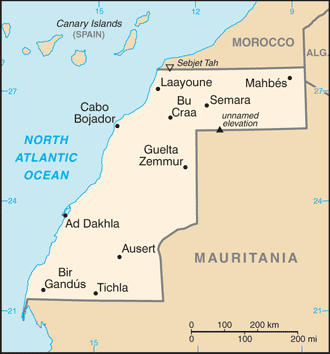
Northern Africa, bordering the North Atlantic Ocean, between Mauritania and Morocco
Geographic coordinates
24 30 N, 13 00 W
Map references
Africa
Area
land: 266,000 sq km
water: 0 sq km
Area - comparative
about the size of Colorado
Land boundaries
border countries: Algeria 41 km, Mauritania 1564 km, Morocco 444 km
Coastline
1,110 km
Climate
hot, dry desert; rain is rare; cold offshore air currents produce fog and heavy dew
Terrain
mostly low, flat desert with large areas of rocky or sandy surfaces rising to small mountains in south and northeast
Elevation
lowest point: Sebjet Tah -55 m
highest point: unnamed elevation 805 m
Natural resources
phosphates, iron ore
Land use
arable land / permanent crops / permanent pasture: 0% (2011 est.) / 0% (2011 est.) / 18.8% (2011 est.)
forest: 2.7% (2011 est.)
other: 78.5% (2011 est.)
Irrigated land
0 sq km (2012)
Population distribution
most of the population lives in the two-thirds of the area west of the berm (Moroccan-occupied) that divides the territory; about 40% of that populace resides in Laayoune as shown in this population distribution map
Natural hazards
hot, dry, dust/sand-laden sirocco wind can occur during winter and spring; widespread harmattan haze exists 60% of time, often severely restricting visibility
Environment - current issues
desertification; overgrazing; sparse water and lack of arable land
Geography - note
the waters off the coast are particularly rich fishing areas
People & Society24
Population
652,271 (July 2020 est.)
Nationality
adjective: Sahrawi, Sahrawian, Sahraouian
Ethnic groups
Arab, Berber
Languages
Standard Arabic, Hassaniya Arabic, Moroccan Arabic, Berber, Spanish, French
Religions
Muslim
Demographic profile
Western Sahara is a non-self governing territory; approximately 75% is under Moroccan control. It was inhabited almost entirely by Sahrawi pastoral nomads until the mid-20th century. Their traditional vast migratory ranges, based on following unpredictable rainfall, did not coincide with colonial and later international borders. Since the 1930s, most Sahrawis have been compelled to adopt a sedentary lifestyle and to live in urban settings as a result of fighting, the presence of minefields, job opportunities in the phosphate industry, prolonged drought, the closure of Western Sahara's border with Mauritania from 1979-2002, and the construction of the defensive berm separating Moroccan- and Polisario-controlled (Sahrawi liberalization movement) areas. Morocco supported rapid urbanization to facilitate surveillance and security. ++ Today more than 80% of Western Sahara's population lives in urban areas; more than 40% live in the administrative center Laayoune. Moroccan immigration has altered the composition and dramatically increased the size of Western Sahara's population. Morocco maintains a large military presence in Western Sahara and has encouraged its citizens to settle there, offering bonuses, pay raises, and food subsidies to civil servants and a tax exemption, in order to integrate Western Sahara into the Moroccan Kingdom and, Sahrawis contend, to marginalize the native population. ++ Western Saharan Sahrawis have been migrating to Europe, principally to former colonial ruler Spain, since the 1950s. Many who moved to refugee camps in Tindouf, Algeria, also have migrated to Spain and Italy, usually alternating between living in cities abroad with periods back at the camps. The Polisario claims that the population of the Tindouf camps is about 155,000, but this figure may include thousands of Arabs and Tuaregs from neighboring countries. Because international organizations have been unable to conduct an independent census in Tindouf, the UNHCR bases its aid on a figure of 90,000 refugees. Western Saharan coastal towns emerged as key migration transit points (for reaching Spain's Canary Islands) in the mid-1990s, when Spain's and Italy's tightening of visa restrictions and EU pressure on Morocco and other North African countries to control illegal migration pushed Sub-Saharan African migrants to shift their routes to the south.
Age structure
15-24 years: 19.44% (male 63,852/female 62,954)
25-54 years: 34.9% (male 112,301/female 115,313)
55-64 years: 5.27% (male 16,095/female 18,292)
65 years and over: 4.1% (male 11,802/female 14,946) (2020 est.)
Dependency ratios
youth dependency ratio: 39.2
elderly dependency ratio: 4.9
potential support ratio: 20.4 (2020 est.)
Median age
male: 21.4 years
female: 22.3 years (2020 est.)
Population growth rate
2.54% (2020 est.)
Birth rate
28 births/1,000 population (2020 est.)
Death rate
7.7 deaths/1,000 population (2020 est.)
Net migration rate
4.9 migrant(s)/1,000 population (2020 est.)
Population distribution
most of the population lives in the two-thirds of the area west of the berm (Moroccan-occupied) that divides the territory; about 40% of that populace resides in Laayoune as shown in this population distribution map
Urbanization
rate of urbanization: 2.61% annual rate of change (2015-20 est.)
Major urban areas - population
232,000 Laayoune (2018)
Sex ratio
at birth
0-14 years
15-24 years
25-54 years
55-64 years
65 years and over
total population
Infant mortality rate
male: 52.5 deaths/1,000 live births
female: 43.1 deaths/1,000 live births (2020 est.)
Life expectancy at birth
male: 62.1 years
female: 67 years (2020 est.)
Total fertility rate
3.65 children born/woman (2020 est.)
HIV/AIDS - adult prevalence rate
NA
HIV/AIDS - people living with HIV/AIDS
NA
HIV/AIDS - deaths
NA
Education expenditures
NA
Government6
Country name
conventional short form: Western Sahara
former: Rio de Oro, Saguia el Hamra, Spanish Sahara
etymology: self-descriptive name specifying the territory's western location on the African continent's vast desert
Government type
legal status of territory and issue of sovereignty unresolved; territory contested by Morocco and Polisario Front (Popular Front for the Liberation of the Saguia el Hamra and Rio de Oro), which in February 1976 formally proclaimed a government-in-exile of the Sahrawi Arab Democratic Republic (SADR), near Tindouf, Algeria, led by President Mohamed ABDELAZIZ until his death in May 2016; current President Brahim GHALI elected in July 2016; territory partitioned between Morocco and Mauritania in April 1976 when Spain withdrew, with Morocco acquiring northern two-thirds; Mauritania, under pressure from Polisario guerrillas, abandoned all claims to its portion in August 1979; Morocco moved to occupy that sector shortly thereafter and has since asserted administrative control; the Polisario's government-in-exile was seated as an Organization of African Unity (OAU) member in 1984; Morocco between 1980 and 1987 built a fortified sand berm delineating the roughly 75% of Western Sahara west of the barrier that currently is controlled by Morocco; guerrilla activities continued sporadically until a UN-monitored cease-fire was implemented on 6 September 1991 (Security Council Resolution 690) by the United Nations Mission for the Referendum in Western Sahara (MINURSO)
Capital
daylight saving time: +1hr, begins last Sunday in March; ends last Sunday in October
Administrative divisions
none officially; the territory west of the Moroccan berm falls under de facto Moroccan control; Morocco claims the territory of Western Sahara, the political status of which is considered undetermined by the US Government; portions of the regions Guelmim-Es Smara and Laayoune-Boujdour-Sakia El Hamra, as claimed by Morocco, lie within Western Sahara; Morocco also claims Oued Eddahab-Lagouira, another region that falls entirely within Western Sahara
Suffrage
none; (residents of Moroccan-controlled Western Sahara participate in Moroccan elections)
International organization participation
AU, WFTU (NGOs)
Economy19
Economic overview
Western Sahara has a small market-based economy whose main industries are fishing, phosphate mining, tourism, and pastoral nomadism. The territory's arid desert climate makes sedentary agriculture difficult, and much of its food is imported. The Moroccan Government administers Western Sahara's economy and is a key source of employment, infrastructure development, and social spending in the territory. ++ Western Sahara's unresolved legal status makes the exploitation of its natural resources a contentious issue between Morocco and the Polisario. Morocco and the EU in December 2013 finalized a four-year agreement allowing European vessels to fish off the coast of Morocco, including disputed waters off the coast of Western Sahara. As of April 2018, Moroccan and EU authorities were negotiating an amendment to renew the agreement. ++ Oil has never been found in Western Sahara in commercially significant quantities, but Morocco and the Polisario have quarreled over rights to authorize and benefit from oil exploration in the territory. Western Sahara's main long-term economic challenge is the development of a more diverse set of industries capable of providing greater employment and income to the territory. However, following King MOHAMMED VI's November 2015 visit to Western Sahara, the Government of Morocco announced a series of investments aimed at spurring economic activity in the region, while the General Confederation of Moroccan Enterprises announced a $609 million investment initiative in the region in March 2015.
GDP (purchasing power parity) - real
$906.5 million (2007 est.)
GDP (official exchange rate)
NA
GDP - per capita (PPP)
$2,500 (2007 est.)
GDP - composition, by sector of origin
industry: NA (2007 est.)
services: 40% (2007 est.)
Agriculture - products
fruits and vegetables (grown in the few oases); camels, sheep, goats (kept by nomads); fish
Industries
phosphate mining, handicrafts
Industrial production growth rate
NA
Labor force
144,000 (2010 est.)
Labor force - by occupation
industry: 50%
industry and services: 50% (2005 est.)
Population below poverty line
NA
Household income or consumption by percentage share
highest 10%: NA
Budget
expenditures: NA
Taxes and other revenues
NA
Budget surplus (+) or deficit (-)
NA
Fiscal year
calendar year
Exports - commodities
phosphates 62% (2012 est.)
Imports - commodities
fuel for fishing fleet, foodstuffs
Exchange rates
Moroccan dirhams (MAD) per US dollar - / 9.639 (2017 est.) / 9.7351 (2016 est.) / 9.7351 (2015) / 9.7351 (2014 est.) / 8.3798 (2013 est.)
Energy23
Electricity - production
0 kWh NA (2016 est.)
Electricity - consumption
0 kWh (2016 est.)
Electricity - exports
0 kWh (2016 est.)
Electricity - imports
0 kWh (2016 est.)
Electricity - installed generating capacity
58,000 kW (2016 est.)
Electricity - from fossil fuels
100% of total installed capacity (2016 est.)
Electricity - from nuclear fuels
0% of total installed capacity (2017 est.)
Electricity - from hydroelectric plants
0% of total installed capacity (2017 est.)
Electricity - from other renewable sources
0% of total installed capacity (2017 est.)
Crude oil - production
0 bbl/day (2018 est.)
Crude oil - exports
0 bbl/day (2015 est.)
Crude oil - imports
0 bbl/day (2015 est.)
Crude oil - proved reserves
0 bbl (1 January 2018 est.)
Refined petroleum products - production
0 bbl/day (2015 est.)
Refined petroleum products - consumption
1,700 bbl/day (2016 est.)
Refined petroleum products - exports
0 bbl/day (2015 est.)
Refined petroleum products - imports
1,702 bbl/day (2015 est.)
Natural gas - production
0 cu m (2017 est.)
Natural gas - consumption
0 cu m (2017 est.)
Natural gas - exports
0 cu m (2017 est.)
Natural gas - imports
0 cu m (2017 est.)
Natural gas - proved reserves
0 cu m (1 January 2014 est.)
Carbon dioxide emissions from consumption of energy
268,400 Mt (2017 est.)
Communications3
Telecommunication systems
international: country code - 212; tied into Morocco's system by microwave radio relay, tropospheric scatter, and satellite; satellite earth stations - 2 Intelsat (Atlantic Ocean) linked to Rabat, Morocco
Broadcast media
Morocco's state-owned broadcaster, Radio-Television Marocaine (RTM), operates a radio service from Laayoune and relays TV service; a Polisario-backed radio station also broadcasts
Internet country code
.eh
Transportation4
Airports
6 (2013)
Airports - with paved runways
2,438 to 3,047 m: 3
Airports - with unpaved runways
1,524 to 2,437 m: 1 (2013)
914 to 1,523 m: 1 (2013)
under 914 m: 1 (2013)
Ports and terminals
Military & Security1
Military - note
the United Nations Mission for the Referendum in Western Sahara (MINURSO) has operated in the Western Sahara since 1991 in accordance with settlement proposals accepted in 1988 by Morocco and the Frente Popular para la Liberación de Saguia el-Hamra y de Río de Oro (Frente POLISARIO); the Mission's responsibilities include monitoring the ceasefire, reducing the threat of mines and unexploded ordnance, and providing logistic support to the UNHCR-led Confidence Building Measures pending an agreement to resume those activities, which were suspended in June 2014; as of November 2019, MINURSO had about 460 personnel deployed ++
Transnational Issues1
Disputes - international
++ many neighboring states reject Moroccan administration of Western Sahara; several states have extended diplomatic relations to the "Sahrawi Arab Democratic Republic" represented by the Polisario Front in exile in Algeria, while others support Morocco's proposal to grant the territory autonomy as part of Morocco, although no state recognizes Moroccan sovereignty over Western Sahara; an estimated 100,000 Sahrawi refugees continue to be sheltered in camps in Tindouf, Algeria, which has hosted Sahrawi refugees since the 1980s
Compare Western Sahara
See how Western Sahara compares to other countries side by side.
Compare Countries