
West Bank
Population
3.31M
Area
5,860 km²
GDP
$13.71B
GDP Per Capita
$3,800
Pop. Density
565/km²
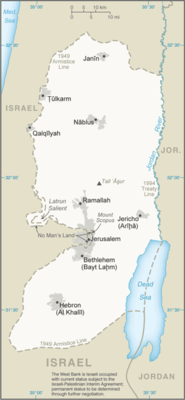
Background
The landlocked West Bank -- the larger of the two Palestinian territories -- is home to some three million Palestinians. Inhabited since at least the 15th century B.C., the area currently known as the West Bank has been dominated by a succession of different powers. In the early 16th century, it was incorporated into the Ottoman Empire. The West Bank fell to British forces during World War I, becoming part of the British Mandate of Palestine. After the 1948 Arab-Israeli War, Transjordan (later renamed Jordan) captured the West Bank and annexed it in 1950; Israel then captured it in the Six-Day War in 1967. Under the Oslo Accords -- a series of agreements that were signed between 1993 and 1999 -- Israel transferred to the newly created Palestinian Authority (PA) security and civilian responsibility for the many Palestinian-populated areas of the West Bank, as well as the Gaza Strip.
In addition to establishing the PA as an interim government, the Oslo Accords divided the West Bank into three areas, with one fully managed by the PA (Area A), another fully managed by Israel (Area C), and a third with shared control (Area B) until a permanent agreement could be reached between the Palestine Liberation Organization (PLO) and Israel. In 2000, a violent intifada, or uprising, began across the Palestinian territories, and in 2001, negotiations for a permanent agreement between the PLO and Israel on final status issues stalled. Subsequent attempts to re-start direct negotiations have not resulted in progress toward determining final status of the area.
The PA last held national elections in 2006, when the Islamic Resistance Movement (HAMAS) won a majority of seats in the Palestinian Legislative Council (PLC). Fatah, the dominant Palestinian political faction in the West Bank, and HAMAS failed to maintain a unity government, leading to violent clashes between their respective supporters and to HAMAS's violent seizure of all PA military and governmental institutions in the Gaza Strip in 2007. In 2018, the Palestinian Constitutional Court dissolved the PLC. In recent years, Fatah and HAMAS have made several attempts at reconciliation, but the factions have been unable to implement agreements.
Geography18
Location
Middle East, west of Jordan, east of Israel
Geographic coordinates
32 00 N, 35 15 E
Map references
Middle East
Area
land: 5,640 sq km
water: 220 sq km
Area - comparative
slightly smaller than Delaware
Land boundaries
border countries: Israel 330 km; Jordan 148 km
Coastline
0 km (landlocked)
Maritime claims
none (landlocked)
Climate
temperate; temperature and precipitation vary with altitude, warm to hot summers, cool to mild winters
Terrain
mostly rugged, dissected upland in west, flat plains descending to Jordan River Valley to the east
Elevation
lowest point: Dead Sea -431 m
Natural resources
arable land
Land use
agricultural land
agricultural land: arable land
agricultural land: permanent crops
agricultural land: permanent pasture
forest
other
Irrigated land
(2013) 151 sq km; note - includes Gaza Strip
Major lakes (area sq km)
note - endorheic hypersaline lake; 9.6 times saltier than the ocean; lake shore is 431 meters below sea level
Population distribution
the most populous Palestinian communities in the West Bank are located in the central ridge and western half of its territory; Jewish settlements are located throughout the West Bank, the most populous in the Seam Zone -- between the 1949 Armistice Line and the separation barrier -- and around Jerusalem
Natural hazards
droughts
Geography - note
landlocked; highlands are main recharge area for Israel's coastal aquifers (2017)
People & Society30
Population
male: 1,682,493
female: 1,628,061
Ethnic groups
Palestinian Arab, Jewish, other
Languages
major-language sample(s):
كتاب حقائق العالم، المصدر الذي لا يمكن الاستغناء عنه للمعلومات الأساسية (Arabic)
The World Factbook, the indispensable source for basic information.
Religions
Age structure
15-64 years: 59.5% (male 979,719/female 949,746)
65 years and over: 3.9% (2024 est.) (male 59,234/female 65,946)
Dependency ratios
youth dependency ratio: 61.4 (2025 est.)
elderly dependency ratio: 6.8 (2025 est.)
potential support ratio: 14.8 (2025 est.)
Median age
male: 21.6 years
female: 22.1 years
Population growth rate
2.03% (2025 est.)
Birth rate
27.24 births/1,000 population (2025 est.)
Death rate
3.2 deaths/1,000 population (2025 est.)
Net migration rate
-3.71 migrant(s)/1,000 population (2025 est.)
Population distribution
the most populous Palestinian communities in the West Bank are located in the central ridge and western half of its territory; Jewish settlements are located throughout the West Bank, the most populous in the Seam Zone -- between the 1949 Armistice Line and the separation barrier -- and around Jerusalem
Urbanization
rate of urbanization: 2.85% annual rate of change (2020-25 est.)
Sex ratio
0-14 years: 1.05 male(s)/female
15-64 years: 1.03 male(s)/female
65 years and over: 0.9 male(s)/female
total population: 1.03 male(s)/female (2024 est.)
Maternal mortality ratio
Infant mortality rate
male: 17.5 deaths/1,000 live births
female: 12.6 deaths/1,000 live births
Life expectancy at birth
male: 74.4 years
female: 78.8 years
Total fertility rate
3.44 children born/woman (2025 est.)
Gross reproduction rate
1.67 (2025 est.)
Drinking water source
improved: rural: rural: 100% of population (2022 est.)
improved: total: total: 98.4% of population (2022 est.)
unimproved: urban: urban: 2% of population (2022 est.)
unimproved: total: total: 1.6% of population (2022 est.)
Health expenditure
Physician density
3.25 physicians/1,000 population (2020)
Hospital bed density
1.3 beds/1,000 population (2019 est.)
Sanitation facility access
improved: urban
improved: rural
improved: total
unimproved: urban
unimproved: rural
unimproved: total
Children under the age of 5 years underweight
Currently married women (ages 15-49)
Child marriage
women married by age 18: 13.4% (2020)
Education expenditure
Literacy
male: 99% (2022 est.)
female: 97% (2022 est.)
School life expectancy (primary to tertiary education)
male: 12 years (2023 est.)
female: 14 years (2023 est.)
Government2
Country name
conventional short form: West Bank
etymology: name refers to the location of the British Mandate of Palestine that was occupied and administered by Jordan in 1948, on the west bank of the Jordan River; the designation was retained after the 1967 Six-Day War and subsequent changes in administration
National heritage
selected World Heritage Site locales: Ancient Jericho/Tell es-Sultan; Birthplace of Jesus: Church of the Nativity and the Pilgrimage Route, Bethlehem; Hebron/Al-Khalil Old Town; Land of Olives and Vines – Cultural Landscape of Southern Jerusalem, Battir
Economy29
Real GDP (purchasing power parity)
Real GDP (purchasing power parity) 2023: $27.694 billion (2023 est.)
Real GDP (purchasing power parity) 2022: $29.016 billion (2022 est.)
Real GDP growth rate
Real GDP growth rate 2023: -4.6% (2023 est.)
Real GDP growth rate 2022: 4.1% (2022 est.)
Real GDP per capita
Real GDP per capita 2023: $5,400 (2023 est.)
Real GDP per capita 2022: $5,800 (2022 est.)
GDP (official exchange rate)
Inflation rate (consumer prices)
Inflation rate (consumer prices) 2023: 5.9% (2023 est.)
Inflation rate (consumer prices) 2022: 3.7% (2022 est.)
GDP - composition, by sector of origin
industry: 17.4% (2022 est.)
services: 58.3% (2022 est.)
GDP - composition, by end use
household consumption
government consumption
investment in fixed capital
investment in inventories
exports of goods and services
imports of goods and services
Agricultural products
tomatoes, cucumbers, olives, poultry, milk, potatoes, sheep milk, eggplants, gourds
Industries
small-scale manufacturing, quarrying, textiles, soap, olive-wood carvings, and mother-of-pearl souvenirs
Industrial production growth rate
Labor force
Unemployment rate
Unemployment rate 2021: 26.4% (2021 est.)
Unemployment rate 2020: 25.9% (2020 est.)
Youth unemployment rate (ages 15-24)
male: 31.6% (2022 est.)
female: 56.6% (2022 est.)
Population below poverty line
Gini Index coefficient - distribution of family income
Household income or consumption by percentage share
highest 10%: 27.1% (2023 est.)
Remittances
Remittances 2023: 18.2% of GDP (2023 est.)
Remittances 2022: 24% of GDP (2022 est.)
Budget
expenditures: $1.499 billion (2021 est.)
Public debt
Taxes and other revenues
Current account balance
Current account balance 2023: -$2.895 billion (2023 est.)
Current account balance 2022: -$2.037 billion (2022 est.)
Exports
Exports 2023: $3.413 billion (2023 est.)
Exports 2022: $3.533 billion (2022 est.)
Exports - partners
Exports - commodities
Imports
Imports 2023: $11.637 billion (2023 est.)
Imports 2022: $12.257 billion (2022 est.)
Imports - partners
Imports - commodities
Reserves of foreign exchange and gold
Reserves of foreign exchange and gold 2023: $1.323 billion (2023 est.)
Reserves of foreign exchange and gold 2022: $896.9 million (2022 est.)
Exchange rates
Currency
Exchange rates 2024
Exchange rates 2023
Exchange rates 2022
Exchange rates 2021
Exchange rates 2020
Energy6
Electricity access
Electricity
consumption: 6.956 billion kWh (2023 est.)
imports: 6.925 billion kWh (2023 est.)
transmission/distribution losses: 988 million kWh (2023 est.)
Electricity generation sources
solar: 33.5% of total installed capacity (2023 est.)
Coal
Petroleum
Energy consumption per capita
Communications6
Telephones - fixed lines
subscriptions per 100 inhabitants: 7 (2023 est.)
Telephones - mobile cellular
subscriptions per 100 inhabitants: 77 (2023 est.)
Broadcast media
the Palestinian Authority operates 1 TV and 1 radio station; about 20 private TV and 40 radio stations; Jordanian TV and satellite TV accessible
Internet country code
Internet users
Broadband - fixed subscriptions
subscriptions per 100 inhabitants: 8 (2023 est.)
Transportation2
Airports
1 (2025)
Heliports
2 (2025)
Military & Security4
Military and security forces
Military expenditures
not available
Military and security service personnel strengths
the PA police and security forces have approximately 28,000 active personnel, including about 11,500 National Security Forces (2024)
Military - note
Palestinian Authority security forces maintain security control of 17.5% (called Area A) of the West Bank, as agreed by the Palestine Liberation Organization and Israel in the Oslo Accords, although Israeli security forces frequently conducted security operations there; Israeli security forces maintain responsibility for the remaining 82.5% of the West Bank, including Area B (22.5%), where the Palestinian Authority has administrative control, and Area C (60%), where Israel maintains administrative control (2024)