
Vietnam
Socialist Republic of Vietnam
Population
106.69M
Area
331,210 km²
GDP
$476.39B
GDP Per Capita
$14,400
Pop. Density
322/km²
Quick Facts
Currency
₫Vietnamese đồng(VND)
Calling Code
+84
Timezone
UTC+07:00
Languages
Vietnamese+more
Driving Side
right
Demonym
Vietnamese
Background
France began its conquest of Vietnam in 1858 and made Vietnam part of French Indochina in 1887. Vietnam declared independence after World War II, but the French continued to rule until communist forces under Ho Chi MINH defeated them in 1954. Under the Geneva Accords of 1954, Vietnam was divided into the communist North and anti-communist South. Fighting erupted between the two governments shortly afterwards with the North supporting communist rebels in the South and eventually committing thousands of combat troops. The US provided to the South significant economic and military assistance, including large numbers of US military forces, which reached a peak strength of over 500,000 troops in 1968. US combat forces were withdrawn following a cease-fire agreement in 1973. Two years later, North Vietnamese forces overran the South, reuniting the country under communist rule. The conflict, known as the Second Indochina War (1955-1975), devastated Vietnam, spilled over into the neighboring countries of Cambodia and Laos, and is estimated to have resulted in the deaths of up to 3 million Vietnamese civilians and soldiers. It also caused more than 58,000 US combat and non-combat deaths and created deep domestic divisions in the US.
Despite the return of peace, the country experienced little economic growth for over a decade because of its diplomatic isolation, leadership policies, and the persecution and mass exodus of citizens, many of them successful South Vietnamese merchants. However, since the enactment of Vietnam's "doi moi" (renovation) policy in 1986, the economy has seen strong growth, particularly in agricultural and industrial production, construction, exports, foreign investment, and tourism. Nevertheless, the Communist Party maintains tight political and social control of the country, and Vietnam faces many related challenges, such as rising income inequality and corruption.
Historical Trends
GDP (USD)
↑617.8% since 2006Population
↑22.9% since 2006Life Expectancy at Birth
Latest: 74.6 yearsData source: World Bank Open Data
Geography19
Location
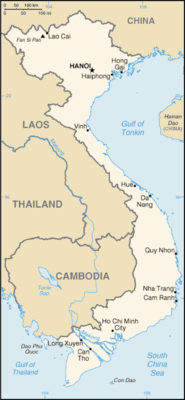
Southeastern Asia, bordering the Gulf of Thailand, Gulf of Tonkin, and South China Sea, as well as China, Laos, and Cambodia
Geographic coordinates
16 10 N, 107 50 E
Map references
Southeast Asia
Area
land: 310,070 sq km
water: 21,140 sq km
Area - comparative
about three times the size of Tennessee; slightly larger than New Mexico
Land boundaries
border countries: Cambodia 1,158 km; China 1,297 km; Laos 2,161 km
Coastline
3,444 km (excludes islands)
Maritime claims
contiguous zone: 24 nm
exclusive economic zone: 200 nm
continental shelf: 200 nm or to the edge of the continental margin
Climate
tropical in south; monsoonal in north with hot, rainy season (May to September) and warm, dry season (October to March)
Terrain
low, flat delta in south and north; central highlands; hilly, mountainous in far north and northwest
Elevation
lowest point: South China Sea 0 m
mean elevation: 398 m
Natural resources
antimony, phosphates, coal, manganese, rare earth elements, bauxite, chromate, offshore oil and gas deposits, timber, hydropower, arable land
Land use
agricultural land
agricultural land: arable land
agricultural land: permanent crops
agricultural land: permanent pasture
forest
other
Irrigated land
46,000 sq km (2012)
Major rivers (by length in km)
note: [s] after country name indicates river source; [m] after country name indicates river mouth
Major watersheds (area sq km)
Population distribution
though it has one of the highest population densities in the world, the population is not evenly dispersed; clustering is heaviest along the South China Sea and Gulf of Tonkin, with the Mekong Delta (in the south) and the Red River Valley (in the north) having the largest concentrations of people
Natural hazards
occasional typhoons (May to January) with extensive flooding, especially in the Mekong River delta
Geography - note
note 2: Son Doong in Phong Nha-Ke Bang National Park is the world's largest cave (greatest cross-sectional area) and is the largest known cave passage in the world by volume at 38.5 million cu m (about 1.35 billion cu ft); it connects to Thoong cave, but not yet officially -- when recognized, it will add an additional 1.6 million cu m; it is so massive that it contains its own jungle, underground river, and localized weather system, with clouds forming inside the cave and spewing from its exits
People & Society35
Population
male: 53,597,784
female: 53,090,385
Nationality
adjective: Vietnamese
Ethnic groups
Languages
major-language sample(s):
Dữ kiện thế giới, là nguồn thông tin cơ bản không thể thiếu. (Vietnamese)
The World Factbook, the indispensable source for basic information.
Religions
Age structure
15-64 years: 68.5% (male 36,591,845/female 35,887,201)
65 years and over: 8.3% (2024 est.) (male 3,563,611/female 5,182,909)
Dependency ratios
youth dependency ratio: 33.6 (2025 est.)
elderly dependency ratio: 12.8 (2025 est.)
potential support ratio: 7.8 (2025 est.)
Median age
male: 32 years
female: 34.2 years
Population growth rate
0.86% (2025 est.)
Birth rate
14.58 births/1,000 population (2025 est.)
Death rate
5.81 deaths/1,000 population (2025 est.)
Net migration rate
-0.21 migrant(s)/1,000 population (2025 est.)
Population distribution
though it has one of the highest population densities in the world, the population is not evenly dispersed; clustering is heaviest along the South China Sea and Gulf of Tonkin, with the Mekong Delta (in the south) and the Red River Valley (in the north) having the largest concentrations of people
Urbanization
rate of urbanization: 2.7% annual rate of change (2020-25 est.)
Major urban areas - population
9.321 million Ho Chi Minh City, 5.253 million HANOI (capital), 1.865 million Can Tho, 1.423 million Hai Phong, 1.221 million Da Nang, 1.111 million Bien Hoa (2023)
Sex ratio
0-14 years: 1.12 male(s)/female
15-64 years: 1.02 male(s)/female
65 years and over: 0.69 male(s)/female
total population: 1.01 male(s)/female (2024 est.)
Maternal mortality ratio
48 deaths/100,000 live births (2023 est.)
Infant mortality rate
male: 14.4 deaths/1,000 live births
female: 13.7 deaths/1,000 live births
Life expectancy at birth
male: 73.5 years
female: 78.9 years
Total fertility rate
2.01 children born/woman (2025 est.)
Gross reproduction rate
0.96 (2025 est.)
Drinking water source
improved: urban
improved: rural
improved: total
unimproved: urban
unimproved: rural
unimproved: total
Health expenditure
Health expenditure (as % of national budget): 10.7% of national budget (2022 est.)
Physician density
1.11 physicians/1,000 population (2021)
Hospital bed density
2.6 beds/1,000 population (2017 est.)
Sanitation facility access
improved: urban
improved: rural
improved: total
unimproved: urban
unimproved: rural
unimproved: total
Obesity - adult prevalence rate
2.1% (2016)
Alcohol consumption per capita
beer: 3.18 liters of pure alcohol (2019 est.)
wine: 0.02 liters of pure alcohol (2019 est.)
spirits: 0.21 liters of pure alcohol (2019 est.)
other alcohols: 0 liters of pure alcohol (2019 est.)
Tobacco use
male: 43.1% (2025 est.)
female: 2.1% (2025 est.)
Children under the age of 5 years underweight
9.7% (2023 est.)
Currently married women (ages 15-49)
72.8% (2021 est.)
Child marriage
women married by age 18: 14.6% (2021)
men married by age 18: 1.9% (2021)
Education expenditure
Education expenditure (% national budget): 15.4% national budget (2022 est.)
Literacy
male: 97.2% (2022 est.)
female: 95.1% (2022 est.)
School life expectancy (primary to tertiary education)
male: 15 years (2022 est.)
female: 14 years (2022 est.)
Government23
Country name
conventional long form
conventional short form
local long form
local short form
former
abbreviation
etymology
Government type
communist party-led state
Capital
geographic coordinates: 21 02 N, 105 51 E
time difference: UTC+7 (12 hours ahead of Washington, DC, during Standard Time)
etymology: the name means "inside the river," from the Vietnamese words ha (river) and noi (inside), and refers to its location in a bend of the Red River
Administrative divisions
provinces: An Giang, Bac Giang, Bac Kan, Bac Lieu, Bac Ninh, Ba Ria-Vung Tau, Ben Tre, Binh Dinh, Binh Duong, Binh Phuoc, Binh Thuan, Ca Mau, Cao Bang, Dak Lak, Dak Nong, Dien Bien, Dong Nai, Dong Thap, Gia Lai, Ha Giang, Ha Nam, Ha Tinh, Hai Duong, Hau Giang, Hoa Binh, Hung Yen, Khanh Hoa, Kien Giang, Kon Tum, Lai Chau, Lam Dong, Lang Son, Lao Cai, Long An, Nam Dinh, Nghe An, Ninh Binh, Ninh Thuan, Phu Tho, Phu Yen, Quang Binh, Quang Nam, Quang Ngai, Quang Ninh, Quang Tri, Soc Trang, Son La, Tay Ninh, Thai Binh, Thai Nguyen, Thanh Hoa, Thua Thien-Hue, Tien Giang, Tra Vinh, Tuyen Quang, Vinh Long, Vinh Phuc, Yen Bai
municipalities: Can Tho, Da Nang, Ha Noi (Hanoi), Hai Phong, Ho Chi Minh City (Saigon)
Legal system
civil law system with European influences
Constitution
amendment process: proposed by the president, by the National Assembly’s Standing Committee, or by at least two thirds of the National Assembly membership; a decision to draft an amendment requires approval by at least a two-thirds majority vote of the Assembly membership, followed by the formation of a constitutional drafting committee to write a draft and collect citizens’ opinions; passage requires at least two-thirds majority of the Assembly membership; the Assembly can opt to conduct a referendum
International law organization participation
has not submitted an ICJ jurisdiction declaration; non-party state to the ICCt
Citizenship
citizenship by descent only: at least one parent must be a citizen of Vietnam
dual citizenship recognized: no
residency requirement for naturalization: 5 years
Suffrage
18 years of age; universal
Executive branch
head of government: Prime Minister Pham Minh CHINH (since 26 July 2021)
cabinet: Cabinet proposed by the prime minister, confirmed by the National Assembly, and appointed by the president
election/appointment process: president indirectly elected by the National Assembly from among its members for a single 5-year term; prime minister recommended by the president and confirmed by the National Assembly; deputy prime ministers appointed by the president and confirmed by the National Assembly
Legislative branch
legislature name
legislative structure
number of seats
electoral system
scope of elections
term in office
most recent election date
parties elected and seats per party
percentage of women in chamber
expected date of next election
Judicial branch
judge selection and term of office: chief justice elected by the National Assembly upon the recommendation of the president for a 5-year, renewable term; deputy chief justice appointed by the president from among the judges for a 5-year term; judges appointed by the president and confirmed by the National Assembly for 5-year terms
subordinate courts: High Courts (administrative, civil, criminal, economic, labor, family, juvenile); provincial courts; district courts; Military Court
Political parties
Diplomatic representation in the US
chief of mission
chancery
telephone
FAX
email address and website
consulate(s) general
consulate(s)
Diplomatic representation from the US
chief of mission
embassy
mailing address
telephone
FAX
email address and website
consulate(s) general
International organization participation
ADB, APEC, ARF, ASEAN, CICA, CP, EAS, FAO, G-77, IAEA, IBRD, ICAO, ICC (NGOs), ICRM, IDA, IFAD, IFC, IFRCS, ILO, IMF, IMO, IMSO, Interpol, IOC, IOM, IPU, ISO, ITSO, ITU, MIGA, NAM, OIF, OPCW, PCA, UN, UNCTAD, UNESCO, UNHRC, UNIDO, UNOOSA, UNWTO, UPU, WCO, WFTU (NGOs), WHO, WIPO, WMO, WTO (2024)
Independence
2 September 1945 (from France)
National holiday
Independence Day (National Day), 2 September (1945)
Flag
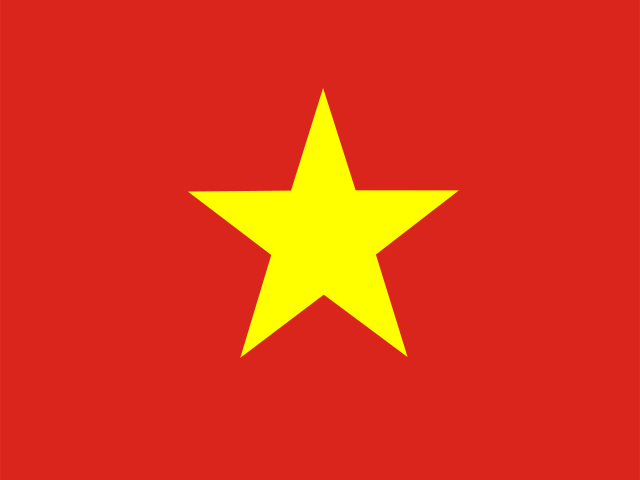
meaning: red stands for revolution and blood, and the five-pointed star for the five elements of the populace -- peasants, workers, intellectuals, traders, and soldiers -- that unite to build socialism
National symbol(s)
five-pointed yellow star on a red field, lotus blossom
National color(s)
red, yellow
National anthem(s)
lyrics/music: Nguyen Van CAO
history: adopted as the national anthem of the Democratic Republic of Vietnam in 1945; it became the national anthem of the unified Socialist Republic of Vietnam in 1976; only the first verse is used as the official anthem
National heritage
selected World Heritage Site locales: Complex of Hué Monuments (c); Ha Long Bay (n); Hoi An Ancient Town (c); My Son Sanctuary (c); Phong Nha-Ke Bang National Park (n); Imperial Citadel of Thang Long - Hanoi (c); Citadel of the Ho Dynasty (c); Trang An Landscape Complex (m); Yen Tu-Vinh Nghiem-Con Son, Kiep Bac Complex of Monuments and Landscapes (c)
Economy31
Economic overview
lower middle-income socialist East Asian economy; rapid economic growth since Đổi Mới reforms; strong investment and productivity growth; tourism and manufacturing hub; TPP signatory; declining poverty aside from ethnic minorities; systemic corruption
Real GDP (purchasing power parity)
Real GDP (purchasing power parity) 2023: $1.359 trillion (2023 est.)
Real GDP (purchasing power parity) 2022: $1.294 trillion (2022 est.)
Real GDP growth rate
Real GDP growth rate 2023: 5.1% (2023 est.)
Real GDP growth rate 2022: 8.5% (2022 est.)
Real GDP per capita
Real GDP per capita 2023: $13,500 (2023 est.)
Real GDP per capita 2022: $13,000 (2022 est.)
GDP (official exchange rate)
Inflation rate (consumer prices)
Inflation rate (consumer prices) 2023: 3.3% (2023 est.)
Inflation rate (consumer prices) 2022: 3.2% (2022 est.)
GDP - composition, by sector of origin
industry: 37.6% (2024 est.)
services: 42.4% (2024 est.)
GDP - composition, by end use
household consumption
government consumption
investment in fixed capital
investment in inventories
exports of goods and services
imports of goods and services
Agricultural products
Industries
food processing, garments, shoes, machine-building; mining, coal, steel; cement, chemical fertilizer, glass, tires, oil, mobile phones
Industrial production growth rate
Labor force
Unemployment rate
Unemployment rate 2023: 1.7% (2023 est.)
Unemployment rate 2022: 1.6% (2022 est.)
Youth unemployment rate (ages 15-24)
male: 7% (2024 est.)
female: 6.6% (2024 est.)
Population below poverty line
Gini Index coefficient - distribution of family income
Average household expenditures
on alcohol and tobacco: 1.9% of household expenditures (2023 est.)
Household income or consumption by percentage share
highest 10%: 28.1% (2022 est.)
Remittances
Remittances 2022: 3.2% of GDP (2022 est.)
Remittances 2021: 3.5% of GDP (2021 est.)
Budget
expenditures: $83.707 billion (2022 est.)
Public debt
Current account balance
Current account balance 2023: $25.793 billion (2023 est.)
Current account balance 2022: $1.402 billion (2022 est.)
Exports
Exports 2023: $374.986 billion (2023 est.)
Exports 2022: $385.241 billion (2022 est.)
Exports - partners
Exports - commodities
Imports
Imports 2023: $339.785 billion (2023 est.)
Imports 2022: $369.746 billion (2022 est.)
Imports - partners
Imports - commodities
Reserves of foreign exchange and gold
Reserves of foreign exchange and gold 2023: $92.238 billion (2023 est.)
Reserves of foreign exchange and gold 2022: $86.54 billion (2022 est.)
Debt - external
Exchange rates
Currency
Exchange rates 2024
Exchange rates 2023
Exchange rates 2022
Exchange rates 2021
Exchange rates 2020
Energy7
Electricity access
Electricity
consumption: 277.501 billion kWh (2023 est.)
exports: 933.237 million kWh (2023 est.)
imports: 3.106 billion kWh (2023 est.)
transmission/distribution losses: 18.197 billion kWh (2023 est.)
Electricity generation sources
solar: 9.7% of total installed capacity (2023 est.)
wind: 4.2% of total installed capacity (2023 est.)
hydroelectricity: 34.3% of total installed capacity (2023 est.)
biomass and waste: 1.1% of total installed capacity (2023 est.)
Coal
consumption: 96.099 million metric tons (2023 est.)
exports: 815,000 metric tons (2023 est.)
imports: 43.637 million metric tons (2023 est.)
proven reserves: 3.116 billion metric tons (2023 est.)
Petroleum
refined petroleum consumption: 544,000 bbl/day (2023 est.)
crude oil estimated reserves: 4.4 billion barrels (2021 est.)
Natural gas
consumption: 7.48 billion cubic meters (2023 est.)
proven reserves: 699.426 billion cubic meters (2021 est.)
Energy consumption per capita
Communications6
Telephones - fixed lines
subscriptions per 100 inhabitants: 2 (2023 est.)
Telephones - mobile cellular
subscriptions per 100 inhabitants: 128 (2024 est.)
Broadcast media
Internet country code
.vn
Internet users
Broadband - fixed subscriptions
subscriptions per 100 inhabitants: 23 (2023 est.)
Transportation6
Civil aircraft registration country code prefix
VN
Airports
36 (2025)
Heliports
26 (2025)
Railways
standard gauge: 178 km (2014) 1.435-m gauge; 253 km mixed gauge
narrow gauge: 2,169 km (2014) 1.000-m gauge
Merchant marine
by type: bulk carrier 117, container ship 45, general cargo 1,176, oil tanker 134, other 501
Ports
total ports
large
medium
small
very small
ports with oil terminals
key ports
Military & Security7
Military and security forces
Vietnam People's Ministry of Public Security; Vietnam Civil Defense Force (2025)
note 2: the Vietnam Coast Guard was established in 1998 as the Vietnam Marine Police and renamed in 2013; Vietnam established a civilian maritime self-defense force in 2010; the Vietnam Department of Fisheries Resources Surveillance (DFIRES; under the Ministry of Agriculture and Rural Development), established in 2013, is responsible for fisheries enforcement, aquatic conservation roles, and is designated as Vietnam's standing agency for combating illegal, unregulated, and unreported fishing; it is armed, allowed to use force if necessary, and works in tandem with the Vietnam Coast Guard
note 3: the PAVN is the military arm of the ruling Communist Party of Vietnam (CPV) and responsible to the Central Military Commission (CMC), the highest party organ on military policy; the CMC is led by the CPV General Secretary
Military expenditures
Military Expenditures 2022: 2.3% of GDP (2022 est.)
Military Expenditures 2021: 2.3% of GDP (2021 est.)
Military Expenditures 2020: 2.4% of GDP (2020 est.)
Military Expenditures 2019: 2.3% of GDP (2019 est.)
Military and security service personnel strengths
approximately 450,000 active-duty People's Army of Vietnam (2025)
Military equipment inventories and acquisitions
the PAVN is equipped largely with armaments from Russia and the former Soviet Union; in recent years, Vietnam has moved to diversify its arms suppliers and has acquired items from countries such as India, Israel, the Netherlands, South Korea, and the US; Vietnam has a small defense industry involved in the manufacture of small arms, ground combat vehicles, and naval systems (2025)
Military service age and obligation
18-27 years of age for compulsory and voluntary military service for men and women (in practice only men are drafted); service obligation is 24-36 months depending on the branch of service (including Coast Guard and Ministry of Public Security) (2025)
Military deployments
200 Abyei/South Sudan/Sudan (UNISFA) (2025)
Military - note
the responsibilities of the People's Army of Vietnam (PAVN) include protecting the country's independence, sovereignty, territorial integrity, and national interests, as well as assisting civilian authorities with natural disasters; in recent years, the PAVN has placed additional emphasis on protecting Vietnam's interests in the disputed South China Sea; the military is also involved in economic projects, such as electrical infrastructure, oil and gas services, hydroelectric projects, aviation and seaport services, telecommunications, and the shipbuilding industry, while military-owned factories and enterprises produce weapons and equipment (2025)
Transnational Issues1
Refugees and internally displaced persons
IDPs: 2,568 (2024 est.)
stateless persons: 20,590 (2024 est.)