
Venezuela
Bolivarian Republic of Venezuela
Population
31.76M
Area
912,050 km²
GDP
$139.40B
GDP Per Capita
$4,900
Pop. Density
35/km²
Quick Facts
Currency
Bs.S.Venezuelan bolívar soberano(VES)
Calling Code
+58
Timezone
UTC-04:00
Languages
Spanish+more
Driving Side
right
Demonym
Venezuelan
Background
Venezuela was one of three countries that emerged from the collapse of Gran Colombia in 1830, the others being Ecuador and New Granada (Colombia). For most of the first half of the 20th century, military strongmen ruled Venezuela and promoted the oil industry while allowing some social reforms. Democratically elected governments largely held sway until 1999, but Hugo CHAVEZ, who was president from 1999 to 2013, exercised authoritarian control over other branches of government. This trend continued in 2018 when Nicolas MADURO claimed the presidency for his second term in an election boycotted by most opposition parties and widely viewed as fraudulent. The legislative elections in 2020 were also seen as fraudulent, and most opposition parties and many international actors consider the resulting National Assembly illegitimate. In 2021, many opposition parties broke a three-year election boycott and participated in mayoral and gubernatorial elections, despite flawed conditions. As a result, the opposition more than doubled its representation at the mayoral level and retained four of 23 governorships. The 2021 regional elections marked the first time since 2006 that the EU was allowed to send an electoral observation mission to Venezuela.
MADURO has placed strong restrictions on free speech and the press. Since CHAVEZ, the ruling party has expanded the state's role in the economy through expropriations of major enterprises, strict currency exchange and price controls, and over-dependence on the petroleum industry for revenues. Years of economic mismanagement left Venezuela ill-prepared to weather the global drop in oil prices in 2014, sparking an economic decline that has resulted in reduced government social spending, shortages of basic goods, and high inflation. Worsened living conditions have prompted nearly 8 million Venezuelans to emigrate, mainly settling in nearby countries. The US imposed financial sanctions on MADURO and his representatives in 2017 and on sectors of the Venezuelan economy in 2018. Limited sanctions relief followed when the MADURO administration began making democratic and electoral concessions.
The government's mismanagement and lack of investment in infrastructure has also weakened the country's energy sector. Caracas has relaxed some controls to mitigate the impact of its sustained economic crisis, such as allowing increased import flexibility for the private sector and the informal use of US dollars and other international currencies. Ongoing concerns include human rights abuses, rampant violent crime, political manipulation of the judicial and electoral systems, and corruption.
Historical Trends
GDP (USD)
↓34.7% since 2006Population
↑4.3% since 2006Life Expectancy at Birth
Latest: 72.5 yearsData source: World Bank Open Data
Geography20
Location
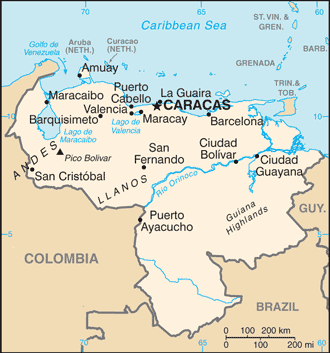
Northern South America, bordering the Caribbean Sea and the North Atlantic Ocean, between Colombia and Guyana
Geographic coordinates
8 00 N, 66 00 W
Map references
South America
Area
land: 882,050 sq km
water: 30,000 sq km
Area - comparative
almost six times the size of Georgia; slightly more than twice the size of California
Land boundaries
border countries: Brazil 2,137 km; Colombia 2,341 km; Guyana 789 km
Coastline
2,800 km
Maritime claims
contiguous zone: 15 nm
exclusive economic zone: 200 nm
continental shelf: 200-m depth or to the depth of exploitation
Climate
tropical; hot, humid; more moderate in highlands
Terrain
Andes Mountains and Maracaibo Lowlands in northwest; central plains (llanos); Guiana Highlands in southeast
Elevation
lowest point: Caribbean Sea 0 m
mean elevation: 450 m
Natural resources
petroleum, natural gas, iron ore, gold, bauxite, other minerals, hydropower, diamonds
Land use
agricultural land
agricultural land: arable land
agricultural land: permanent crops
agricultural land: permanent pasture
forest
other
Irrigated land
10,550 sq km (2012)
Major lakes (area sq km)
Major rivers (by length in km)
note: [s] after country name indicates river source; [m] after country name indicates river mouth
Major watersheds (area sq km)
Population distribution
most of the population is concentrated in the northern and western highlands along an eastern spur at the northern end of the Andes, an area that includes the capital of Caracas
Natural hazards
subject to floods, rockslides, mudslides; periodic droughts
Geography - note
note 1: the country lies on major sea and air routes linking North and South America
note 2: Venezuela has some of the most unique geology in the world; tepuis are the massive table-top mountains of the western Guiana Highlands that tend to be isolated and thus support unique endemic plant and animal species; their sheer cliffsides help create some of the most spectacular waterfalls in the world, including Angel Falls, the world's highest (979 m; 3,212 ft) that drops from Auyan Tepui
People & Society30
Population
male: 15,808,263
female: 15,947,172
Nationality
adjective: Venezuelan
Ethnic groups
unspecified Spanish, Italian, Portuguese, Arab, German, African, Indigenous
Languages
major-language sample(s):
La Libreta Informativa del Mundo, la fuente indispensable de información básica. (Spanish)
The World Factbook, the indispensable source for basic information.
Religions
Roman Catholic 48.1%, Protestant 31.6% (Evangelical 31.4%, Adventist 0.2%), Jehovah's Witness 1.4%, African American/umbanda 0.7%, other 0.1%, believer 3.5%, agnostic 0.1%, atheist, 0.4%, none 13.6%, unspecified 0.6% (2023 est.)
Age structure
15-64 years: 65.9% (male 10,264,353/female 10,330,376)
65 years and over: 9.1% (2024 est.) (male 1,303,737/female 1,553,172)
Dependency ratios
youth dependency ratio: 37.5 (2025 est.)
elderly dependency ratio: 14.3 (2025 est.)
potential support ratio: 7 (2025 est.)
Median age
male: 30.3 years
female: 31.7 years
Population growth rate
0.88% (2025 est.)
Birth rate
16.45 births/1,000 population (2025 est.)
Death rate
6.54 deaths/1,000 population (2025 est.)
Net migration rate
-1.15 migrant(s)/1,000 population (2025 est.)
Population distribution
most of the population is concentrated in the northern and western highlands along an eastern spur at the northern end of the Andes, an area that includes the capital of Caracas
Urbanization
rate of urbanization: 1.16% annual rate of change (2020-25 est.)
Major urban areas - population
2.972 million CARACAS (capital), 2.368 million Maracaibo, 1.983 million Valencia, 1.254 million Barquisimeto, 1.243 million Maracay, 964,000 Ciudad Guayana (2023)
Sex ratio
0-14 years: 1.05 male(s)/female
15-64 years: 0.99 male(s)/female
65 years and over: 0.84 male(s)/female
total population: 0.99 male(s)/female (2024 est.)
Maternal mortality ratio
227 deaths/100,000 live births (2023 est.)
Infant mortality rate
male: 15.4 deaths/1,000 live births
female: 12.2 deaths/1,000 live births
Life expectancy at birth
male: 71.5 years
female: 77.7 years
Total fertility rate
2.16 children born/woman (2025 est.)
Gross reproduction rate
1.05 (2025 est.)
Drinking water source
unimproved: total: total: 6.7% of population (2022 est.)
Health expenditure
Health expenditure (as % of national budget): 6% of national budget (2022 est.)
Physician density
1.66 physicians/1,000 population (2017)
Hospital bed density
1 beds/1,000 population (2020 est.)
Sanitation facility access
unimproved: total: total: 1.6% of population (2022 est.)
Obesity - adult prevalence rate
25.6% (2016)
Alcohol consumption per capita
beer: 1.54 liters of pure alcohol (2019 est.)
wine: 0.01 liters of pure alcohol (2019 est.)
spirits: 0.92 liters of pure alcohol (2019 est.)
other alcohols: 0.03 liters of pure alcohol (2019 est.)
Education expenditure
Education expenditure (% national budget): 10.3% national budget (2024 est.)
Literacy
male: 97.2% (2017 est.)
female: 97.3% (2017 est.)
Government23
Country name
conventional long form
conventional short form
local long form
local short form
former
etymology
Government type
federal presidential republic
Capital
geographic coordinates: 10 29 N, 66 52 W
time difference: UTC-4 (1 hour ahead of Washington, DC, during Standard Time)
etymology: named for the Caracas tribe that originally settled in the area; the origin of their name is unknown
Administrative divisions
Legal system
civil law system based on the Spanish civil code
Constitution
amendment process: proposed through agreement by at least 39% of the National Assembly membership, by the president of the republic in session with the cabinet of ministers, or by petition of at least 15% of registered voters; passage requires simple majority vote by the Assembly and simple majority approval in a referendum
International law organization participation
has not submitted an ICJ jurisdiction declaration; accepts ICCt jurisdiction
Citizenship
citizenship by descent only: yes
dual citizenship recognized: yes
residency requirement for naturalization: 10 years; reduced to five years in the case of applicants from Spain, Portugal, Italy, or a Latin American or Caribbean country
Suffrage
18 years of age; universal
Executive branch
chief of state
head of government
cabinet
election/appointment process
most recent election date
election results
2024: official results disputed; Nicolas MADURO Moros was declared the winner by the MADURO-controlled National Electoral Council; percent of vote - Nicolas MADURO Moros (PSUV) 52%, Edmundo GONZÁLEZ Urrutia (Independent) 43.2%, Luis Eduardo MARTÍNEZ (AD) 1.2%, other 3.6%
2018: Nicolas MADURO Moros reelected president; percent of vote - Nicolas MADURO Moros (PSUV) 67.9%, Henri FALCON (AP) 20.9%, Javier BERTUCCI 10.8%
expected date of next election
Legislative branch
legislature name
legislative structure
number of seats
electoral system
scope of elections
term in office
most recent election date
percentage of women in chamber
expected date of next election
Judicial branch
judge selection and term of office: judges proposed by the Committee of Judicial Postulation (an independent body of organizations dealing with legal issues and of the organs of citizen power) and appointed by the National Assembly; judges serve nonrenewable 12-year terms
subordinate courts: Superior or Appeals Courts (Tribunales Superiores); District Tribunals (Tribunales de Distrito); Courts of First Instance (Tribunales de Primera Instancia); Parish Courts (Tribunales de Parroquia); Justices of the Peace (Justicia de Paz) Network
Political parties
Cambiemos Movimiento Ciudadano or CMC
Christian Democrats or COPEI (also known as the Social Christian Party)
Citizens Encounter or EC
Clear Accounts or CC
Coalition of parties loyal to Nicolas MADURO - Great Patriotic Pole or GPP
Coalition of opposition parties - Democratic Alliance (Alianza Democratica) (includes AD, EL CAMBIO, COPEI, CMC, and AP)
Come Venezuela (Vente Venezuela) or VV
Communist Party of Venezuela or PCV
Consenso en la Zona or Conenzo
Convergencia
Democratic Action or AD
Fatherland for All (Patria para Todos) or PPT
Fearless People's Alliance or ABP
Fuerza Vecinal or FV
Hope for Change (Esperanza por el Cambio) or EL CAMBIO
Justice First (Primero Justicia) or PJ
LAPIZ
Movement to Socialism (Movimiento al Socialismo) or MAS
Popular Will (Voluntad Popular) or VP
Progressive Advance (Avanzada Progresista) or AP
The Radical Cause or La Causa R
United Socialist Party of Venezuela or PSUV
Venezuela First (Primero Venezuela) or PV
Venezuelan Progressive Movement or MPV
Venezuela Project or PV
Diplomatic representation in the US
note: the embassy, which had been run by the Venezuelan political opposition, announced on 5 January 2023, that it had ended all embassy functions
Diplomatic representation from the US
embassy: Venezuela Affairs Unit, US Embassy, Carrera 45 N. 24B-27, Bogota, Colombia
mailing address: 3140 Caracas Place, Washington DC 20521-3140
telephone: 1-888-407-4747
email address and website:
[email protected]
https://ve.usembassy.gov/
International organization participation
ACS, Caricom (observer), CD, CDB, CELAC, FAO, G-15, G-24, G-77, IADB, IAEA, IBRD, ICAO, ICC (national committees), ICCt (signatory), ICRM, IDA, IFAD, IFC, IFRCS, IHO, ILO, IMF, IMO, IMSO, Interpol, IOC, IOM, IPU, ITSO, ITU, ITUC (NGOs), LAES, LAIA, LAS (observer), MIGA, NAM, OAS, OPANAL, OPCW, OPEC, PCA, Petrocaribe, UN, UNASUR, UNCTAD, UNESCO, UNHCR, UNHRC, UNIDO, Union Latina, UNOOSA, UNWTO, UPU, WCO, WFTU (NGOs), WHO, WIPO, WMO, WTO
Independence
5 July 1811 (from Spain)
National holiday
Independence Day, 5 July (1811)
Flag
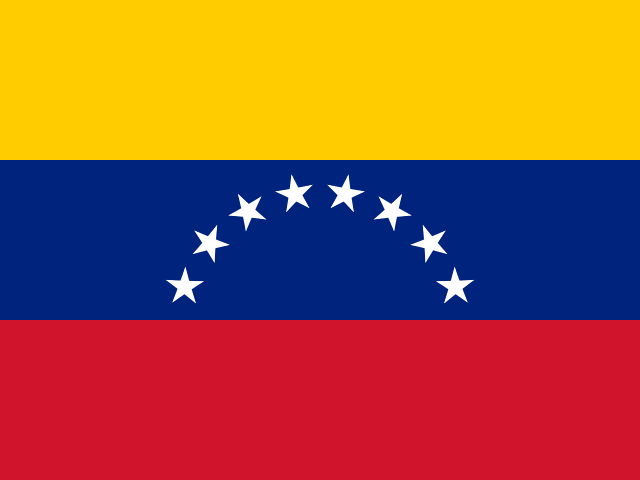
meaning: yellow stands for the riches of the land, blue for the courage of its people, and red for the blood shed in attaining independence
history: the flag retains the three equal horizontal bands and three main colors from the flag of Gran Colombia, the South American republic that broke up in 1830; in 2006, President Hugo CHAVEZ added the eighth star -- the original seven stars represented the country's provinces that united in the war of independence -- to match Simon Bolivar's flag from 1827 and to represent the historic province of Guayana
National symbol(s)
troupial (bird)
National color(s)
yellow, blue, red
National anthem(s)
lyrics/music: Vicente SALIAS/Juan Jose LANDAETA
history: adopted 1881; lyrics were written in 1810; both SALIAS and LANDAETA were executed in 1814 during Venezuela's fight for independence
National heritage
selected World Heritage Site locales: Coro and its Port (c); Canaima National Park (n); Ciudad Universitaria de Caracas (c)
Economy24
Economic overview
South American economy; ongoing hyperinflation since mid-2010s; chaotic economy due to political corruption, infrastructure cuts, and human rights abuses; in debt default; oil exporter; hydropower consumer; rising Chinese relations
Real GDP (purchasing power parity)
Real GDP (purchasing power parity) 2022: $106.672 billion (2022 est.)
Real GDP (purchasing power parity) 2021: $98.768 billion (2021 est.)
Real GDP growth rate
Real GDP growth rate 2017: -15.76% (2017 est.)
Real GDP per capita
Real GDP per capita 2022: $4,600 (2022 est.)
Real GDP per capita 2021: $4,000 (2021 est.)
GDP (official exchange rate)
Inflation rate (consumer prices)
Inflation rate (consumer prices) 2021: 1,588.5% (2021 est.)
Inflation rate (consumer prices) 2020: 2,355.1% (2020 est.)
Agricultural products
Industries
agricultural products, livestock, raw materials, machinery and equipment, transport equipment, construction materials, medical equipment, pharmaceuticals, chemicals, iron and steel products, crude oil and petroleum products
Labor force
Unemployment rate
Unemployment rate 2023: 5.5% (2023 est.)
Unemployment rate 2022: 5.8% (2022 est.)
Youth unemployment rate (ages 15-24)
male: 9.3% (2024 est.)
female: 13.2% (2024 est.)
Population below poverty line
Average household expenditures
on alcohol and tobacco: 2.8% of household expenditures (2023 est.)
Budget
expenditures: $76 million (2017 est.)
Public debt
Current account balance
Current account balance 2015: -$16.051 billion (2015 est.)
Exports
Exports 2017: $93.485 billion (2017 est.)
Exports 2016: $28.684 billion (2016 est.)
Exports - partners
Exports - commodities
Imports
Imports 2017: $18.376 billion (2017 est.)
Imports 2016: $25.81 billion (2016 est.)
Imports - partners
Imports - commodities
Reserves of foreign exchange and gold
Reserves of foreign exchange and gold 2016: $10.15 billion (2016 est.)
Reserves of foreign exchange and gold 2015: $15.625 billion (2015 est.)
Exchange rates
Currency
Exchange rates 2017
Exchange rates 2016
Exchange rates 2015
Exchange rates 2014
Exchange rates 2013
Energy7
Electricity access
Electricity
consumption: 56.493 billion kWh (2023 est.)
exports: 600 million kWh (2023 est.)
transmission/distribution losses: 25.849 billion kWh (2023 est.)
Electricity generation sources
hydroelectricity: 78.3% of total installed capacity (2023 est.)
Coal
consumption: 80,000 metric tons (2023 est.)
exports: 124,000 metric tons (2023 est.)
imports: 2,000 metric tons (2023 est.)
proven reserves: 730.999 million metric tons (2023 est.)
Petroleum
refined petroleum consumption: 203,000 bbl/day (2023 est.)
crude oil estimated reserves: 303.806 billion barrels (2021 est.)
Natural gas
consumption: 23.873 billion cubic meters (2023 est.)
proven reserves: 5.674 trillion cubic meters (2021 est.)
Energy consumption per capita
Communications6
Telephones - fixed lines
subscriptions per 100 inhabitants: 10 (2022 est.)
Telephones - mobile cellular
subscriptions per 100 inhabitants: 71 (2024 est.)
Broadcast media
Internet country code
.ve
Internet users
Broadband - fixed subscriptions
subscriptions per 100 inhabitants: 10 (2022 est.)
Transportation6
Civil aircraft registration country code prefix
YV
Airports
509 (2025)
Heliports
88 (2025)
Railways
standard gauge: 447 km (2014) 1.435-m gauge (41.4 km electrified)
Merchant marine
by type: bulk carrier 3, container ship 1, general cargo 26, oil tanker 17, other 225
Ports
total ports
large
medium
small
very small
ports with oil terminals
key ports
Military & Security6
Military and security forces
Ministry of Interior, Justice, and Peace: Bolivarian National Police (Policía Nacional Bolivariana, PNB) (2025)
note 2: the National Guard was made part of the FANB in 2007 and is responsible for maintaining public order, guarding the exterior of key government installations and prisons, conducting counter-narcotics operations, monitoring borders, and providing law enforcement in remote areas; it reports to both the Ministry of Defense and the Ministry of Interior, Justice, and Peace
note 3: the PNB is a federal force created by Hugo CHAVEZ in 2008 as a “preventative police force,” separate from state and local ones; the PNB largely focuses on policing Caracas’ Libertador municipality, patrolling Caracas-area highways, railways, and metro system, and protecting diplomatic missions; the PNB includes the Special Action Forces (Fuerzas de Acciones Especiales, FAES), a paramilitary unit created by President MADURO to bolster internal security after the 2017 anti-government protests
note 4: there are also pro-government armed groups known as colectivos operating in Caracas and other cities
Military expenditures
Military Expenditures 2023: 0.5% of GDP (2023 est.)
Military Expenditures 2022: 0.6% of GDP (2022 est.)
Military Expenditures 2021: 0.3% of GDP (2021 est.)
Military Expenditures 2020: 1.6% of GDP (2020 est.)
Military and security service personnel strengths
information varies; approximately 125-150,000 active Armed Forces; estimated 200,000 Bolivarian Militia (2025)
Military equipment inventories and acquisitions
the FANB inventory is a mix of mostly older and some more modern armaments from a variety of foreign suppliers, including China, France, Germany, Iran, Italy, Russia/former Soviet Union, Spain, the UK, and the US (2025)
Military service age and obligation
18-30 (25 for women) for voluntary service; the minimum service obligation is 24-30 months; 17-39 for Militia service; all citizens of military service age (18-50) are obligated to register for military service and subject to military training (2025)
Military - note
the FANB has a role in the country’s economy and political sectors; military officers hold key positions in state-owned companies, government ministries, and funding agencies; the FANB runs corporation involved in agriculture, banking, communications, energy, insurance, mining, and transportation (2025)
Transnational Issues3
Refugees and internally displaced persons
IDPs: 2,338 (2024 est.)
Trafficking in persons
Illicit drugs
major illicit drug-producing and/or drug-transit country
major precursor-chemical producer (2025)