
Turkmenistan
Population
5.74M
Area
488,100 km²
GDP
$64.24B
GDP Per Capita
$18,000
Pop. Density
12/km²
Quick Facts
Currency
mTurkmenistan manat(TMT)
Calling Code
+993
Timezone
UTC+05:00
Languages
Russian, Turkmen+more
Driving Side
right
Demonym
Turkmen
Background
President for Life Saparmurat NIYAZOV died in 2006, and Gurbanguly BERDIMUHAMEDOV, a deputy chairman under NIYAZOW, emerged as the country's new president. BERDIMUHAMEDOV won Turkmenistan's first multi-candidate presidential election in 2007, and again in 2012 and 2017 with over 97% of the vote in elections widely regarded as undemocratic. In 2022, BERDIMUHAMEDOV announced that he would step down from the presidency and called for an election to replace him. His son, Serdar BERDIMUHAMEDOV, won the ensuing election with 73% of the vote. Gurbanguly BERDIMUHAMEDOV, although no longer head of state, maintains an influential political position as head of the Halk Maslahaty (People’s Council) and as National Leader of the Turkmen People, a title that provides additional privileges and immunity for him and his family. Since Gurbanguly BERDIMUHAMEDOV stepped down from the presidency, state-controlled media upgraded his honorific from Arkadag (protector) to Hero-Arkadag, and began referring to Serdar BERDIMUHAMEDOV as Arkadagly Serdar, which can be translated as "Serdar who has a protector to support him."
Turkmenistan has sought new export markets for its extensive hydrocarbon/natural gas reserves, which have yet to be fully exploited. Turkmenistan's reliance on gas exports has made the economy vulnerable to fluctuations in the global energy market, and economic hardships since the drop in energy prices in 2014 have led many citizens of Turkmenistan to emigrate, mostly to Turkey.
Historical Trends
GDP (USD)
↑400.0% since 2006Population
↑45.6% since 2006Life Expectancy at Birth
Latest: 70.1 yearsData source: World Bank Open Data
Geography20
Location
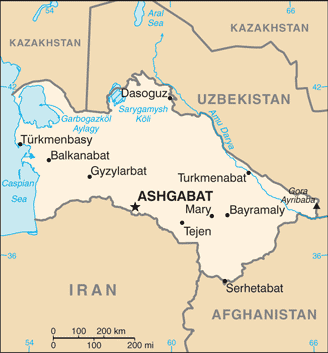
Central Asia, bordering the Caspian Sea, between Iran and Kazakhstan
Geographic coordinates
40 00 N, 60 00 E
Map references
Asia
Area
land: 469,930 sq km
water: 18,170 sq km
Area - comparative
slightly more than three times the size of Georgia; slightly larger than California
Land boundaries
border countries: Afghanistan 804 km; Iran 1,148 km; Kazakhstan 413 km; Uzbekistan 1,793 km
Coastline
Maritime claims
none (landlocked)
Climate
subtropical desert
Terrain
flat-to-rolling sandy desert with dunes rising to mountains in the south; low mountains along border with Iran; borders Caspian Sea in west
Elevation
lowest point: Vpadina Akchanaya (Sarygamysh Koli is a lake in northern Turkmenistan with a water level that fluctuates above and below the elevation of Vpadina Akchanaya, the lake has dropped as low as -110 m) -81 m
mean elevation: 230 m
Natural resources
petroleum, natural gas, sulfur, salt
Land use
agricultural land
agricultural land: arable land
agricultural land: permanent crops
agricultural land: permanent pasture
forest
other
Irrigated land
16,459 sq km (2012)
Major lakes (area sq km)
Major rivers (by length in km)
note: [s] after country name indicates river source; [m] after country name indicates river mouth
Major watersheds (area sq km)
Population distribution
the most densely populated areas are the southern, eastern, and northeastern oases; approximately 50% of the population lives in and around the capital of Ashgabat
Natural hazards
earthquakes; mudslides; droughts; dust storms; floods
Geography - note
landlocked; the western and central low-lying desolate portions of the country make up the great Garagum (Kara-Kum) desert, which occupies over 80% of the country; eastern part is plateau
People & Society36
Population
male: 2,842,870
female: 2,901,281
Nationality
adjective: Turkmenistani
Ethnic groups
Turkmen 85%, Uzbek 5%, Russian 4%, other 6% (2003 est.)
Languages
major-language sample(s):
Dünýä Faktlar Kitaby – esasy maglumatlaryň wajyp çeşmesidir (Turkmen)
The World Factbook, the indispensable source for basic information.
Religions
Age structure
15-64 years: 68.6% (male 1,956,740/female 1,984,333)
65 years and over: 6.9% (2024 est.) (male 174,346/female 223,981)
Dependency ratios
youth dependency ratio: 35.6 (2024 est.)
elderly dependency ratio: 10.1 (2024 est.)
potential support ratio: 9.9 (2024 est.)
Median age
male: 30.7 years
female: 31.7 years
Population growth rate
0.88% (2025 est.)
Birth rate
16.43 births/1,000 population (2025 est.)
Death rate
5.99 deaths/1,000 population (2025 est.)
Net migration rate
-1.66 migrant(s)/1,000 population (2025 est.)
Population distribution
the most densely populated areas are the southern, eastern, and northeastern oases; approximately 50% of the population lives in and around the capital of Ashgabat
Urbanization
rate of urbanization: 2.23% annual rate of change (2020-25 est.)
Major urban areas - population
902,000 ASHGABAT (capital) (2023)
Sex ratio
0-14 years: 1.03 male(s)/female
15-64 years: 0.99 male(s)/female
65 years and over: 0.78 male(s)/female
total population: 0.98 male(s)/female (2024 est.)
Mother's mean age at first birth
24.2 years (2019)
Maternal mortality ratio
5 deaths/100,000 live births (2023 est.)
Infant mortality rate
male: 43.6 deaths/1,000 live births
female: 27.7 deaths/1,000 live births
Life expectancy at birth
male: 69.4 years
female: 75.5 years
Total fertility rate
2.02 children born/woman (2025 est.)
Gross reproduction rate
0.99 (2025 est.)
Drinking water source
improved: urban
improved: rural
improved: total
unimproved: urban
unimproved: rural
unimproved: total
Health expenditure
Health expenditure (as % of national budget): 8.5% of national budget (2022 est.)
Physician density
1.93 physicians/1,000 population (2023)
Hospital bed density
4 beds/1,000 population (2021 est.)
Sanitation facility access
improved: urban
improved: rural
improved: total
unimproved: urban
unimproved: rural
unimproved: total
Obesity - adult prevalence rate
18.6% (2016)
Alcohol consumption per capita
beer: 0.65 liters of pure alcohol (2019 est.)
wine: 1.25 liters of pure alcohol (2019 est.)
spirits: 0.98 liters of pure alcohol (2019 est.)
other alcohols: 0 liters of pure alcohol (2019 est.)
Tobacco use
male: 9.4% (2025 est.)
female: 0.5% (2025 est.)
Children under the age of 5 years underweight
3.1% (2019 est.)
Currently married women (ages 15-49)
65% (2019 est.)
Child marriage
women married by age 18: 6.1% (2019)
Education expenditure
Education expenditure (% national budget): 29.6% national budget (2024 est.)
Literacy
male: 99.9% (2022 est.)
female: 99.9% (2022 est.)
School life expectancy (primary to tertiary education)
male: 12 years (2022 est.)
female: 12 years (2022 est.)
Government23
Country name
conventional long form
conventional short form
local long form
local short form
former
etymology
Government type
presidential republic; authoritarian
Capital
geographic coordinates: 37 57 N, 58 23 E
time difference: UTC+5 (10 hours ahead of Washington, DC, during Standard Time)
etymology: derived from the Turkmen words ushq, meaning "love," and abad, meaning "inhabited place" or "town;" the city was originally a military outpost built in 1881 that took its name from an ancient settlement on the site
Administrative divisions
Legal system
civil law system with Islamic (sharia) law influences
Constitution
amendment process: proposed by the Assembly or Mejlis; passage requires two-thirds majority vote or absolute majority approval in a referendum
International law organization participation
has not submitted an ICJ jurisdiction declaration; non-party state to the ICCt
Citizenship
citizenship by descent only: at least one parent must be a citizen of Turkmenistan
dual citizenship recognized: yes
residency requirement for naturalization: 7 years
Suffrage
18 years of age; universal
Executive branch
chief of state
head of government
cabinet
election/appointment process
most recent election date
election results
2022: Serdar BERDIMUHAMEDOV elected president; percent of vote - Serdar BERDIMUHAMEDOV (DPT) 73%, Khydyr NUNNAYEV (independent) 11.1%, Agadzhan BEKMYRADOV (IAP) 7.2%, other 8.7%
2017: Gurbanguly BERDIMUHAMEDOV reelected president in the first round; percent of vote - Gurbanguly BERDIMUHAMEDOV (DPT) 97.7%, other 2.3%
expected date of next election
Legislative branch
legislature name
legislative structure
number of seats
electoral system
scope of elections
term in office
most recent election date
parties elected and seats per party
percentage of women in chamber
expected date of next election
Judicial branch
judge selection and term of office: judges appointed by the president for 5-year terms
subordinate courts: High Commercial Court; appellate courts; provincial, district, and city courts; military courts
Political parties
Party of Industrialists and Entrepreneurs of Turkmenistan or TSTP
The Democratic Party of Turkmenistan or TDP
Diplomatic representation in the US
chancery: 2207 Massachusetts Avenue NW, Washington, DC 20008
telephone: [1] (202) 588-1500
FAX: [1] (202) 588-1500
email address and website:
[email protected]
https://usa.tmembassy.gov.tm/en
Diplomatic representation from the US
chief of mission
embassy
mailing address
telephone
FAX
email address and website
International organization participation
ADB, CIS (associate member, has not ratified the 1993 CIS charter although it participates in meetings and held the chairmanship of the CIS in 2012), EAPC, EBRD, ECO, FAO, G-77, IBRD, ICAO, ICRM, IDA, IDB, IFC, IFRCS, ILO, IMF, IMO, Interpol, IOC, IOM (observer), ISO (correspondent), ITU, MIGA, NAM, OIC, OPCW, OSCE, PFP, UN, UNCTAD, UNESCO, UNHCR, UNIDO, UNWTO, UPU, WCO, WFTU (NGOs), WHO, WIPO, WMO
Independence
27 October 1991 (from the Soviet Union)
National holiday
Independence Day, 27 October (1991)
Flag
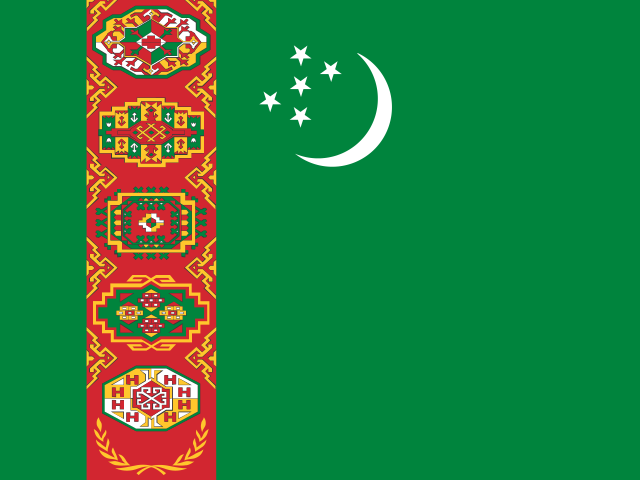
meaning: the green color and crescent moon stand for Islam, the five stars for the country's regions, and the guls for national identity
National symbol(s)
Akhal-Teke horse
National color(s)
green, white
National anthem(s)
lyrics/music: collective/Veli MUKHATOV
history: adopted 1997; lyrics revised in 2008 to eliminate references to deceased President Saparmurat NYYAZOW
National heritage
selected World Heritage Site locales: Ancient Merv (c); Kunya-Urgench (c); Parthian Fortresses of Nisa (c); Cold Winter Deserts of Turan (n); Silk Roads: Zarafshan-Karakum Corridor (c)
Economy24
Economic overview
upper-middle-income Central Asian economy; houses fourth-largest natural gas reserves and rich in natural resources; authoritarian and dominated by state-owned enterprises; challenges include overvalued currency, high inflation risks, lack of economic diversification due to heavy state control and bureaucracy
Real GDP (purchasing power parity)
Real GDP (purchasing power parity) 2023: $131.576 billion (2023 est.)
Real GDP (purchasing power parity) 2022: $123.778 billion (2022 est.)
Real GDP growth rate
Real GDP growth rate 2023: 6.3% (2023 est.)
Real GDP growth rate 2022: 6.2% (2022 est.)
Real GDP per capita
Real GDP per capita 2023: $17,900 (2023 est.)
Real GDP per capita 2022: $17,100 (2022 est.)
GDP (official exchange rate)
Inflation rate (consumer prices)
Inflation rate (consumer prices) 2021: 19.5% (2021 est.)
Inflation rate (consumer prices) 2020: 6.1% (2020 est.)
GDP - composition, by sector of origin
industry: 39.3% (2023 est.)
services: 49.4% (2023 est.)
Agricultural products
Industries
natural gas, oil, petroleum products, textiles, food processing
Labor force
Unemployment rate
Unemployment rate 2023: 4.1% (2023 est.)
Unemployment rate 2022: 4.2% (2022 est.)
Youth unemployment rate (ages 15-24)
male: 14.7% (2024 est.)
female: 6% (2024 est.)
Average household expenditures
on alcohol and tobacco: 2.2% of household expenditures (2023 est.)
Remittances
Remittances 2022: 0% of GDP (2022 est.)
Remittances 2021: 0% of GDP (2021 est.)
Budget
expenditures: $6.134 billion (2019 est.)
Public debt
Exports
Exports 2022: $14.67 billion (2022 est.)
Exports 2021: $10.282 billion (2021 est.)
Exports - partners
Exports - commodities
Imports
Imports 2022: $7.362 billion (2022 est.)
Imports 2021: $6.25 billion (2021 est.)
Imports - partners
Imports - commodities
Debt - external
Exchange rates
Exchange rates 2017: 4.125 (2017 est.)
Exchange rates 2016: 3.5 (2016 est.)
Exchange rates 2015: 3.5 (2015 est.)
Exchange rates 2014: 3.5 (2014 est.)
Energy7
Electricity access
Electricity
consumption: 21.526 billion kWh (2023 est.)
exports: 9 billion kWh (2023 est.)
transmission/distribution losses: 3.258 billion kWh (2023 est.)
Electricity generation sources
Coal
proven reserves: 799.999 million metric tons (2023 est.)
Petroleum
refined petroleum consumption: 152,000 bbl/day (2023 est.)
crude oil estimated reserves: 600 million barrels (2021 est.)
Natural gas
consumption: 44.936 billion cubic meters (2023 est.)
exports: 41.334 billion cubic meters (2023 est.)
proven reserves: 11.327 trillion cubic meters (2021 est.)
Energy consumption per capita
Communications6
Telephones - fixed lines
subscriptions per 100 inhabitants: 10 (2022 est.)
Telephones - mobile cellular
subscriptions per 100 inhabitants: 99 (2021 est.)
Broadcast media
state-controlled broadcast media; 7 state-owned TV and 4 state-owned radio networks; satellite dishes available for other broadcasts; officials sometimes limit access to satellite TV by removing satellite dishes
Internet country code
.tm
Internet users
Broadband - fixed subscriptions
subscriptions per 100 inhabitants: 5 (2022 est.)
Transportation5
Civil aircraft registration country code prefix
EZ
Airports
23 (2025)
Heliports
25 (2025)
Railways
broad gauge: 5,113 km (2017) 1.520-m gauge
Merchant marine
by type: general cargo 6, oil tanker 8, other 59
Military & Security6
Military and security forces
Ministry of Internal Affairs: Internal Troops, Turkmen (National) Police, Federal/State Border Guard Service (2025)
Military expenditures
Military Expenditures 2018: 1.8% of GDP (2018 est.)
Military Expenditures 2017: 1.8% of GDP (2017 est.)
Military Expenditures 2016: 1.8% of GDP (2016 est.)
Military Expenditures 2015: 1.5% of GDP (2015 est.)
Military and security service personnel strengths
estimated 35,000 active Armed Forces (2025)
Military equipment inventories and acquisitions
Military service age and obligation
18-27 years of age for compulsory military service for men and volunteer service for men and women; 24-month conscript service obligation (2025)
Military - note
Transnational Issues2
Refugees and internally displaced persons
Trafficking in persons
Compare Turkmenistan
See how Turkmenistan compares to other countries side by side.
Compare Countries