Thailand
Kingdom of Thailand
Population
70.03M
Area
513,120 km²
GDP
$526.41B
GDP Per Capita
$21,700
Pop. Density
136/km²
Quick Facts
Currency
฿Thai baht(THB)
Calling Code
+66
Timezone
UTC+07:00
Languages
Thai+more
Driving Side
left
Demonym
Thai
Background
Two unified Thai kingdoms emerged in the mid-13th century. The Sukhothai Kingdom, located in the south-central plains, gained its independence from the Khmer Empire to the east. By the late 13th century, Sukhothai’s territory extended into present-day Burma and Laos. Sukhothai lasted until the mid-15th century. The Thai Lan Na Kingdom was established in the north with its capital at Chang Mai; the Burmese conquered Lan Na in the 16th century. The Ayutthaya Kingdom (14th-18th centuries) succeeded the Sukhothai and would become known as the Siamese Kingdom. During the Ayutthaya period, the Thai/Siamese peoples consolidated their hold on what is present-day central and north-central Thailand. Following a military defeat at the hands of the Burmese in 1767, the Siamese Kingdom rose to new heights under the military ruler TAKSIN, who defeated the Burmese occupiers and expanded the kingdom’s territory into modern-day northern Thailand (formerly the Lan Na Kingdom), Cambodia, Laos, and the Malay Peninsula. In the mid-1800s, Western pressure led to Siam signing trade treaties that reduced the country’s sovereignty and independence. In the 1890s and 1900s, the British and French forced the kingdom to cede Cambodian, Laotian, and Malay territories that had been under Siamese control.
Following a bloodless revolution in 1932 that led to the establishment of a constitutional monarchy, Thailand's political history was marked by a series of mostly bloodless coups with power concentrated among military and bureaucratic elites. Periods of civilian rule were unstable. The Cold War era saw a communist insurgency and the rise of strongman leaders. Thailand became a US treaty ally in 1954 after sending troops to Korea and later fighting alongside the US in Vietnam. In the 21st century, Thailand has experienced additional turmoil, including a military coup in 2006 that ousted then Prime Minister THAKSIN Chinnawat and large-scale street protests led by competing political factions in 2008-2010. In 2011, THAKSIN's youngest sister, YINGLAK Chinnawat, led the Puea Thai Party to an electoral win and assumed control of the government.
In 2014, after months of major anti-government protests in Bangkok, the Constitutional Court removed YINGLAK from office, and the Army, led by Gen. PRAYUT Chan-ocha, then staged a coup against the caretaker government. The military-affiliated National Council for Peace and Order (NCPO) ruled the country under PRAYUT for more than four years, drafting a new constitution that allowed the military to appoint the entire 250-member Senate and required a joint meeting of the House and Senate to select the prime minister -- which effectively gave the military a veto on the selection. King PHUMIPHON Adunyadet passed away in 2016 after 70 years on the throne; his only son, WACHIRALONGKON (aka King RAMA X), formally ascended the throne in 2019. The same year, a long-delayed election allowed PRAYUT to continue his premiership, although the results were disputed and widely viewed as skewed in favor of the party aligned with the military. The country again experienced major anti-government protests in 2020. The reformist Move Forward Party won the most seats in the 2023 election but was unable to form a government, and Srettha THRAVISIN from the Pheu Thai Party replaced PRAYUT as prime minister after forming a coalition of moderate and conservative parties.
Historical Trends
GDP (USD)
↑137.4% since 2006Population
↑7.7% since 2006Life Expectancy at Birth
Latest: 76.4 yearsData source: World Bank Open Data
Geography20
Location
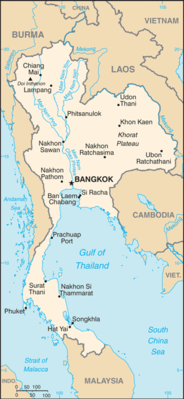
Southeastern Asia, bordering the Andaman Sea and the Gulf of Thailand, southeast of Burma
Geographic coordinates
15 00 N, 100 00 E
Map references
Southeast Asia
Area
land: 510,890 sq km
water: 2,230 sq km
Area - comparative
about three times the size of Florida; slightly more than twice the size of Wyoming
Land boundaries
border countries: Burma 2,416 km; Cambodia 817 km; Laos 1,845 km; Malaysia 595 km
Coastline
3,219 km
Maritime claims
exclusive economic zone: 200 nm
continental shelf: 200-m depth or to the depth of exploitation
Climate
tropical; rainy, warm, cloudy southwest monsoon (mid-May to September); dry, cool northeast monsoon (November to mid-March); southern isthmus always hot and humid
Terrain
central plain; Khorat Plateau in the east; mountains elsewhere
Elevation
lowest point: Gulf of Thailand 0 m
mean elevation: 287 m
Natural resources
tin, rubber, natural gas, tungsten, tantalum, timber, lead, fish, gypsum, lignite, fluorite, arable land
Land use
agricultural land
agricultural land: arable land
agricultural land: permanent crops
agricultural land: permanent pasture
forest
other
Irrigated land
64,150 sq km (2012)
Major lakes (area sq km)
Major rivers (by length in km)
note: [s] after country name indicates river source; [m] after country name indicates river mouth
Major watersheds (area sq km)
Pacific Ocean drainage: Mekong (805,604 sq km)
Population distribution
highest population density is found in and around Bangkok; significant population clusters throughout large parts of the country, particularly north and northeast of Bangkok and in the extreme southern region of the country
Natural hazards
land subsidence in Bangkok area resulting from the depletion of the water table; droughts
Geography - note
controls only land route from Asia to Malaysia and Singapore
People & Society36
Population
male: 34,101,016
female: 35,924,232
Nationality
adjective: Thai
Ethnic groups
Languages
major-language sample(s):
สารานุกรมโลก - แหล่งข้อมูลพื้นฐานที่สำคัญ (Thai)
The World Factbook, the indispensable source for basic information.
Religions
Buddhist 92.5%, Muslim 5.4%, Christian 1.2%, other 0.9% (includes animist, Confucian, Hindu, Jewish, Sikh, and Taoist) (2021 est.)
Age structure
15-64 years: 69% (male 23,681,528/female 24,597,535)
65 years and over: 15.1% (2024 est.) (male 4,714,191/female 5,863,754)
Dependency ratios
youth dependency ratio: 22.9 (2025 est.)
elderly dependency ratio: 23.1 (2025 est.)
potential support ratio: 4.3 (2025 est.)
Median age
male: 40.2 years
female: 42.7 years
Population growth rate
0.13% (2025 est.)
Birth rate
9.82 births/1,000 population (2025 est.)
Death rate
8.08 deaths/1,000 population (2025 est.)
Net migration rate
-0.41 migrant(s)/1,000 population (2025 est.)
Population distribution
highest population density is found in and around Bangkok; significant population clusters throughout large parts of the country, particularly north and northeast of Bangkok and in the extreme southern region of the country
Urbanization
rate of urbanization: 1.43% annual rate of change (2020-25 est.)
Major urban areas - population
11.070 million BANGKOK (capital), 1.454 Chon Buri, 1.359 million Samut Prakan, 1.213 million Chiang Mai, 1.005 million Songkla, 1.001 million Nothaburi (2023)
Sex ratio
0-14 years: 1.05 male(s)/female
15-64 years: 0.96 male(s)/female
65 years and over: 0.8 male(s)/female
total population: 0.95 male(s)/female (2024 est.)
Mother's mean age at first birth
23.3 years (2009 est.)
Maternal mortality ratio
34 deaths/100,000 live births (2023 est.)
Infant mortality rate
male: 6.9 deaths/1,000 live births
female: 5.6 deaths/1,000 live births
Life expectancy at birth
male: 75.2 years
female: 81.3 years
Total fertility rate
1.55 children born/woman (2025 est.)
Gross reproduction rate
0.75 (2025 est.)
Drinking water source
improved: urban
improved: rural
improved: total
unimproved: urban
unimproved: rural
unimproved: total
Health expenditure
Health expenditure (as % of national budget): 16.1% of national budget (2022 est.)
Physician density
0.54 physicians/1,000 population (2021)
Hospital bed density
2.3 beds/1,000 population (2021 est.)
Sanitation facility access
improved: urban
improved: rural
improved: total
unimproved: urban
unimproved: rural
unimproved: total
Obesity - adult prevalence rate
10% (2016)
Alcohol consumption per capita
beer: 1.85 liters of pure alcohol (2019 est.)
wine: 0.23 liters of pure alcohol (2019 est.)
spirits: 4.78 liters of pure alcohol (2019 est.)
other alcohols: 0 liters of pure alcohol (2019 est.)
Tobacco use
male: 36.1% (2025 est.)
female: 1.6% (2025 est.)
Children under the age of 5 years underweight
6.7% (2022 est.)
Currently married women (ages 15-49)
52.4% (2022 est.)
Child marriage
women married by age 18: 17% (2022)
men married by age 18: 5.8% (2022)
Education expenditure
Education expenditure (% national budget): 12.6% national budget (2025 est.)
Literacy
male: 90.7% (2022 est.)
female: 91.5% (2022 est.)
School life expectancy (primary to tertiary education)
male: 16 years (2023 est.)
female: 16 years (2023 est.)
Government26
Country name
conventional long form
conventional short form
local long form
local short form
former
etymology
Government type
constitutional monarchy
Capital
geographic coordinates: 13 45 N, 100 31 E
time difference: UTC+7 (12 hours ahead of Washington, DC, during Standard Time)
etymology: the name is from the Thai words bang (region) and kok (olive trees); the city's full ceremonial name holds the world record for longest place name, Krungthepmahanakhon amonrattanakosin mahintharayutthaya mahadilokphop noppharatratchathaniburirom udomratchaniwetmahasathan amonphimanawatansathit sakkathattiyawitsanukamprasit, which means "City of angels, great city of immortals, magnificent city of the nine gems, seat of the king, city of royal palaces, home of gods incarnate, erected by Vishvakarman at Indra's behest"
Administrative divisions
Legal system
civil law system with common law influences
Constitution
amendment process: amendments require a majority vote in a joint session of the House and Senate and further require at least one fifth of opposition House members and one third of the Senate vote in favor; a national referendum is additionally required for certain amendments; all amendments require signature by the king
International law organization participation
has not submitted an ICJ jurisdiction declaration; non-party state to the ICCt
Citizenship
citizenship by descent only: at least one parent must be a citizen of Thailand
dual citizenship recognized: no
residency requirement for naturalization: 5 years
Suffrage
18 years of age; universal and compulsory
Executive branch
head of government: Prime Minister ANUTIN Charnvirakul (since 5 Sep 2025)
cabinet: Council of Ministers nominated by the prime minister, appointed by the king; a Privy Council advises the king
election/appointment process: the monarchy is hereditary; prime minister candidate approved by House of Representatives and appointed by the king
Legislative branch
legislative structure: bicameral
Legislative branch - lower chamber
chamber name
number of seats
electoral system
scope of elections
term in office
most recent election date
parties elected and seats per party
percentage of women in chamber
expected date of next election
Legislative branch - upper chamber
chamber name
number of seats
scope of elections
term in office
most recent election date
percentage of women in chamber
expected date of next election
Judicial branch
judge selection and term of office: Supreme Court judges selected by the Judicial Commission of the Courts of Justice and approved by the monarch; judge term determined by the monarch; Constitutional Court justices - 3 judges drawn from the Supreme Court, 2 judges drawn from the Administrative Court, and 4 judge candidates selected by the Selective Committee for Judges of the Constitutional Court, and confirmed by the Senate; judges appointed by the monarch serve single 9-year terms; Supreme Administrative Court judges selected by the Judicial Commission of the Administrative Courts and appointed by the monarch; judges serve for life
subordinate courts: courts of first instance and appeals courts within both the judicial and administrative systems; military courts
Political parties
Chat Thai Phatthana Party (Thai Nation Development Party) or CTP
Democrat Party
Move Forward Party or MFP (dissolved by order of the Constitutional Court, August 2024)
Palang Pracharat Party (People's State Power Party) or PPRP
Pheu (Puea) Thai Party (For Thais Party) or PTP
Prachachat Party or PCC
Prachathipat Party (Democrat Party) or DP
Thai Sang Thai Party
United Thai Nation (Ruam Thai Sang Chat) or UTN
Diplomatic representation in the US
chief of mission
chancery
telephone
FAX
email address and website
consulate(s) general
Diplomatic representation from the US
chief of mission
embassy
mailing address
telephone
FAX
email address and website
consulate(s) general
International organization participation
ADB, APEC, ARF, ASEAN, BIMSTEC, BIS, CD, CICA, CP, EAS, FAO, G-77, IAEA, IBRD, ICAO, ICC (national committees), ICRM, IDA, IFAD, IFC, IFRCS, IHO, ILO, IMF, IMO, IMSO, Interpol, IOC, IOM, IPU, ISO, ITSO, ITU, ITUC (NGOs), MIGA, NAM, OAS (observer), OIC (observer), OIF (observer), OPCW, OSCE (partner), PCA, PIF (partner), UN, UNAMID, UNCTAD, UNESCO, UNHCR, UNIDO, UNMOGIP, UNOOSA, UNOCI, UNWTO, UPU, WCO, WFTU (NGOs), WHO, WIPO, WMO, WTO
Independence
1238 (traditional founding date; never colonized)
National holiday
Birthday of King WACHIRALONGKON, 28 July (1952)
Flag
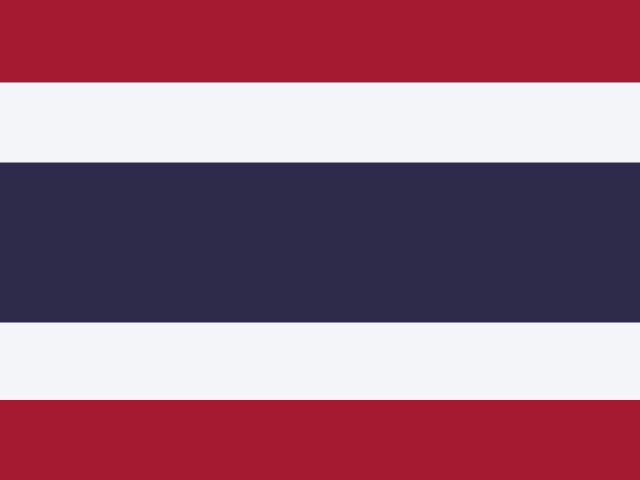
meaning: red stands for the nation and the blood of life, white for religion and the purity of Buddhism, and blue for the monarchy
National symbol(s)
garuda (mythical half-man, half-bird figure), elephant
National color(s)
red, white, blue
National coat of arms
National anthem(s)
lyrics/music: Narisara NUWATTIWONG and King VAJIRAVUDH/Pyotr SHCHUROVSKY
history: royal anthem, played in the presence of the royal family and during certain state ceremonies
National heritage
selected World Heritage Site locales: Historic City of Ayutthaya (c); Historic Sukhothai and Associated Historic Towns (c); Thungyai-Huai Kha Khaeng Wildlife Sanctuaries (n); Ban Chiang Archaeological Site (c); Dong Phayayen-Khao Yai Forest Complex (n); Kaeng Krachan Forest Complex (n); The Ancient Town of Si Thep and its Associated Dvaravati Monuments (n); Phu Phrabat, a testimony to the Sīma stone tradition of the Dvaravati period (c)
Economy32
Economic overview
upper middle-income Southeast Asian economy; substantial infrastructure; major electronics, food, and automobile parts exporter; globally used currency; extremely low unemployment; ongoing Thailand 4.0 economic development
Real GDP (purchasing power parity)
Real GDP (purchasing power parity) 2023: $1.519 trillion (2023 est.)
Real GDP (purchasing power parity) 2022: $1.489 trillion (2022 est.)
Real GDP growth rate
Real GDP growth rate 2023: 2% (2023 est.)
Real GDP growth rate 2022: 2.6% (2022 est.)
Real GDP per capita
Real GDP per capita 2023: $21,200 (2023 est.)
Real GDP per capita 2022: $20,800 (2022 est.)
GDP (official exchange rate)
Inflation rate (consumer prices)
Inflation rate (consumer prices) 2023: 8.5% (2023 est.)
Inflation rate (consumer prices) 2022: -1.6% (2022 est.)
GDP - composition, by sector of origin
industry: 32.1% (2024 est.)
services: 59.2% (2024 est.)
GDP - composition, by end use
household consumption
government consumption
investment in fixed capital
investment in inventories
exports of goods and services
imports of goods and services
Agricultural products
Industries
tourism, textiles and garments, agricultural processing, beverages, tobacco, cement, light manufacturing such as jewelry and electric appliances, computers and parts, integrated circuits, furniture, plastics, automobiles and automotive parts, agricultural machinery, air conditioning and refrigeration, ceramics, aluminum, chemical, environmental management, glass, granite and marble, leather, machinery and metal work, petrochemical, petroleum refining, pharmaceuticals, printing, pulp and paper, rubber, sugar, rice, fishing, cassava, world's second-largest tungsten producer and third-largest tin producer
Industrial production growth rate
Labor force
Unemployment rate
Unemployment rate 2023: 0.8% (2023 est.)
Unemployment rate 2022: 1% (2022 est.)
Youth unemployment rate (ages 15-24)
male: 3.1% (2024 est.)
female: 6% (2024 est.)
Population below poverty line
Gini Index coefficient - distribution of family income
Average household expenditures
on alcohol and tobacco: 3% of household expenditures (2023 est.)
Household income or consumption by percentage share
highest 10%: 26.1% (2023 est.)
Remittances
Remittances 2023: 1.9% of GDP (2023 est.)
Remittances 2022: 1.8% of GDP (2022 est.)
Budget
expenditures: $114.521 billion (2023 est.)
Public debt
Taxes and other revenues
Current account balance
Current account balance 2023: $7.412 billion (2023 est.)
Current account balance 2022: -$17.162 billion (2022 est.)
Exports
Exports 2023: $337.45 billion (2023 est.)
Exports 2022: $324.111 billion (2022 est.)
Exports - partners
Exports - commodities
Imports
Imports 2023: $327.008 billion (2023 est.)
Imports 2022: $334.44 billion (2022 est.)
Imports - partners
Imports - commodities
Reserves of foreign exchange and gold
Reserves of foreign exchange and gold 2023: $224.47 billion (2023 est.)
Reserves of foreign exchange and gold 2022: $216.501 billion (2022 est.)
Debt - external
Exchange rates
Currency
Exchange rates 2024
Exchange rates 2023
Exchange rates 2022
Exchange rates 2021
Exchange rates 2020
Energy7
Electricity access
electrification - urban areas: 100%
electrification - rural areas: 100%
Electricity
consumption: 215.281 billion kWh (2023 est.)
exports: 2.256 billion kWh (2023 est.)
imports: 35.805 billion kWh (2023 est.)
transmission/distribution losses: 14.44 billion kWh (2023 est.)
Electricity generation sources
solar: 2.7% of total installed capacity (2023 est.)
wind: 1.8% of total installed capacity (2023 est.)
hydroelectricity: 3.5% of total installed capacity (2023 est.)
biomass and waste: 10.1% of total installed capacity (2023 est.)
Coal
consumption: 42.371 million metric tons (2023 est.)
exports: 65,000 metric tons (2023 est.)
imports: 29.757 million metric tons (2023 est.)
proven reserves: 1.063 billion metric tons (2023 est.)
Petroleum
refined petroleum consumption: 1.397 million bbl/day (2023 est.)
crude oil estimated reserves: 252.75 million barrels (2021 est.)
Natural gas
consumption: 52.351 billion cubic meters (2023 est.)
imports: 22.738 billion cubic meters (2023 est.)
proven reserves: 138.243 billion cubic meters (2021 est.)
Energy consumption per capita
Communications6
Telephones - fixed lines
subscriptions per 100 inhabitants: 6 (2023 est.)
Telephones - mobile cellular
subscriptions per 100 inhabitants: 161 (2024 est.)
Broadcast media
26 digital TV stations and 6 terrestrial TV stations broadcast nationally via relay stations, with 2 of the terrestrial stations military-owned and the other 4 state-owned or state-controlled; some leased to private enterprise; all required to broadcast government-produced news; multi-channel satellite and cable TV subscriptions available; radio frequencies allotted for over 500 government and commercial radio stations; many small community radio stations operate with low-power transmitters (2017)
Internet country code
.th
Internet users
Broadband - fixed subscriptions
subscriptions per 100 inhabitants: 16 (2023 est.)
Transportation6
Civil aircraft registration country code prefix
HS
Airports
105 (2025)
Heliports
5 (2025)
Railways
standard gauge: 84 km (2017) 1.435-m gauge (84 km electrified)
narrow gauge: 4,043 km (2017) 1.000-m gauge
Merchant marine
by type: bulk carrier 28, container ship 28, general cargo 88, oil tanker 251, other 489
Ports
total ports
large
medium
small
very small
ports with oil terminals
key ports
Military & Security7
Military and security forces
Office of the Prime Minister: Royal Thai Police (2025)
Military expenditures
Military Expenditures 2023: 1.3% of GDP (2023 est.)
Military Expenditures 2022: 1.3% of GDP (2022 est.)
Military Expenditures 2021: 1.3% of GDP (2021 est.)
Military Expenditures 2020: 1.4% of GDP (2020 est.)
Military and security service personnel strengths
estimated 350,000 active-duty Armed Forces (250,000 Army; 70,000 Navy; 30,000 Air Force) (2025)
Military equipment inventories and acquisitions
the RTARF has a diverse array of foreign-supplied armaments, as well as some domestically produced items; its imported weapons and equipment are from a variety of suppliers, including China, several European countries, Israel, Russia, South Korea, and the US; Thailand's domestic defense industry produces such items as armored vehicles, artillery systems, naval vessels, unmanned aerial vehicles, and other military technologies (2025)
Military service age and obligation
Military deployments
280 South Sudan (UNMISS) (2025)
Military - note
in July 2025, following months of rising tensions, the RTARF and Cambodian military forces clashed in multiple locations along their disputed border; both sides blamed the other for provoking the five-day conflict, which included cross-border artillery shelling by both sides and air attacks by RTARF fighter aircraft and drones; since 2004, the RTARF and Thai paramilitary forces have combated a separatist insurgency in the southern Thailand provinces of Pattani, Yala, and Narathiwat, as well as parts of Songkhla; the insurgency is rooted in ethnic Malay nationalist resistance to Thai rule that followed the extension of Siamese sovereignty over the Patani Sultanate in the 18th century; the insurgency consists of several armed groups, the largest of which is the Barisan Revolusi Nasional-Koordinasi (BRN-C): insurgent attacks have largely involved bombings; since 2020, Thai officials have been negotiating with BRN, and has parallel talks with an umbrella organization, MARA Pattani, that claims to represent the insurgency groups (2025)
Transnational Issues2
Refugees and internally displaced persons
IDPs: 19 (2023 est.)
stateless persons: 612,524 (2024 est.)
Illicit drugs
major precursor-chemical producer (2025)