
Taiwan
Population
23.60M
Area
35,980 km²
GDP
$611.39B
GDP Per Capita
$32,300
Pop. Density
656/km²
Quick Facts
Currency
$New Taiwan dollar(TWD)
Calling Code
+886
Timezone
UTC+08:00
Languages
Chinese+more
Driving Side
right
Demonym
Taiwanese
Background
The democratization process expanded rapidly in the 1980s, leading to the then-illegal founding of the Democratic Progressive Party (DPP), Taiwan’s first opposition party, in 1986 and the lifting of martial law the following year. Taiwan held legislative elections in 1992, the first in over 40 years, and its first direct presidential election in 1996. In the 2000 presidential elections, Taiwan underwent its first peaceful transfer of power with the KMT loss to the DPP and afterwards experienced two additional democratic transfers of power in 2008 and 2016. Throughout this period, the island prospered and turned into one of East Asia's economic "Tigers," becoming a major investor in mainland China after 2000 as cross-Strait ties matured. The dominant political issues continue to be economic reform and growth, as well as management of sensitive relations between Taiwan and China.
Geography17
Location
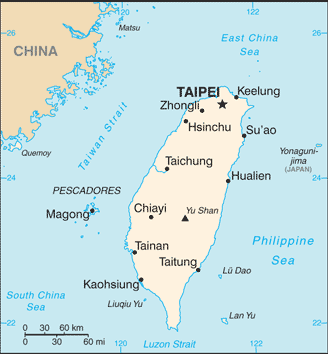
Eastern Asia, islands bordering the East China Sea, Philippine Sea, South China Sea, and Taiwan Strait, north of the Philippines, off the southeastern coast of China
Geographic coordinates
23 30 N, 121 00 E
Map references
Southeast Asia
Area
land: 32,260 sq km
water: 3,720 sq km
Area - comparative
slightly smaller than Maryland and Delaware combined
Land boundaries
Coastline
1,566.3 km
Maritime claims
exclusive economic zone: 200 nm
Climate
tropical; marine; rainy season during southwest monsoon (June to August); persistent and extensive cloudiness all year
Terrain
eastern two-thirds mostly rugged mountains; flat to gently rolling plains in west
Elevation
lowest point: South China Sea 0 m
mean elevation: 1,150 m
Natural resources
small deposits of coal, natural gas, limestone, marble, asbestos, arable land
Land use
agricultural land
agricultural land: arable land
agricultural land: permanent crops
agricultural land: permanent pasture
forest
other
Irrigated land
3,820 sq km (2012)
Population distribution
distribution exhibits a peripheral coastal settlement pattern, with the largest populations on the north and west coasts
Natural hazards
volcanism: Kueishantao Island (401 m), east of Taiwan, is the only historically active volcano, but it has not erupted in centuries
Geography - note
strategic location adjacent to both the Taiwan Strait and the Luzon Strait
People & Society20
Population
male: 11,596,835
female: 12,003,941
Nationality
adjective: Taiwan (or Taiwanese)
Ethnic groups
note 2: although not definitive, the majority of current genetic, archeological, and linguistic data support the theory that Taiwan is the ultimate source for the spread of humans across the Pacific to Polynesia; the expansion (ca. 3000 B.C. to A.D. 1200) took place via the Philippines and eastern Indonesia and reached Fiji and Tonga by about 900 B.C.; from there voyagers spread across the rest of the Pacific islands over the next two millennia
Languages
major-language sample(s):
世界概況 – 不可缺少的基本消息來源 (Mandarin)
The World Factbook, the indispensable source for basic information.
Religions
Buddhist 35.3%, Taoist 33.2%, Christian 3.9%, folk religion (includes Confucian) approximately 10%, none or unspecified 18.2% (2005 est.)
Age structure
15-64 years: 69% (male 8,132,356/female 8,155,582)
65 years and over: 18.8% (2024 est.) (male 2,002,076/female 2,442,170)
Dependency ratios
youth dependency ratio: 17.7 (2025 est.)
elderly dependency ratio: 28.7 (2025 est.)
potential support ratio: 3.5 (2025 est.)
Median age
male: 43.6 years
female: 45.5 years
Population growth rate
0.02% (2025 est.)
Birth rate
7.22 births/1,000 population (2025 est.)
Death rate
8.18 deaths/1,000 population (2025 est.)
Net migration rate
1.17 migrant(s)/1,000 population (2025 est.)
Population distribution
distribution exhibits a peripheral coastal settlement pattern, with the largest populations on the north and west coasts
Urbanization
rate of urbanization: 0.65% annual rate of change (2020-25 est.)
Major urban areas - population
4.504 million New Taipei City, 2.754 million TAIPEI (capital), 2.319 million Taoyuan, 1.553 million Kaohsiung, 1.369 million Taichung, 863,000 Tainan (2023)
Sex ratio
0-14 years: 1.06 male(s)/female
15-64 years: 1 male(s)/female
65 years and over: 0.82 male(s)/female
total population: 0.97 male(s)/female (2024 est.)
Infant mortality rate
male: 4.2 deaths/1,000 live births
female: 3.5 deaths/1,000 live births
Life expectancy at birth
male: 78.6 years
female: 84.7 years
Total fertility rate
1.12 children born/woman (2025 est.)
Gross reproduction rate
0.54 (2025 est.)
Government21
Country name
conventional long form
conventional short form
local long form
local short form
former
etymology
Government type
semi-presidential republic
Capital
geographic coordinates: 25 02 N, 121 31 E
time difference: UTC+8 (13 hours ahead of Washington, DC, during Standard Time)
etymology: the name means "Northern Taiwan," from the Chinese words tai (a short form of Taiwan) and bei (north), reflecting the city's position in the far north of the island
Administrative divisions
counties: Changhua, Chiayi, Hsinchu, Hualien, Kinmen, Lienchiang, Miaoli, Nantou, Penghu, Pingtung, Taitung, Yilan, Yunlin
cities: Chiayi, Hsinchu, Keelung
special municipalities: Kaohsiung (city), New Taipei (city), Taichung (city), Tainan (city), Taipei (city), Taoyuan (city)
Legal system
civil law system
Constitution
amendment process: proposed by at least one fourth of the Legislative Yuan membership; passage requires approval by at least three-fourths majority vote of at least three fourths of the Legislative Yuan membership and approval in a referendum by more than half of eligible voters
International law organization participation
has not submitted an ICJ jurisdiction declaration; non-party state to the ICCt
Citizenship
citizenship by descent only: at least one parent must be a citizen of Taiwan
dual citizenship recognized: yes, except that citizens of Taiwan are not recognized as dual citizens of the People's Republic of China
residency requirement for naturalization: 5 years
Suffrage
20 years of age; universal
Executive branch
chief of state
head of government
cabinet
election/appointment process
most recent election date
election results
2024: LAI Ching-te elected president; percent of vote - LAI Ching-te (DPP) 40.1%, HOU Yu-ih (KMT) 33.5%, KO Wen-je (TPP) 26.5%)
2020: TSAI Ing-wen reelected president; percent of vote - TSAI Ing-wen (DPP) 57.1%, HAN Kuo-yu (KMT) 38.6%, James SOONG (PFP) 4.3%
expected date of next election
Legislative branch
legislature name
legislative structure
number of seats
electoral system
scope of elections
term in office
most recent election date
parties elected and seats per party
percentage of women in chamber
expected date of next election
Judicial branch
judge selection and term of office: Supreme Court justices appointed for life by the president; Constitutional Court justices appointed by the president, with approval of the Legislative Yuan, for 8-year terms, with half the membership renewed every 4 years
subordinate courts: high courts; district courts; hierarchy of administrative courts
Political parties
Kuomintang or KMT (Nationalist Party)
Taiwan People's Party or TPP
Diplomatic representation in the US
Taipei Economic and Cultural Offices (branch offices): Atlanta, Boston, Chicago, Denver (CO), Hagatna (Guam), Honolulu, Houston, Los Angeles, Miami, New York, San Francisco, Seattle, Washington DC
Diplomatic representation from the US
chief of mission
mailing address
telephone
FAX
email address and website
branch office(s)
No. 100, Jinhu Road,
Neihu District 11461, Taipei City
other offices
International organization participation
National holiday
Flag
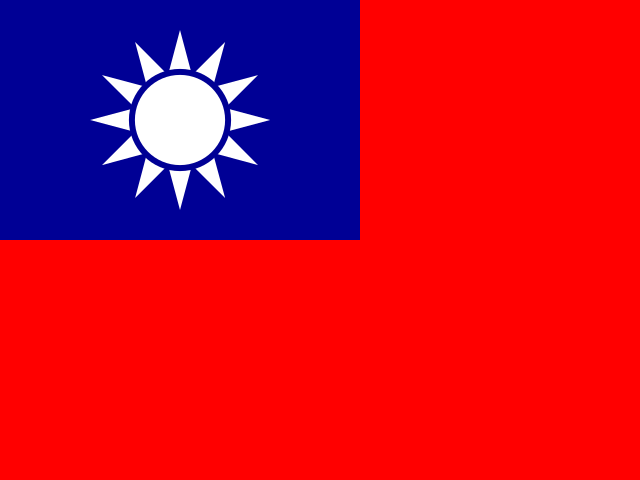
meaning: blue stands for liberty, justice, and democracy; red for fraternity, sacrifice, and nationalism; white for equality, frankness, and the people's livelihood; the 12 rays represent the months of the year and the traditional Chinese hours (each ray equals two hours)
history: the blue-and-white design of the canton (symbolizing the sun of progress) dates to 1895
National symbol(s)
white sun with 12 rays on a blue field
National color(s)
blue, white, red
National anthem(s)
lyrics/music: HU Han-min, TAI Chi-t'ao, and LIAO Chung-k'ai/CHENG Mao-yun
history: adopted 1937; also the song of the Kuomintang Party; informally known as "San Min Chu I" or "San Min Zhu Yi" (Three Principles of the People); the anthem is banned from performance in mainland China, Hong Kong, and Macau
Economy22
Economic overview
high-income East Asian economy; most technologically advanced computer microchip manufacturing; increasing Chinese interference threatens market capabilities; minimum wages rising; longstanding regional socioeconomic inequality
Real GDP (purchasing power parity)
Real GDP (purchasing power parity) 2022: $1.664 trillion (2022 est.)
Real GDP (purchasing power parity) 2021: $1.512 trillion (2021 est.)
Real GDP growth rate
Real GDP growth rate 2022: 2.59% (2022 est.)
Real GDP growth rate 2021: 6.62% (2021 est.)
Real GDP per capita
Real GDP per capita 2022: $32,600 (2022 est.)
Real GDP per capita 2021: $32,900 (2021 est.)
GDP (official exchange rate)
Inflation rate (consumer prices)
Inflation rate (consumer prices) 2023: 2.5% (2023 est.)
Inflation rate (consumer prices) 2022: 2.9% (2022 est.)
GDP - composition, by end use
household consumption
government consumption
investment in fixed capital
investment in inventories
exports of goods and services
imports of goods and services
Agricultural products
Industries
electronics, communications and information technology products, petroleum refining, chemicals, textiles, iron and steel, machinery, cement, food processing, vehicles, consumer products, pharmaceuticals
Unemployment rate
Unemployment rate 2023: 3.5% (2023 est.)
Unemployment rate 2022: 3.7% (2022 est.)
Gini Index coefficient - distribution of family income
Average household expenditures
on alcohol and tobacco: 2.5% of household expenditures (2023 est.)
Budget
expenditures: $105.833 billion (2019 est.)
Public debt
Current account balance
Current account balance 2022: $101.032 billion (2022 est.)
Current account balance 2021: $118.298 billion (2021 est.)
Exports
Exports 2022: $479.415 billion (2022 est.)
Exports 2021: $446.371 billion (2021 est.)
Exports - partners
Exports - commodities
Imports
Imports 2022: $428.083 billion (2022 est.)
Imports 2021: $381.958 billion (2021 est.)
Imports - partners
Imports - commodities
Exchange rates
Currency
Exchange rates 2024
Exchange rates 2023
Exchange rates 2022
Exchange rates 2021
Exchange rates 2020
Energy7
Electricity
consumption: 270.648 billion kWh (2023 est.)
transmission/distribution losses: 7.907 billion kWh (2023 est.)
Electricity generation sources
fossil fuels
nuclear
solar
wind
hydroelectricity
biomass and waste
Nuclear energy
Net capacity of operational nuclear reactors: 0.94GW (2025 est.)
Percent of total electricity production: 6.9% (2023 est.)
Number of nuclear reactors permanently shut down: 5 (2025)
Coal
consumption: 64.609 million metric tons (2023 est.)
exports: 47,000 metric tons (2023 est.)
imports: 58.15 million metric tons (2023 est.)
proven reserves: 1 million metric tons (2023 est.)
Petroleum
refined petroleum consumption: 954,000 bbl/day (2023 est.)
crude oil estimated reserves: 2.38 million barrels (2021 est.)
Natural gas
consumption: 27.222 billion cubic meters (2023 est.)
imports: 26.997 billion cubic meters (2023 est.)
proven reserves: 6.23 billion cubic meters (2021 est.)
Energy consumption per capita
Communications6
Telephones - fixed lines
subscriptions per 100 inhabitants: 43 (2023 est.)
Telephones - mobile cellular
subscriptions per 100 inhabitants: 128 (2024 est.)
Broadcast media
5 national TV networks with about 22 stations; over 300 satellite TV channels available; about half of households use multi-channel cable TV; almost all subscribe to digital cable TV; national and regional radio networks with about 171 radio stations (2023)
Internet country code
.tw
Internet users
Broadband - fixed subscriptions
subscriptions per 100 inhabitants: 25 (2019 est.)
Transportation6
Civil aircraft registration country code prefix
B
Airports
57 (2025)
Heliports
56 (2025)
Railways
standard gauge: 345 km (2018) 1.435-m gauge (345 km electrified)
narrow gauge: 1,118.1 km (2018) 1.067-m gauge (793.9 km electrified)
Merchant marine
by type: bulk carrier 29, container ship 53, general cargo 58, oil tanker 35, other 290
Ports
total ports
large
medium
small
very small
ports with oil terminals
key ports
Military & Security6
Military and security forces
Ocean Affairs Council: Coast Guard Administration (CGA)
Ministry of Interior: National Police (2025)
Military expenditures
Military Expenditures 2023: 2.5% of GDP (2023 est.)
Military Expenditures 2022: 2.1% of GDP (2022 est.)
Military Expenditures 2021: 2.1% of GDP (2021 est.)
Military Expenditures 2020: 2.1% of GDP (2020 est.)
Military and security service personnel strengths
approximately 170,000 active duty Armed Forces (2025)
Military equipment inventories and acquisitions
the military's inventory is a mix of domestically produced and foreign-supplied armaments, mostly from the US either as secondhand or direct acquisitions; Taiwan's domestic defense industry produces weapons systems such as aircraft, armored vehicles, missiles, and naval platforms (2025)
Military service age and obligation
Military - note
Transnational Issues2
Refugees and internally displaced persons
Illicit drugs
major precursor-chemical producer (2025)