
Svalbard (sometimes referred to as Spitsbergen, the largest island in the archipelago)
Population
2.6K
Area
62,045 km²
GDP
N/A
GDP Per Capita
N/A
Quick Facts
Currency
krkrone(NOK)
Calling Code
+4779
Timezone
UTC+01:00
Languages
Norwegian+more
Driving Side
right
Demonym
Norwegian
Background
Geography16
Location
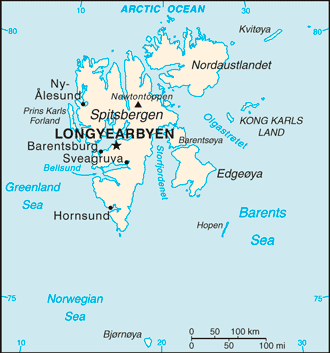
Northern Europe, islands between the Arctic Ocean, Barents Sea, Greenland Sea, and Norwegian Sea, north of Norway
Geographic coordinates
78 00 N, 20 00 E
Map references
Arctic Region
Area
land: 62,045 sq km
water: 0 sq km
Area - comparative
slightly smaller than West Virginia
Land boundaries
Coastline
3,587 km
Maritime claims
contiguous zone: 24 nm
continental shelf: extends to depth of exploitation
exclusive fishing zone: 200 nm
Climate
arctic, tempered by warm North Atlantic Current; cool summers, cold winters; North Atlantic Current flows along west and north coasts of Spitsbergen, keeping water open and navigable most of the year
Terrain
rugged mountains; much of the upland areas are ice covered; west coast clear of ice about half the year; fjords along west and north coasts
Elevation
lowest point: Arctic Ocean 0 m
Natural resources
coal, iron ore, copper, zinc, phosphate, wildlife, fish
Land use
other: 100% (2018 est.)
Population distribution
the small population is primarily concentrated on the island of Spitsbergen in a handful of settlements on the south side of the Isfjorden, with Longyearbyen being the largest
Natural hazards
ice floes often block the entrance to Bellsund (a transit point for coal export) on the west coast and occasionally make parts of the northeastern coast inaccessible to maritime traffic
Geography - note
northernmost part of the Kingdom of Norway; consists of nine main islands; glaciers and snowfields cover 60% of the total area
People & Society6
Population
male: 1,353
female: 1,203
Ethnic groups
Languages
major-language sample(s):
Verdens Faktabok, den essensielle kilden for grunnleggende informasjon. (Norwegian)
The World Factbook, the indispensable source for basic information.
Population growth rate
-0.03% (2019 est.)
Net migration rate
-5.57 migrant(s)/1,000 population (2021 est.)
Population distribution
the small population is primarily concentrated on the island of Spitsbergen in a handful of settlements on the south side of the Isfjorden, with Longyearbyen being the largest
Government13
Country name
conventional short form: Svalbard (sometimes referred to as Spitsbergen, the largest island in the archipelago)
etymology: the archipelago was traditionally known as Spitsbergen, a Dutch name meaning "jagged peaks," but Norway renamed it Svalbard in the 1920s when it assumed sovereignty of the islands, from the Norwegian sval (cold) and bard (shore); the Norwegian name may have been used during the Norse era for other locations
Government type
non-self-governing territory of Norway
Dependency status
Capital
geographic coordinates: 78 13 N, 15 38 E
time difference: UTC+1 (6 hours ahead of Washington, DC, during Standard Time)
daylight saving time: +1hr, begins last Sunday in March; ends last Sunday in October
etymology: the name in Norwegian means Longyear Town; the site was established by and named after John Munro LONGYEAR, whose Arctic Coal Company began mining operations there in 1906
Legal system
laws of Norway that explicitly apply to Svalbard, including the Svalbard Act, the Svalbard Environmental Protection Act, and certain regulations; the Spitsbergen Treaty and the Svalbard Treaty grant certain rights to citizens and corporations of signatory nations
Citizenship
see Norway
Executive branch
head of government: Governor Lars FAUSE (since 24 June 2021)
election/appointment process: none; the monarchy is hereditary; governor and assistant governor responsible to the Polar Department of the Ministry of Justice
Judicial branch
Political parties
Labor
Liberal
Progress
Socialist Left
International organization participation
none
Independence
none (territory of Norway)
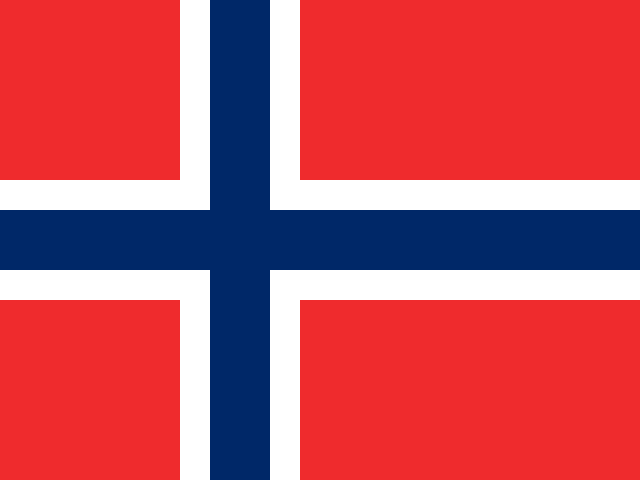
Flag
the flag of Norway is used
National anthem(s)
lyrics/music: Bjornstjerne BJORNSON/Rikard NORDRAAK
history: official anthem, as a Norwegian territory
Economy2
Economic overview
high-income Norwegian island economy; major coal mining, tourism, and research sectors; recently established northernmost brewery; key whaling and fishing base; home to the Global Seed Vault
Exchange rates
Currency
Exchange rates 2024
Exchange rates 2023
Exchange rates 2022
Exchange rates 2021
Exchange rates 2020
Communications2
Broadcast media
Norwegian Broadcasting Corporation (NRK) provides TV transmission to Svalbard via satellite; access to 3 NRK radio stations and 2 TV stations
Internet country code
.sj
Transportation1
Ports
total ports
large
medium
small
very small
ports with oil terminals
key ports
Military & Security2
Military and security forces
no regular military forces
Military - note
Svalbard is a territory of Norway, demilitarized by treaty on 9 February 1920; Norwegian military activity is limited to fisheries surveillance by the Norwegian Coast Guard (2025)
Compare Svalbard (sometimes referred to as Spitsbergen, the largest island in the archipelago)
See how Svalbard (sometimes referred to as Spitsbergen, the largest island in the archipelago) compares to other countries side by side.
Compare Countries