Somalia
Federal Republic of Somalia
Population
20.32M
Area
637,657 km²
GDP
$12.11B
GDP Per Capita
$1,400
Pop. Density
32/km²
Quick Facts
Currency
ShSomali shilling(SOS)
Calling Code
+252
Timezone
UTC+03:00
Languages
Arabic, Somali+more
Driving Side
right
Demonym
Somali
Background
Between A.D. 800 and 1100, immigrant Muslim Arabs and Persians set up coastal trading posts along the Gulf of Aden and the Indian Ocean, solidifying present-day Somalia’s close trading relationship with the Arab Peninsula. In the late 19th century, Britain, France, and Italy established colonies in the Somali Peninsula that lasted until 1960, when British Somaliland gained independence and joined with Italian Somaliland to form the Republic of Somalia.
The country functioned as a parliamentary democracy until 1969, when General Mohamed SIAD Barre took control in a coup, beginning a 22-year socialist dictatorship. In an effort to centralize power, SIAD called for the eradication of the clan, the key cultural and social organizing principle in Somali society. Resistance to SIAD’s socialist leadership, which was causing a rapid deterioration of the country, prompted allied clan militias to overthrow SIAD in 1991, resulting in state collapse. Subsequent fighting between rival clans for resources and territory overwhelmed the country, causing a manmade famine and prompting international intervention. Beginning in 1993, the UN spearheaded an international humanitarian mission, but the international community largely withdrew by 1995 after an incident that became known as Black Hawk Down, in which two US military helicopters were shot down in Mogadishu. The fighting and subsequent siege and rescue resulted in 21 deaths and 82 wounded among the international forces.
International peace conferences in the 2000s resulted in a number of transitional governments that operated outside Somalia. Left largely to themselves, Somalis in the country established alternative governance structures; some areas formed their own administrations, such as Somaliland and Puntland, while others developed localized institutions. Many local populations turned to sharia courts, an Islamic judicial system that implements religious law. Several of these courts came together in 2006 to form the Islamic Courts Union (ICU). The ICU established order in many areas of central and southern Somalia, including Mogadishu, but was forced out when Ethiopia intervened militarily in 2006 on behalf of the Somali Transitional Federal Government (TFG). As the TFG settled in the capital, the ICU fled to rural areas or left Somalia altogether, but the organization reemerged less than a year later as the Islamic insurgent and terrorist movement al-Shabaab, which is still active today.
In 2007, the African Union (AU) established a peacekeeping force, took over security responsibility for the country, and gave the TFG space to develop Somalia’s new government. By 2012, Somali powerbrokers agreed on a provisional constitution with a loose federal structure and established a central government in Mogadishu called the Somali Federal Government (SFG). Since then, the country has seen several interim regional administrations and three presidential elections, but significant governance and security problems remain because al-Shabaab still controls large portions of the country.
Historical Trends
GDP (USD)
↑138.1% since 2006Population
↑73.2% since 2006Life Expectancy at Birth
Latest: 58.8 yearsData source: World Bank Open Data
Geography18
Location
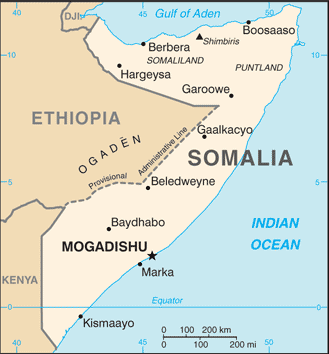
Eastern Africa, bordering the Gulf of Aden and the Indian Ocean, east of Ethiopia
Geographic coordinates
10 00 N, 49 00 E
Map references
Africa
Area
land: 627,337 sq km
water: 10,320 sq km
Area - comparative
almost five times the size of Alabama; slightly smaller than Texas
Land boundaries
border countries: Djibouti 61 km; Ethiopia 1,640 km; Kenya 684 km
Coastline
3,025 km
Maritime claims
exclusive economic zone: 200 nm
Climate
principally desert; northeast monsoon (December to February), moderate temperatures in north and hot in south; southwest monsoon (May to October), torrid in the north and hot in the south, irregular rainfall, hot and humid periods (tangambili) between monsoons
Terrain
mostly flat to undulating plateau rising to hills in north
Elevation
lowest point: Indian Ocean 0 m
mean elevation: 410 m
Natural resources
uranium and largely unexploited reserves of iron ore, tin, gypsum, bauxite, copper, salt, natural gas, likely oil reserves
Land use
agricultural land
agricultural land: arable land
agricultural land: permanent crops
agricultural land: permanent pasture
forest
other
Irrigated land
2,000 sq km (2012)
Major aquifers
Ogaden-Juba Basin
Population distribution
distribution varies greatly throughout the country; least densely populated areas are in the northeast and central regions, as well as areas along the Kenyan border; most populated areas are in and around the cities of Mogadishu, Marka, Boorama, Hargeysa, and Baidoa, as shown on this population distribution map
Natural hazards
recurring droughts; frequent dust storms over eastern plains in summer; floods during rainy season
Geography - note
strategic location on Horn of Africa along southern approaches to Bab el Mandeb and route through Red Sea and Suez Canal
People & Society31
Population
male: 10,170,863
female: 10,153,297
Nationality
adjective: Somali
Ethnic groups
predominantly Somali with lesser numbers of Arabs, Bantus, and others
Languages
major-language sample(s):
Buugga Xaqiiqda Aduunka, waa laga maarmaanka macluumaadka assasiga. (Somali)
The World Factbook, the indispensable source for basic information.
Religions
Muslim 99.9% (Sunni Muslim 98.1%, Shia Muslim 1.2%, Islamic schismatic 0.6%), ethnic religionist 0.1% (2020 est.)
Age structure
15-64 years: 55.8% (male 3,699,721/female 3,568,163)
65 years and over: 2.8% (2024 est.) (male 157,505/female 208,426)
Dependency ratios
youth dependency ratio: 97.1 (2025 est.)
elderly dependency ratio: 3.3 (2025 est.)
potential support ratio: 29.9 (2025 est.)
Median age
male: 19.3 years
female: 18.9 years
Population growth rate
3.32% (2025 est.)
Birth rate
46.36 births/1,000 population (2025 est.)
Death rate
11.22 deaths/1,000 population (2025 est.)
Net migration rate
-1.91 migrant(s)/1,000 population (2025 est.)
Population distribution
distribution varies greatly throughout the country; least densely populated areas are in the northeast and central regions, as well as areas along the Kenyan border; most populated areas are in and around the cities of Mogadishu, Marka, Boorama, Hargeysa, and Baidoa, as shown on this population distribution map
Urbanization
rate of urbanization: 4.2% annual rate of change (2020-25 est.)
Major urban areas - population
2.610 million MOGADISHU (capital), 1.127 million Hargeysa (2023)
Sex ratio
0-14 years: 1 male(s)/female
15-64 years: 1.04 male(s)/female
65 years and over: 0.76 male(s)/female
total population: 1.01 male(s)/female (2024 est.)
Maternal mortality ratio
563 deaths/100,000 live births (2023 est.)
Infant mortality rate
male: 93.2 deaths/1,000 live births
female: 73.7 deaths/1,000 live births
Life expectancy at birth
male: 54.1 years
female: 59 years
Total fertility rate
6.38 children born/woman (2025 est.)
Gross reproduction rate
3.14 (2025 est.)
Drinking water source
improved: urban
improved: rural
improved: total
unimproved: urban
unimproved: rural
unimproved: total
Health expenditure
2.5% of national budget (2022 est.)
Physician density
0.05 physicians/1,000 population (2014)
Hospital bed density
0.9 beds/1,000 population (2019 est.)
Sanitation facility access
improved: urban
improved: rural
improved: total
unimproved: urban
unimproved: rural
unimproved: total
Obesity - adult prevalence rate
8.3% (2016)
Alcohol consumption per capita
beer: 0 liters of pure alcohol (2019 est.)
wine: 0 liters of pure alcohol (2019 est.)
spirits: 0 liters of pure alcohol (2019 est.)
other alcohols: 0 liters of pure alcohol (2019 est.)
Currently married women (ages 15-49)
62.4% (2019 est.)
Education expenditure
Education expenditure (% national budget): 8.1% national budget (2025 est.)
Literacy
male: 64.5% (2022 est.)
female: 43.9% (2022 est.)
Government25
Country name
conventional long form
conventional short form
local long form
local short form
former
etymology
Government type
federal parliamentary republic
Capital
geographic coordinates: 2 04 N, 45 20 E
time difference: UTC+3 (8 hours ahead of Washington, DC, during Standard Time)
etymology: the name is probably derived from the Arabic word mukaddas, meaning "holy"
Administrative divisions
Legal system
mixed system of civil law, Islamic (sharia) law, and customary law (referred to as Xeer)
Constitution
amendment process: proposed by the federal government, by members of the state governments, the Federal Parliament, or by public petition; proposals require review by a joint committee of Parliament with inclusion of public comments and state legislatures’ comments; passage requires at least two-thirds majority vote in both houses of Parliament and approval by a majority of votes cast in a referendum; constitutional clauses on Islamic principles, the federal system, human rights and freedoms, powers and authorities of the government branches, and inclusion of women in national institutions cannot be amended
International law organization participation
accepts compulsory ICJ jurisdiction with reservations; non-party state to the ICCt
Citizenship
citizenship by descent only: the father must be a citizen of Somalia
dual citizenship recognized: no
residency requirement for naturalization: 7 years
Suffrage
Executive branch
chief of state
head of government
cabinet
election/appointment process
most recent election date
election results
2022: HASSAN SHEIKH Mohamud elected president in third round - Federal Parliament percent of vote in first round - Said ABDULLAHI DENI (Kaah) 20.2%, Mohamed ABDULLAHI Mohamed "Farmaajo" (TPP) 18.3%, HASSAN SHEIKH Mohamud (PDP) 16.2%, Hassan Ali KHAYRE (independent) 14.6%, other 30.7%; Federal Parliament percent of vote in second round - HASSAN SHEIKH Mohamud 34.1%, Mohamed ABDULLAHI Mohamed "Farmaajo" 25.7%, Said ABDULLAHI DENI 21%, Hassan Ali KHAYRE 19.2%; Federal Parliament percent of vote in third round - HASSAN SHEIKH Mohamud 66%, Mohamed ABDULLAHI Mohamed "Farmaajo" 34%
expected date of next election
Legislative branch
legislative structure: bicameral
Legislative branch - lower chamber
chamber name
number of seats
scope of elections
term in office
most recent election date
percentage of women in chamber
expected date of next election
Legislative branch - upper chamber
chamber name
number of seats
scope of elections
term in office
most recent election date
percentage of women in chamber
expected date of next election
Judicial branch
judge selection and term of office: judges appointed by the president on proposal of the Judicial Service Commission, a 9-member judicial and administrative body; judge tenure NA
subordinate courts: federal courts; federal member state-level courts; military courts; sharia courts
Political parties
Green Party
Himilo Qaran Party
Ilays Party
Justice and Reconciliation Party
National Progressive Party
Peace and Unity Party
Qaransoor Party
Qiimo Qaran Party
Security and Justice Party
Social Justice Party
Somali Labour Party
Somali Republic Party
Somali Social Unity Party or SSUP
Union for Peace and Development Party or PDP
Wadajir Party
Diplomatic representation in the US
chancery: 1609 22nd Street NW, Washington, DC 20008
telephone: [1] (202) 853-9164
email address and website:
[email protected]
https://usa.mfa.gov.so/
Diplomatic representation from the US
embassy: Mogadishu, (reopened October 2019 on the grounds of the Mogadishu Airport)
mailing address: P.O. Box 606 Village Market
00621 Nairobi, Kenya
telephone: [254] 20 363-6451
email address and website:
[email protected]
https://so.usembassy.gov/
International organization participation
ACP, AfDB, AFESD, AMF, AU, CAEU (candidate), EAC, FAO, G-77, IBRD, ICAO, ICRM, IDA, IDB, IFAD, IFC, IFRCS, IGAD, ILO, IMF, IMO, Interpol, IOC, IOM, IPU, ITSO, ITU, LAS, NAM, OIC, OPCW, OPCW (signatory), UN, UNCTAD, UNESCO, UNHCR, UNHRC, UNIDO, UPU, WFTU (NGOs), WHO, WIPO, WMO
Independence
1 July 1960 (from a merger of British Somaliland, which became independent from the UK on 26 June 1960, and Italian Somaliland, which became independent from the Italian-administered UN trusteeship on 1 July 1960 to form the Somali Republic)
National holiday
Foundation of the Somali Republic, 1 July (1960); note - 26 June (1960) in Somaliland
Flag
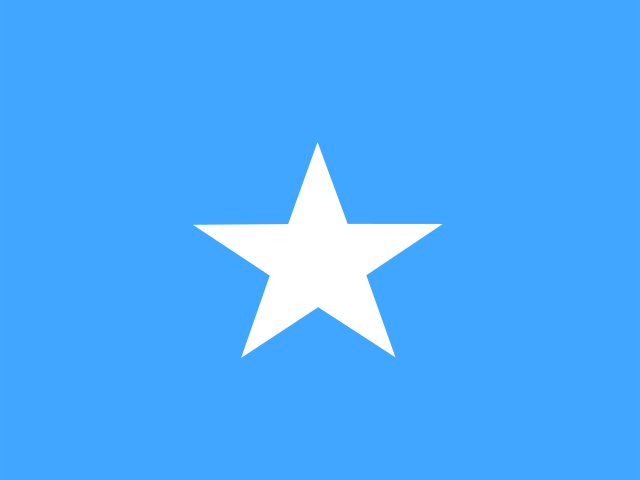
meaning: the blue field was originally influenced by the UN flag but today is said to represent the sky and the Indian Ocean; the five points of the star represent the regions in the horn of Africa where Somali people live: the former British Somaliland and Italian Somaliland (which together make up Somalia), Djibouti, Ogaden (Ethiopia), and the Northeast Province (Kenya)
National symbol(s)
leopard
National color(s)
blue, white
National anthem(s)
lyrics/music: Abdullahi QARSHE
history: adopted 2012
Government - note
regional and local governing bodies continue to exist and control various areas of the country, including the self-declared Republic of Somaliland in northwestern Somalia
Economy24
Economic overview
low-income African Horn economy; 30 years of war and instability crippled economic potential; high remittances for basic survival; new fiscal federalism approach; cleared some unsustainable debt; environmentally fragile; digitally driven urbanization efforts
Real GDP (purchasing power parity)
Real GDP (purchasing power parity) 2023: $25.747 billion (2023 est.)
Real GDP (purchasing power parity) 2022: $24.706 billion (2022 est.)
Real GDP growth rate
Real GDP growth rate 2023: 4.2% (2023 est.)
Real GDP growth rate 2022: 2.7% (2022 est.)
Real GDP per capita
Real GDP per capita 2023: $1,400 (2023 est.)
Real GDP per capita 2022: $1,400 (2022 est.)
GDP (official exchange rate)
Inflation rate (consumer prices)
Inflation rate (consumer prices) 2021: 4.6% (2021 est.)
Inflation rate (consumer prices) 2020: 4.3% (2020 est.)
GDP - composition, by end use
household consumption
government consumption
investment in fixed capital
investment in inventories
exports of goods and services
imports of goods and services
Agricultural products
Industries
light industries, including sugar refining, textiles, wireless communication
Labor force
Unemployment rate
Unemployment rate 2023: 19% (2023 est.)
Unemployment rate 2022: 19.1% (2022 est.)
Youth unemployment rate (ages 15-24)
male: 32.1% (2024 est.)
female: 37% (2024 est.)
Population below poverty line
Remittances
Remittances 2022: 17% of GDP (2022 est.)
Remittances 2021: 18.3% of GDP (2021 est.)
Public debt
Taxes and other revenues
Exports
Exports 2023: $2.164 billion (2023 est.)
Exports 2022: $1.804 billion (2022 est.)
Exports - partners
Exports - commodities
Imports
Imports 2023: $8.002 billion (2023 est.)
Imports 2022: $7.456 billion (2022 est.)
Imports - partners
Imports - commodities
Debt - external
Exchange rates
Currency
Exchange rates 2017
Exchange rates 2016
Exchange rates 2015
Exchange rates 2014
Exchange rates 2013
Energy7
Electricity access
electrification - urban areas: 76.7%
electrification - rural areas: 30.6%
Electricity
consumption: 396.792 million kWh (2023 est.)
transmission/distribution losses: 15.408 million kWh (2023 est.)
Electricity generation sources
solar: 16% of total installed capacity (2023 est.)
wind: 1.5% of total installed capacity (2023 est.)
Coal
Petroleum
Natural gas
Energy consumption per capita
Communications6
Telephones - fixed lines
subscriptions per 100 inhabitants: 1 (2022 est.) less than 1
Telephones - mobile cellular
subscriptions per 100 inhabitants: 54 (2023 est.)
Broadcast media
2 private TV stations rebroadcast Al-Jazeera and CNN; 1 state-operated TV station and 1 private TV station; state-operated Radio Mogadishu; 1 SW and roughly 10 private FM radio stations in Mogadishu; several radio stations in central and southern regions; transmissions of at least 2 international broadcasters available (2019)
Internet country code
.so
Internet users
Broadband - fixed subscriptions
subscriptions per 100 inhabitants: 1 (2022 est.)
Transportation4
Civil aircraft registration country code prefix
6O
Airports
40 (2025)
Merchant marine
by type: general cargo 1, other 3
Ports
total ports
large
medium
small
very small
ports with oil terminals
key ports
Military & Security6
Military and security forces
Ministry of Internal Security: Somali National Police (SNP, includes Coast Guard, commando unit) (2025)
note 2: Somaliland and Puntland have separate military, security, and paramilitary forces
Military expenditures
Military Expenditures 2020: 6% of GDP (2020 est.)
Military Expenditures 2019: 5.6% of GDP (2019 est.)
Military Expenditures 2018: 6% of GDP (2018 est.)
Military Expenditures 2017: 5.9% of GDP (2017 est.)
Military and security service personnel strengths
Military equipment inventories and acquisitions
Military service age and obligation
18-22 for voluntary military service for men and women in the Somali Armed Forces; compulsory service is reportedly authorized, but not currently utilized (2025)
Military - note
Turkey and the US have formed and trained SNA units, including the US-backed Danab ("Lightning") Brigade and the Turkish-trained Gorgor ("Eagle") brigades; SNA soldiers have also received training from Egypt, Eritrea, Ethiopia, the EU, Uganda, UAE, and the UK (2025)
Transnational Issues2
Refugees and internally displaced persons
IDPs: 3,869,345 (2024 est.)