Sierra Leone
Republic of Sierra Leone
Population
9.33M
Area
71,740 km²
GDP
$7.55B
GDP Per Capita
$3,100
Pop. Density
130/km²
Quick Facts
Currency
LeLeone(SLE)
Calling Code
+232
Timezone
UTC
Languages
English+more
Driving Side
right
Demonym
Sierra Leonean
Background
Continuously populated for at least 2,500 years, the area now known as Sierra Leone is covered with dense jungle that allowed the region to remain relatively protected from invading West African empires. Traders introduced Sierra Leone to Islam, which occupies a central role in Sierra Leonean culture and history. In the 17th century, the British set up a trading post near present-day Freetown. The trade originally involved timber and ivory but later expanded to enslaved people. In 1787, after the American Revolution, Sierra Leone became a destination for Black British loyalists from the new United States. When Britain abolished the slave trade in 1807, British ships delivered thousands of liberated Africans to Sierra Leone. During the 19th century, the colony gradually expanded inland.
In 1961, Sierra Leone became independent of the UK. Sierra Leone held free and fair elections in 1962 and 1967, but Siaka STEVENS -- Sierra Leone’s second prime minister -- quickly reverted to authoritarian tendencies, outlawing most political parties and ruling from 1967 to 1985. In 1991, Sierra Leonean soldiers launched a civil war against STEVENS’ ruling party. The war caused tens of thousands of deaths and displaced more than 2 million people (about one third of the population). In 1998, a Nigerian-led West African coalition military force intervened, installing Tejan KABBAH -- who was originally elected in 1996 -- as prime minister. In 2002, KABBAH officially announced the end of the war. Since 1998, Sierra Leone has conducted democratic elections dominated by the two main political parties, the Sierra Leone People’s Party (SLPP) and the All People’s Congress (APC) party. In 2018, Julius Maada BIO of the Sierra Leone People’s Party won the presidential election that saw a high voter turnout despite some allegations of voter intimidation. BIO won again in June 2023, although irregularities were noted that called into question the integrity of the results. In October 2023, the Government of Sierra Leone and the main opposition party, the All People’s Congress, signed the Agreement for National Unity to boost cooperation between political parties and begin the process of reforming the country’s electoral system.
Historical Trends
GDP (USD)
↑113.6% since 2006Population
↑53.7% since 2006Life Expectancy at Birth
Latest: 61.8 yearsData source: World Bank Open Data
Geography18
Location
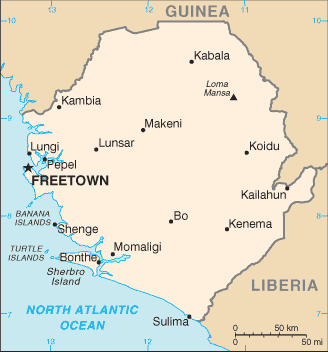
Western Africa, bordering the North Atlantic Ocean, between Guinea and Liberia
Geographic coordinates
8 30 N, 11 30 W
Map references
Africa
Area
land: 71,620 sq km
water: 120 sq km
Area - comparative
slightly smaller than South Carolina
Land boundaries
border countries: Guinea 794 km; Liberia 299 km
Coastline
402 km
Maritime claims
contiguous zone: 24 nm
exclusive economic zone: 200 nm
continental shelf: 200 nm
Climate
tropical; hot, humid; summer rainy season (May to December); winter dry season (December to April)
Terrain
coastal belt of mangrove swamps, wooded hill country, upland plateau, mountains in east
Elevation
lowest point: Atlantic Ocean 0 m
mean elevation: 279 m
Natural resources
diamonds, titanium ore, bauxite, iron ore, gold, chromite
Land use
agricultural land
agricultural land: arable land
agricultural land: permanent crops
agricultural land: permanent pasture
forest
other
Irrigated land
300 sq km (2012)
Major watersheds (area sq km)
Population distribution
population clusters are found in the lower elevations of the south and west; the northern third of the country is less populated, as shown on this population distribution map
Natural hazards
dry, sand-laden harmattan winds blow from the Sahara (December to February); sandstorms, dust storms
Geography - note
rainfall along the coast can reach 495 cm (195 in) a year, making it one of the wettest places along coastal western Africa
People & Society34
Population
male: 4,620,638
female: 4,710,565
Nationality
adjective: Sierra Leonean
Ethnic groups
Temne 35.4%, Mende 30.8%, Limba 8.8%, Kono 4.3%, Korankoh 4%, Fullah 3.8%, Mandingo 2.8%, Loko 2%, Sherbro 1.9%, Creole 1.2% (descendants of freed Jamaican slaves who were settled in the Freetown area in the late-18th century; also known as Krio), other 5% (2019 est.)
Languages
English (official, regular use limited to literate minority), Mende (principal vernacular in the south), Temne (principal vernacular in the north), Krio (English-based Creole, spoken by the descendants of freed Jamaican slaves; a first language for 10% of the population but understood by 95%)
Religions
Muslim 77.1%, Christian 22.9% (2019 est.)
Age structure
15-64 years: 57.4% (male 2,557,715/female 2,675,418)
65 years and over: 2.5% (2024 est.) (male 114,405/female 117,601)
Dependency ratios
youth dependency ratio: 68.4 (2025 est.)
elderly dependency ratio: 4.4 (2025 est.)
potential support ratio: 22.9 (2025 est.)
Median age
male: 19 years
female: 19.9 years
Population growth rate
2.24% (2025 est.)
Birth rate
30.04 births/1,000 population (2025 est.)
Death rate
8.8 deaths/1,000 population (2025 est.)
Net migration rate
1.13 migrant(s)/1,000 population (2025 est.)
Population distribution
population clusters are found in the lower elevations of the south and west; the northern third of the country is less populated, as shown on this population distribution map
Urbanization
rate of urbanization: 3.02% annual rate of change (2020-25 est.)
Major urban areas - population
1.309 million FREETOWN (capital) (2023)
Sex ratio
0-14 years: 1.02 male(s)/female
15-64 years: 0.96 male(s)/female
65 years and over: 0.97 male(s)/female
total population: 0.98 male(s)/female (2024 est.)
Mother's mean age at first birth
Maternal mortality ratio
354 deaths/100,000 live births (2023 est.)
Infant mortality rate
male: 76 deaths/1,000 live births
female: 66.2 deaths/1,000 live births
Life expectancy at birth
male: 57.8 years
female: 61 years
Total fertility rate
3.52 children born/woman (2025 est.)
Gross reproduction rate
1.73 (2025 est.)
Drinking water source
improved: urban
improved: rural
improved: total
unimproved: urban
unimproved: rural
unimproved: total
Health expenditure
Health expenditure (as % of national budget): 5.2% of national budget (2022 est.)
Physician density
0.13 physicians/1,000 population (2022)
Sanitation facility access
improved: urban
improved: rural
improved: total
unimproved: urban
unimproved: rural
unimproved: total
Obesity - adult prevalence rate
8.7% (2016)
Alcohol consumption per capita
beer: 0.17 liters of pure alcohol (2019 est.)
wine: 0.01 liters of pure alcohol (2019 est.)
spirits: 0.15 liters of pure alcohol (2019 est.)
other alcohols: 2.9 liters of pure alcohol (2019 est.)
Tobacco use
male: 14.8% (2025 est.)
female: 4.9% (2025 est.)
Children under the age of 5 years underweight
12% (2021 est.)
Currently married women (ages 15-49)
61.5% (2019 est.)
Child marriage
women married by age 18: 29.6% (2019)
men married by age 18: 4.1% (2019)
Education expenditure
Education expenditure (% national budget): 20.5% national budget (2025 est.)
Literacy
male: 54.6% (2019 est.)
female: 33.9% (2019 est.)
Government23
Country name
conventional short form: Sierra Leone
local long form: Republic of Sierra Leone
local short form: Sierra Leone
etymology: Portuguese explorer Pedro de SINTRA is usually credited with naming the country "Serra da Leao" (Lion Mountains) in 1462, but Venetian explorer Alvise CA' DA MOSTO recorded the name as "Serre-Lionne" in 1457, referring to the rumbling of thunder over the mountains
Government type
presidential republic
Capital
geographic coordinates: 8 29 N, 13 14 W
time difference: UTC 0 (5 hours ahead of Washington, DC, during Standard Time)
etymology: the name described the original settlement in 1781, which served as a haven for free-born and freed African Americans
Administrative divisions
4 provinces and 1 area*; Eastern, Northern, North Western, Southern, Western*
Legal system
mixed system of English common law and customary law
Constitution
amendment process: proposed by Parliament; passage of amendments requires at least two-thirds majority vote of Parliament in two successive readings and assent of the president of the republic; passage of amendments affecting fundamental rights and freedoms and many other constitutional sections also requires approval in a referendum with participation of at least one half of qualified voters and at least two thirds of votes cast
International law organization participation
has not submitted an ICJ jurisdiction declaration; accepts ICCt jurisdiction
Citizenship
citizenship by descent only: at least one parent or grandparent must be a citizen of Sierra Leone
dual citizenship recognized: yes
residency requirement for naturalization: 5 years
Suffrage
18 years of age; universal
Executive branch
chief of state
head of government
cabinet
election/appointment process
most recent election date
election results
2023: Julius Maada BIO reelected president in first round; percent of vote - Julius Maada BIO (SLPP) 56.2%, Samura KAMARA (APC) 41.2%, other 2.6%
2018: Julius Maada BIO elected president in second round; percent of vote - Julius Maada BIO (SLPP) 51.8%, Samura KAMARA (APC) 48.2%
expected date of next election
Legislative branch
legislature name
legislative structure
number of seats
electoral system
scope of elections
term in office
most recent election date
parties elected and seats per party
percentage of women in chamber
expected date of next election
Judicial branch
judge selection and term of office: Supreme Court chief justice and other judges of the Judicature appointed by the president on the advice of the Judicial and Legal Service Commission, a 7-member independent body of judges, presidential appointees, and the Commission chairman, and are subject to approval by Parliament; all Judicature judges serve until retirement at age 65
subordinate courts: magistrates' courts; District Appeals Court; local courts
Political parties
Sierra Leone People's Party or SLPP
Diplomatic representation in the US
chancery: 1701 19th Street NW, Washington, DC 20009-1605
telephone: [1] (202) 939-9261
FAX: [1] (202) 483-1793
email address and website:
[email protected]
https://embassyofsierraleone.net/
Diplomatic representation from the US
embassy: Southridge-Hill Station, Freetown
mailing address: 2160 Freetown Place, Washington DC 20521-2160
telephone: [232] 99 105 000
email address and website:
[email protected]
https://sl.usembassy.gov/
International organization participation
ACP, AfDB, ATMIS, AU, C, ECOWAS, EITI (compliant country), FAO, G-77, IAEA, IBRD, ICAO, ICCt, ICRM, IDA, IDB, IFAD, IFC, IFRCS, IHO (pending member), ILO, IMF, IMO, Interpol, IOC, IOM, IPU, ISO (correspondent), ITU, ITUC (NGOs), MIGA, NAM, OIC, OPCW, UN, UNAMID, UNCTAD, UNESCO, UNIDO, UNIFIL, UNISFA, UNOOSA, UNSOM, UNWTO, UPU, WCO, WFTU (NGOs), WHO, WIPO, WMO, WTO
Independence
27 April 1961 (from the UK)
National holiday
Independence Day, 27 April (1961)
Flag
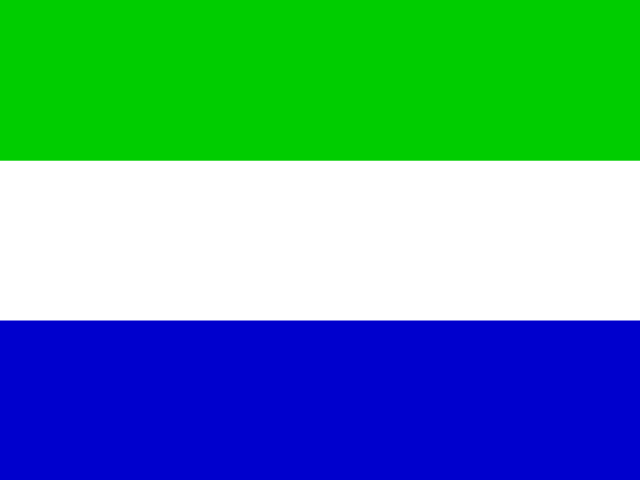
meaning: green stands for agriculture, mountains, and natural resources; white for unity and justice; and blue for the sea and the natural harbor in Freetown
National symbol(s)
lion
National color(s)
green, white, blue
National anthem(s)
lyrics/music: Clifford Nelson FYLE/John Joseph AKA
history: adopted 1961
National heritage
selected World Heritage Site locales: Gola-Tiwai Complex (n)
Economy30
Economic overview
low-income West African economy; primarily subsistent agriculture; key iron and diamond mining activities suspended; slow recovery from 1990s civil war; systemic corruption; high-risk debt; high youth unemployment; natural resource rich
Real GDP (purchasing power parity)
Real GDP (purchasing power parity) 2023: $25.7 billion (2023 est.)
Real GDP (purchasing power parity) 2022: $24.312 billion (2022 est.)
Real GDP growth rate
Real GDP growth rate 2023: 5.7% (2023 est.)
Real GDP growth rate 2022: 5.3% (2022 est.)
Real GDP per capita
Real GDP per capita 2023: $3,000 (2023 est.)
Real GDP per capita 2022: $2,900 (2022 est.)
GDP (official exchange rate)
Inflation rate (consumer prices)
Inflation rate (consumer prices) 2023: 47.6% (2023 est.)
Inflation rate (consumer prices) 2022: 27.2% (2022 est.)
GDP - composition, by sector of origin
industry: 27.3% (2024 est.)
services: 44.8% (2024 est.)
GDP - composition, by end use
household consumption
government consumption
investment in fixed capital
investment in inventories
exports of goods and services
imports of goods and services
Agricultural products
Industries
diamond mining; iron ore, rutile and bauxite mining; small-scale manufacturing (beverages, textiles, footwear)
Industrial production growth rate
Labor force
Unemployment rate
Unemployment rate 2023: 3.2% (2023 est.)
Unemployment rate 2022: 3.2% (2022 est.)
Youth unemployment rate (ages 15-24)
male: 4.8% (2024 est.)
female: 2.5% (2024 est.)
Population below poverty line
Gini Index coefficient - distribution of family income
Household income or consumption by percentage share
highest 10%: 29.4% (2018 est.)
Remittances
Remittances 2022: 4.1% of GDP (2022 est.)
Remittances 2021: 2.6% of GDP (2021 est.)
Budget
expenditures: $867 million (2019 est.)
Public debt
Current account balance
Current account balance 2022: -$452.094 million (2022 est.)
Current account balance 2021: -$522.815 million (2021 est.)
Exports
Exports 2022: $1.202 billion (2022 est.)
Exports 2021: $928.689 million (2021 est.)
Exports - partners
Exports - commodities
Imports
Imports 2022: $2.074 billion (2022 est.)
Imports 2021: $1.91 billion (2021 est.)
Imports - partners
Imports - commodities
Reserves of foreign exchange and gold
Reserves of foreign exchange and gold 2022: $624.496 million (2022 est.)
Reserves of foreign exchange and gold 2021: $945.908 million (2021 est.)
Debt - external
Exchange rates
Currency
Exchange rates 2023
Exchange rates 2022
Exchange rates 2021
Exchange rates 2020
Exchange rates 2019
Energy5
Electricity access
electrification - urban areas: 55.3%
electrification - rural areas: 5%
Electricity
consumption: 131.321 million kWh (2023 est.)
transmission/distribution losses: 81.921 million kWh (2023 est.)
Electricity generation sources
solar: 9.8% of total installed capacity (2023 est.)
hydroelectricity: 84.4% of total installed capacity (2023 est.)
biomass and waste: 2.3% of total installed capacity (2023 est.)
Petroleum
Energy consumption per capita
Communications6
Telephones - fixed lines
subscriptions per 100 inhabitants: (2022 est.) less than 1
Telephones - mobile cellular
subscriptions per 100 inhabitants: 108 (2022 est.)
Broadcast media
1 state-owned TV station; 3 private TV stations; 1 pay-TV service; 1 state-owned national radio station; about 24 private radio stations; transmissions of several international broadcasters available (2019)
Internet country code
.sl
Internet users
Broadband - fixed subscriptions
subscriptions per 100 inhabitants: (2021 est.) less than 1
Transportation5
Civil aircraft registration country code prefix
9L
Airports
8 (2025)
Heliports
3 (2025)
Merchant marine
by type: bulk carrier 33, container ship 8, general cargo 320, oil tanker 97, other 126
Ports
total ports
large
medium
small
very small
ports with oil terminals
key ports
Military & Security6
Military and security forces
Ministry of Internal Affairs: Sierra Leone Police (2025)
Military expenditures
Military Expenditures 2023: 0.6% of GDP (2023 est.)
Military Expenditures 2022: 0.6% of GDP (2022 est.)
Military Expenditures 2021: 0.3% of GDP (2021 est.)
Military Expenditures 2020: 0.3% of GDP (2020 est.)
Military and security service personnel strengths
estimated 10,000 active Armed Forces (2025)
Military equipment inventories and acquisitions
the RSLAF has a small inventory comprised of obsolescent or secondhand imported armaments (2025)
Military service age and obligation
18-25 for voluntary military service for men and women; no conscription (2025)
Military - note
the RSLAF’s origins lie in the Sierra Leone Battalion of the Royal West African Frontier Force (RWAFF), a multi-regiment force formed by the British colonial office in 1900 to garrison the West African colonies of Gold Coast (Ghana), Nigeria (Lagos and the protectorates of Northern and Southern Nigeria), Sierra Leone, and The Gambia; the RWAFF fought in both World Wars (2025)
Compare Sierra Leone
See how Sierra Leone compares to other countries side by side.
Compare Countries