
Serbia
Republic of Serbia
Population
6.65M
Area
77,474 km²
GDP
$89.08B
GDP Per Capita
$26,900
Pop. Density
86/km²
Quick Facts
Currency
дин.Serbian dinar(RSD)
Calling Code
+381
Timezone
UTC+01:00
Languages
Serbian+more
Driving Side
right
Demonym
Serbian
Background
In 1918, the Croats, Serbs, and Slovenes formed a kingdom known after 1929 as Yugoslavia. The monarchy remained in power until 1945, when the communist Partisans headed by Josip Broz (aka TITO) took control of the newly created Socialist Federal Republic of Yugoslavia (SFRY). After TITO died in 1980, communism in Yugoslavia gradually gave way to resurgent nationalism. In 1989, Slobodan MILOSEVIC became president of the Republic of Serbia, and his calls for Serbian domination led to the violent breakup of Yugoslavia along ethnic lines. In 1991, Croatia, Slovenia, and Macedonia declared independence, followed by Bosnia in 1992. The remaining republics of Serbia and Montenegro declared a new Federal Republic of Yugoslavia (FRY) in 1992, and MILOSEVIC led military campaigns to unite ethnic Serbs in neighboring republics into a "Greater Serbia." These actions ultimately failed, and international intervention led to the signing of the Dayton Accords in 1995.
In 1998, an ethnic Albanian insurgency in the formerly autonomous Serbian province of Kosovo resulted in a brutal Serbian counterinsurgency campaign. Serbia rejected a proposed international settlement, and NATO responded with a bombing campaign that forced Serbian forces to withdraw from Kosovo in June 1999. In 2003, the FRY became the State Union of Serbia and Montenegro, a loose federation of the two republics. In 2006, Montenegro seceded and declared itself an independent nation.
In 2008, Kosovo also declared independence -- an action Serbia still refuses to recognize. In 2013, Serbia and Kosovo signed the first agreement of principles governing the normalization of relations between the two countries. Additional agreements were reached in 2015 and 2023, but implementation remains incomplete. Serbia has been an official candidate for EU membership since 2012, and President Aleksandar VUCIC has promoted the ambitious goal of Serbia joining the EU by 2025.
Historical Trends
GDP (USD)
↑170.6% since 2006Population
↓11.1% since 2006Life Expectancy at Birth
Latest: 76.2 yearsData source: World Bank Open Data
Geography19
Location
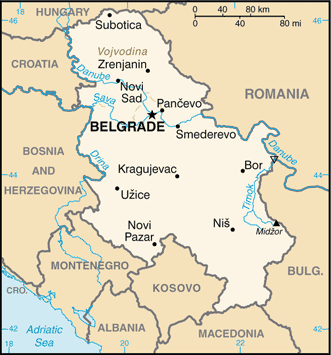
Southeastern Europe, between Macedonia and Hungary
Geographic coordinates
44 00 N, 21 00 E
Map references
Europe
Area
land: 77,474 sq km
water: 0 sq km
Area - comparative
slightly smaller than South Carolina
Land boundaries
border countries: Bosnia and Herzegovina 345 km; Bulgaria 344 km; Croatia 314 km; Hungary 164 km; Kosovo 366 km; North Macedonia 101 km; Montenegro 157 km; Romania 531 km
Coastline
0 km (landlocked)
Maritime claims
none (landlocked)
Climate
in the north, continental climate (cold winters and hot, humid summers with well-distributed rainfall); in other parts, continental and Mediterranean climate (relatively cold winters with heavy snowfall and hot, dry summers and autumns)
Terrain
extremely varied; to the north, rich fertile plains; to the east, limestone ranges and basins; to the southeast, ancient mountains and hills
Elevation
lowest point: Danube and Timok Rivers 35 m
mean elevation: 442 m
Natural resources
oil, gas, coal, iron ore, copper, zinc, antimony, chromite, gold, silver, magnesium, pyrite, limestone, marble, salt, arable land
Land use
agricultural land
agricultural land: arable land
agricultural land: permanent crops
agricultural land: permanent pasture
forest
other
Irrigated land
550 sq km (2022)
Major rivers (by length in km)
note: [s] after country name indicates river source; [m] after country name indicates river mouth
Major watersheds (area sq km)
Population distribution
a fairly even distribution throughout most of the country, with urban areas attracting larger and denser populations
Natural hazards
destructive earthquakes
Geography - note
landlocked; controls one of the major land routes from Western Europe to Turkey and the Near East
People & Society36
Population
male: 3,242,751
female: 3,409,461
Nationality
adjective: Serbian
Ethnic groups
Languages
major-language sample(s):
Knjiga svetskih činjenica, neophodan izvor osnovnih informacija. (Serbian)
The World Factbook, the indispensable source for basic information.
Religions
Serbian Orthodox 81.1%, unknown 5.3%, Islam 4.2%, Catholic 3.9%, no response 2.5%, atheist 1.1%; less than 1%: other Christians, Protestant, agnostic (2022)
Age structure
15-64 years: 65.6% (male 2,198,591/female 2,168,113)
65 years and over: 20% (2024 est.) (male 551,197/female 777,353)
Dependency ratios
youth dependency ratio: 21.9 (2024 est.)
elderly dependency ratio: 30.4 (2024 est.)
potential support ratio: 3.3 (2024 est.)
Median age
male: 42.4 years
female: 45.4 years
Population growth rate
-0.6% (2025 est.)
Birth rate
8.72 births/1,000 population (2025 est.)
Death rate
14.66 deaths/1,000 population (2025 est.)
Net migration rate
0 migrant(s)/1,000 population (2025 est.)
Population distribution
a fairly even distribution throughout most of the country, with urban areas attracting larger and denser populations
Urbanization
rate of urbanization: 0.04% annual rate of change (2020-25 est.)
Major urban areas - population
1.408 million BELGRADE (capital) (2023)
Sex ratio
0-14 years: 1.06 male(s)/female
15-64 years: 1.01 male(s)/female
65 years and over: 0.71 male(s)/female
total population: 0.95 male(s)/female (2024 est.)
Mother's mean age at first birth
Maternal mortality ratio
11 deaths/100,000 live births (2023 est.)
Infant mortality rate
male: 5.1 deaths/1,000 live births
female: 3.9 deaths/1,000 live births
Life expectancy at birth
male: 72.7 years
female: 78.1 years
Total fertility rate
1.47 children born/woman (2025 est.)
Gross reproduction rate
0.71 (2025 est.)
Drinking water source
improved: urban
improved: rural
improved: total
unimproved: urban
unimproved: rural
unimproved: total
Health expenditure
Health expenditure (as % of national budget): 13.7% of national budget (2022 est.)
Physician density
3.1 physicians/1,000 population (2022)
Hospital bed density
5.4 beds/1,000 population (2020 est.)
Sanitation facility access
improved: urban
improved: rural
improved: total
unimproved: urban
unimproved: rural
unimproved: total
Obesity - adult prevalence rate
21.5% (2016)
Alcohol consumption per capita
beer: 3.24 liters of pure alcohol (2019 est.)
wine: 1.62 liters of pure alcohol (2019 est.)
spirits: 2.37 liters of pure alcohol (2019 est.)
other alcohols: 0.22 liters of pure alcohol (2019 est.)
Tobacco use
male: 37.8% (2025 est.)
female: 34.5% (2025 est.)
Children under the age of 5 years underweight
1% (2019 est.)
Currently married women (ages 15-49)
54.3% (2022 est.)
Child marriage
women married by age 18: 5.5% (2019)
Education expenditure
Education expenditure (% national budget): 8.4% national budget (2023 est.)
Literacy
male: 99.6% (2022 est.)
female: 99.1% (2022 est.)
School life expectancy (primary to tertiary education)
male: 14 years (2022 est.)
female: 16 years (2022 est.)
Government23
Country name
conventional long form
conventional short form
local long form
local short form
former
etymology
Government type
parliamentary republic
Capital
geographic coordinates: 44 50 N, 20 30 E
time difference: UTC+1 (6 hours ahead of Washington, DC, during Standard Time)
daylight saving time: +1hr, begins last Sunday in March; ends last Sunday in October
etymology: the name comes from the Serbian words beo (white) and grad (city); it probably referred to the white stone of the city fortress
Administrative divisions
municipalities: Ada*, Aleksandrovac, Aleksinac, Alibunar*, Apatin*, Arandelovac, Arilje, Babusnica, Bac*, Backa Palanka*, Backa Topola*, Backi Petrovac*, Bajina Basta, Batocina, Becej*, Bela Crkva*, Bela Palanka, Beocin*, Blace, Bogatic, Bojnik, Boljevac, Bosilegrad, Brus, Bujanovac, Cajetina, Cicevac, Coka*, Crna Trava, Cuprija, Despotovac, Dimitrov, Doljevac, Gadzin Han, Golubac, Gornji Milanovac, Indija*, Irig*, Ivanjica, Kanjiza*, Kladovo, Knic, Knjazevac, Koceljeva, Kosjeric, Kovacica*, Kovin*, Krupanj, Kucevo, Kula*, Kursumlija, Lajkovac, Lapovo, Lebane, Ljig, Ljubovija, Lucani, Majdanpek, Mali Idos*, Mali Zvornik, Malo Crnice, Medveda, Merosina, Mionica, Negotin, Nova Crnja*, Nova Varos, Novi Becej*, Novi Knezevac*, Odzaci*, Opovo*, Osecina, Paracin, Pecinci*, Petrovac na Mlavi, Plandiste*, Pozega, Presevo, Priboj, Prijepolje, Raca, Raska, Razanj, Rekovac, Ruma*, Secanj*, Senta*, Sid*, Sjenica, Smederevska Palanka, Sokobanja, Srbobran*, Sremski Karlovci*, Stara Pazova*, Surdulica, Svilajnac, Svrljig, Temerin*, Titel*, Topola, Trgoviste, Trstenik, Tutin, Ub, Varvarin, Velika Plana, Veliko Gradiste, Vladicin Han, Vladimirci, Vlasotince, Vrbas*, Vrnjacka Banja, Zabalj*, Zabari, Zagubica, Zitiste*, Zitorada
cities: Beograd (Belgrade), Bor, Cacak, Jagodina, Kikinda*, Kragujevac, Kraljevo, Krusevac, Leskovac, Loznica, Nis, Novi Pazar, Novi Sad*, Pancevo*, Pirot, Pozarevac, Prokuplje, Sabac, Smederevo, Sombor*, Sremska Mitrovica*, Subotica*, Uzice, Valjevo, Vranje, Vrsac*, Zajecar, Zrenjanin*
Legal system
civil law system
Constitution
amendment process: proposed by at least one third of deputies in the National Assembly, by the president of the republic, by the government, or by petition of at least 150,000 voters; passage of proposals and draft amendments each requires at least two-thirds majority vote in the Assembly; amendments to constitutional articles including the preamble, constitutional principles, and human and minority rights and freedoms also require passage by simple majority vote in a referendum
International law organization participation
has not submitted an ICJ jurisdiction declaration; accepts ICCt jurisdiction
Citizenship
citizenship by descent only: at least one parent must be a citizen of Serbia
dual citizenship recognized: yes
residency requirement for naturalization: 3 years
Suffrage
18 years of age, 16 if employed; universal
Executive branch
chief of state
head of government
cabinet
election/appointment process
most recent election date
election results
2022: Aleksandar VUCIC reelected in first round; percent of vote - Aleksandar VUCIC (SNS) 60%, Zdravko PONOS (US) 18.9%, Milos JOVANOVIC (NADA) 6.1%, Bosko OBRADOVIC (Dveri-POKS) 4.5%, Milica DJURDJEVIC STAMENKOVSKI (SSZ) 4.3%, other 6.2%
2017: Aleksandar VUCIC elected president in first round; percent of vote - Aleksandar VUCIC (SNS) 55.1%, Sasa JANKOVIC (independent) 16.4%, Luka MAKSIMOVIC (independent) 9.4%, Vuk JEREMIC (independent) 5.7%, Vojislav SESELJ (SRS) 4.5%, other 7.3%, invalid/blank 1.6%; Prime Minister Ana BRNABIC reelected by the National Assembly on 5 October 2020; National Assembly vote - NA
expected date of next election
Legislative branch
legislature name
legislative structure
number of seats
electoral system
scope of elections
term in office
most recent election date
parties elected and seats per party
percentage of women in chamber
expected date of next election
Judicial branch
judge selection and term of office: Supreme Court justices proposed by the High Judicial Council (HJC), an 11-member independent body consisting of 8 judges elected by the National Assembly and 3 ex-officio members; justices appointed by the National Assembly; Constitutional Court judges elected - 5 each by the National Assembly, the president, and the Supreme Court of Cassation; initial appointment of Supreme Court judges by the HJC is 3 years and beyond that period tenure is permanent; Constitutional Court judges elected for 9-year terms
subordinate courts: basic courts, higher courts, appellate courts; courts of special jurisdiction include the Administrative Court, commercial courts, and misdemeanor courts
Political parties
Democratic Alliance of Croats in Vojvodina or DSHV
Democratic Party or DS
Ecological Uprising or EU
Green - Left Front or ZLF
Greens of Serbia or ZS
Justice and Reconciliation Party or SPP (formerly Bosniak Democratic Union of Sandzak or BDZS)
Movement for Reversal or PZP
Movement for the Restoration of the Kingdom of Serbia or POKS
Movement of Free Citizens or PSG
Movement of Socialists or PS
National Democratic Alternative or NADA (electoral coalition includes NDSS and POKS)
New Communist Party of Yugoslavia or NKPJ
New Democratic Party of Serbia or NDSS or New DSS (formerly Democratic Party of Serbia or DSS)
New Face of Serbia or NLS
Party of Democratic Action of the Sandzak or SDAS
Party of Freedom and Justice or SSP
Party of United Pensioners, Farmers, and Proletarians of Serbia – Solidarity and Justice or PUPS - Solidarity and Justice (formerly Party of United Pensioners of Serbia or PUPS)
People's Movement of Serbia or NPS
People's Movement of Serbs from Kosovo and Metohija or Fatherland
People's Peasant Party or NSS
Political Battle of the Albanians Continues
Russian Party or RS
Serbia Against Violence or SPN (electoral coalition includes DS, SSP, ZLF, Zajedno, NPS, PSG, EU, PZP, USS Sloga, NLS, Fatherland)
Serbia Must Not Stop (electoral coalitions includes SNS, SDPS, PUPS, PSS, SNP, SPO, PS, NSS, USS)
Serbian People's Party or SNP
Serbian Progressive Party or SNS
Serbian Renewal Movement or SPO
Social Democratic Party of Serbia or SDPS
Socialist Party of Serbia or SPS
Strength of Serbia or PSS
Together or ZAJEDNO
United Peasant Party or USS
United Serbia or JS
United Trade Unions of Serbia "Sloga" or USS Sloga
We - The Voice from the People or MI-GIN
Diplomatic representation in the US
chief of mission
chancery
telephone
FAX
email address and website
consulate(s) general
Diplomatic representation from the US
chief of mission
embassy
mailing address
telephone
FAX
email address and website
International organization participation
Independence
5 June 2006 (from the State Union of Serbia and Montenegro); notable earlier dates: 1217 (Serbian Kingdom established); 16 April 1346 (Serbian Empire established); 13 July 1878 (Congress of Berlin recognizes Serbian independence); 1 December 1918 (Kingdom of Serbs, Croats, and Slovenes established, later known as Yugoslavia)
National holiday
Statehood Day, 15 February (1835), the day the first constitution of the country was adopted
Flag
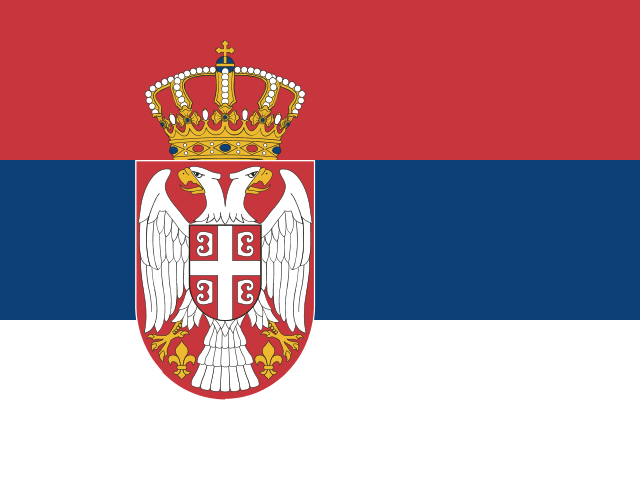
meaning: red, blue, and white are the pan-Slav colors that represent freedom and revolutionary ideals; the eagle on a red shield represents the government; the smaller shield represents the country; the meaning and origin of the curved white symbols in each quarter are not clear
National symbol(s)
white double-headed eagle
National color(s)
red, blue, white
National anthem(s)
lyrics/music: Jovan DORDEVIC/Davorin JENKO
history: adopted 1904; song originally written as part of a play in 1872, and the Serbian people have used it as an anthem in the 20th and 21st centuries
National heritage
selected World Heritage Site locales: Stari Ras and Sopoćani; Studenica Monastery; Gamzigrad-Romuliana, Palace of Galerius; Stećci Medieval Tombstone Graveyards
Economy32
Economic overview
upper middle-income Balkan economy; current EU accession candidate; hit by COVID-19; pursuing green growth development; manageable public debt; new anticorruption efforts; falling unemployment; historic Russian relations; energy import-dependent
Real GDP (purchasing power parity)
Real GDP (purchasing power parity) 2023: $170.482 billion (2023 est.)
Real GDP (purchasing power parity) 2022: $164.166 billion (2022 est.)
Real GDP growth rate
Real GDP growth rate 2023: 3.8% (2023 est.)
Real GDP growth rate 2022: 2.6% (2022 est.)
Real GDP per capita
Real GDP per capita 2023: $25,700 (2023 est.)
Real GDP per capita 2022: $24,600 (2022 est.)
GDP (official exchange rate)
Inflation rate (consumer prices)
Inflation rate (consumer prices) 2023: 12.4% (2023 est.)
Inflation rate (consumer prices) 2022: 12% (2022 est.)
GDP - composition, by sector of origin
industry: 23.3% (2024 est.)
services: 58.5% (2024 est.)
GDP - composition, by end use
household consumption
government consumption
investment in fixed capital
investment in inventories
exports of goods and services
imports of goods and services
Agricultural products
Industries
automobiles, base metals, furniture, food processing, machinery, chemicals, sugar, tires, clothes, pharmaceuticals
Industrial production growth rate
Labor force
Unemployment rate
Unemployment rate 2023: 8.3% (2023 est.)
Unemployment rate 2022: 8.5% (2022 est.)
Youth unemployment rate (ages 15-24)
male: 21.8% (2024 est.)
female: 24.1% (2024 est.)
Population below poverty line
Gini Index coefficient - distribution of family income
Average household expenditures
on alcohol and tobacco: 7.8% of household expenditures (2023 est.)
Household income or consumption by percentage share
highest 10%: 24.7% (2022 est.)
Remittances
Remittances 2022: 8.5% of GDP (2022 est.)
Remittances 2021: 6.9% of GDP (2021 est.)
Budget
expenditures: $28.12 billion (2022 est.)
Public debt
Taxes and other revenues
Current account balance
Current account balance 2022: -$4.457 billion (2022 est.)
Current account balance 2021: -$2.654 billion (2021 est.)
Exports
Exports 2022: $39.905 billion (2022 est.)
Exports 2021: $34.035 billion (2021 est.)
Exports - partners
Exports - commodities
Imports
Imports 2022: $47.395 billion (2022 est.)
Imports 2021: $39.476 billion (2021 est.)
Imports - partners
Imports - commodities
Reserves of foreign exchange and gold
Reserves of foreign exchange and gold 2023: $27.569 billion (2023 est.)
Reserves of foreign exchange and gold 2022: $20.68 billion (2022 est.)
Debt - external
Exchange rates
Currency
Exchange rates 2024
Exchange rates 2023
Exchange rates 2022
Exchange rates 2021
Exchange rates 2020
Energy7
Electricity access
Electricity
consumption: 34.413 billion kWh (2023 est.)
exports: 7.351 billion kWh (2023 est.)
imports: 5.395 billion kWh (2023 est.)
transmission/distribution losses: 4.881 billion kWh (2023 est.)
Electricity generation sources
solar: 1% of total installed capacity (2023 est.)
wind: 2.6% of total installed capacity (2023 est.)
hydroelectricity: 30.7% of total installed capacity (2023 est.)
biomass and waste: 0.6% of total installed capacity (2023 est.)
Coal
consumption: 37.828 million metric tons (2023 est.)
exports: 16,000 metric tons (2023 est.)
imports: 4.542 million metric tons (2023 est.)
proven reserves: 7.112 billion metric tons (2023 est.)
Petroleum
refined petroleum consumption: 88,000 bbl/day (2023 est.)
crude oil estimated reserves: 77.5 million barrels (2021 est.)
Natural gas
consumption: 2.886 billion cubic meters (2023 est.)
imports: 2.471 billion cubic meters (2023 est.)
proven reserves: 48.139 billion cubic meters (2021 est.)
Energy consumption per capita
Communications5
Telephones - fixed lines
subscriptions per 100 inhabitants: 37 (2023 est.)
Telephones - mobile cellular
subscriptions per 100 inhabitants: 124 (2021 est.)
Internet country code
.rs
Internet users
Broadband - fixed subscriptions
subscriptions per 100 inhabitants: 31 (2023 est.)
Transportation4
Civil aircraft registration country code prefix
YU
Airports
46 (2025)
Heliports
11 (2025)
Railways
Military & Security7
Military and security forces
Serbian Ministry of Internal Affairs: Police Directorate (2025)
Military expenditures
Military Expenditures 2023: 2.4% of GDP (2023 est.)
Military Expenditures 2022: 2.2% of GDP (2022 est.)
Military Expenditures 2021: 2.2% of GDP (2021 est.)
Military Expenditures 2020: 2% of GDP (2020 est.)
Military and security service personnel strengths
approximately 25,000 active-duty Armed Forces (15,000 Land Forces; 5,000 Air/Air Defense; 5,000 other, including Serbian Guard) (2025)
Military equipment inventories and acquisitions
the military's inventory consists of a mix of Soviet/Cold War-era and some more modern weapons systems from suppliers such as China, France, and Russia; Serbia has a defense industry focused on armored vehicles, artillery systems, and munitions (2025)
Military service age and obligation
Military deployments
180 Lebanon (UNIFIL) (2025)
Military - note
the modern Serbian military was established in 2006 but traces its origins back through World War II, World War I, the Balkan Wars of 1912-1913, and the Bulgarian-Serb War of 1885 to the First (1804-1813) and Second (1815-1817) Uprisings against the Ottoman Empire (2025)
Transnational Issues1
Refugees and internally displaced persons
IDPs: 194,171 (2024 est.)
stateless persons: 1,715 (2024 est.)