
Romania
Population
18.15M
Area
238,391 km²
GDP
$382.77B
GDP Per Capita
$40,600
Pop. Density
76/km²
Quick Facts
Currency
leiRomanian leu(RON)
Calling Code
+40
Timezone
UTC+02:00
Languages
Romanian+more
Driving Side
right
Demonym
Romanian
Background
Historical Trends
GDP (USD)
↑213.5% since 2006Population
↓10.1% since 2006Life Expectancy at Birth
Latest: 76.6 yearsData source: World Bank Open Data
Geography19
Location
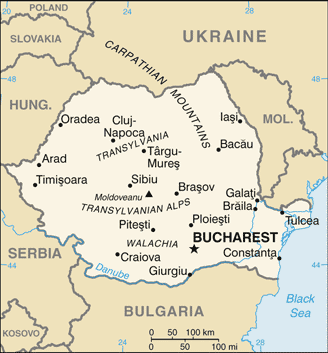
Southeastern Europe, bordering the Black Sea, between Bulgaria and Ukraine
Geographic coordinates
46 00 N, 25 00 E
Map references
Europe
Area
land: 229,891 sq km
water: 8,500 sq km
Area - comparative
twice the size of Pennsylvania; slightly smaller than Oregon
Land boundaries
border countries: Bulgaria 605 km; Hungary 424 km; Moldova 683 km; Serbia 531 km; Ukraine 601 km
Coastline
225 km
Maritime claims
contiguous zone: 24 nm
exclusive economic zone: 200 nm
continental shelf: 200-m depth or to the depth of exploitation
Climate
temperate; cold, cloudy winters with frequent snow and fog; sunny summers with frequent showers and thunderstorms
Terrain
central Transylvanian Basin is separated from the Moldavian Plateau on the east by the Eastern Carpathian Mountains and separated from the Walachian Plain on the south by the Transylvanian Alps
Elevation
lowest point: Black Sea 0 m
mean elevation: 414 m
Natural resources
petroleum (reserves declining), timber, natural gas, coal, iron ore, salt, arable land, hydropower
Land use
agricultural land
agricultural land: arable land
agricultural land: permanent crops
agricultural land: permanent pasture
forest
other
Irrigated land
5,280 sq km (2022)
Major rivers (by length in km)
note: [s] after country name indicates river source; [m] after country name indicates river mouth
Major watersheds (area sq km)
Population distribution
urbanization is not particularly high, and the population distribution is fairly even throughout most of the country, with urban areas attracting larger and denser populations
Natural hazards
earthquakes, most severe in south and southwest; geologic structure and climate promote landslides
Geography - note
controls the most easily traversable land route between the Balkans, Moldova, and Ukraine; the Carpathian Mountains dominate the center of the country, and the Danube River forms much of the southern boundary with Serbia and Bulgaria
People & Society35
Population
male: 8,747,795
female: 9,400,360
Nationality
adjective: Romanian
Ethnic groups
Languages
major-language sample(s):
Cartea informativa a lumii, sursa indispensabila pentru informatii de baza. (Romanian)
The World Factbook, the indispensable source for basic information.
Religions
Age structure
15-64 years: 62% (male 5,618,366/female 5,632,718)
65 years and over: 22.6% (2024 est.) (male 1,688,070/female 2,405,338)
Dependency ratios
youth dependency ratio: 24.9 (2024 est.)
elderly dependency ratio: 36.4 (2024 est.)
potential support ratio: 2.7 (2024 est.)
Median age
male: 44 years
female: 46.9 years
Population growth rate
-0.86% (2025 est.)
Birth rate
8.45 births/1,000 population (2025 est.)
Death rate
14.28 deaths/1,000 population (2025 est.)
Net migration rate
-2.81 migrant(s)/1,000 population (2025 est.)
Population distribution
urbanization is not particularly high, and the population distribution is fairly even throughout most of the country, with urban areas attracting larger and denser populations
Urbanization
rate of urbanization: -0.15% annual rate of change (2020-25 est.)
Major urban areas - population
1.776 million BUCHAREST (capital) (2023)
Sex ratio
0-14 years: 1.06 male(s)/female
15-64 years: 1 male(s)/female
65 years and over: 0.7 male(s)/female
total population: 0.93 male(s)/female (2024 est.)
Mother's mean age at first birth
27.1 years (2020 est.)
Maternal mortality ratio
12 deaths/100,000 live births (2023 est.)
Infant mortality rate
male: 5.8 deaths/1,000 live births
female: 5.2 deaths/1,000 live births
Life expectancy at birth
male: 73.4 years
female: 80.5 years
Total fertility rate
1.63 children born/woman (2025 est.)
Gross reproduction rate
0.79 (2025 est.)
Drinking water source
improved: urban
improved: rural
improved: total
unimproved: urban
unimproved: rural
unimproved: total
Health expenditure
Health expenditure (as % of national budget): 11.2% of national budget (2022 est.)
Physician density
3.63 physicians/1,000 population (2022)
Hospital bed density
7.1 beds/1,000 population (2020 est.)
Sanitation facility access
improved: urban
improved: rural
improved: total
unimproved: urban
unimproved: rural
unimproved: total
Obesity - adult prevalence rate
22.5% (2016)
Alcohol consumption per capita
beer: 5.33 liters of pure alcohol (2019 est.)
wine: 3.38 liters of pure alcohol (2019 est.)
spirits: 2.25 liters of pure alcohol (2019 est.)
other alcohols: 0 liters of pure alcohol (2019 est.)
Tobacco use
male: 36.2% (2025 est.)
female: 17.9% (2025 est.)
Currently married women (ages 15-49)
56% (2021 est.)
Child marriage
women married by age 18: 6.9% (2021)
Education expenditure
Education expenditure (% national budget): 8.8% national budget (2022 est.)
Literacy
male: 99% (2021 est.)
female: 99.3% (2021 est.)
School life expectancy (primary to tertiary education)
male: 13 years (2023 est.)
female: 14 years (2023 est.)
Government25
Country name
conventional long form
conventional short form
local long form
local short form
former
etymology
Government type
semi-presidential republic
Capital
geographic coordinates: 44 26 N, 26 06 E
time difference: UTC+2 (7 hours ahead of Washington, DC, during Standard Time)
daylight saving time: +1hr, begins last Sunday in March; ends last Sunday in October
etymology: the name is said to come from a shepherd named Bucur who is reputed to have founded the town in 1457, but a settlement probably already existed on the site; the name may come from the personal name of an early landowner
Administrative divisions
Legal system
civil law system
Constitution
amendment process: initiated by the president of Romania through a proposal by the government, by at least one fourth of deputies or senators in Parliament, or by petition of eligible voters representing at least half of Romania’s counties; passage requires at least two-thirds majority vote by both chambers or – if mediation is required - by three-fourths majority vote in a joint session, followed by approval in a referendum; articles, including those on national sovereignty, form of government, political pluralism, and fundamental rights and freedoms cannot be amended
International law organization participation
accepts compulsory ICJ jurisdiction with reservations; accepts ICCt jurisdiction
Citizenship
citizenship by descent only: at least one parent must be a citizen of Romania
dual citizenship recognized: yes
residency requirement for naturalization: 5 years
Suffrage
18 years of age; universal
Executive branch
chief of state
head of government
cabinet
election/appointment process
most recent election date
election results
2025: Nicușor DAN elected president in runoff; percent of vote - Nicușor DAN (unaffiliated) 53.6%, George SIMION (AUR) 46.4%
2019: Klaus IOHANNIS reelected president in second round; percent of vote - Klaus IOHANNIS (PNL) 66.1%, Viorica DANCILA (PSD) 33.9%
expected date of next election
Legislative branch
legislative structure: bicameral
Legislative branch - lower chamber
chamber name
number of seats
electoral system
scope of elections
term in office
most recent election date
parties elected and seats per party
percentage of women in chamber
expected date of next election
Legislative branch - upper chamber
chamber name
number of seats
electoral system
scope of elections
term in office
most recent election date
parties elected and seats per party
percentage of women in chamber
expected date of next election
Judicial branch
judge selection and term of office: High Court of Cassation and Justice judges appointed by the president upon nomination by the Superior Council of Magistracy, a 19-member body of judges, prosecutors, and law specialists; judges appointed for 6-year renewable terms; Constitutional Court members - 6 elected by Parliament and 3 appointed by the president; members serve 9-year, nonrenewable terms
subordinate courts: Courts of Appeal; regional tribunals; first instance courts; military and arbitration courts
Political parties
Alliance for the Unity of Romanians or AUR
Christian-Democratic National Peasants' Party or PNT-CD
Civic Hungarian Party
Democratic Union of Hungarians in Romania or UDMR
Ecologist Party of Romania or PER
Force of the Right or FD
Greater Romania Party or PRM
Green Party
National Liberal Party or PNL
Popular Movement Party or PMP
PRO Romania or PRO
Romanian Nationhood Party or PNR
Save Romania Union Party or USR
Social Democratic Party or PSD
Social Liberal Humanist Party or PUSL (formerly Humanist Power Party (Social-Liberal) or PPU-SL)
S.O.S. Romania
The Right Alternative or AD
United Romania Party or PRU
We are Renewing the European Project in Romania or REPER
Diplomatic representation in the US
chief of mission
chancery
telephone
FAX
email address and website
consulate(s) general
Diplomatic representation from the US
chief of mission
embassy
mailing address
telephone
FAX
email address and website
International organization participation
Australia Group, BIS, BSEC, CBSS (observer), CD, CE, CEI, EAPC, EBRD, ECB, EIB, ESA, EU, FAO, G-9, IAEA, IBRD, ICAO, ICC (national committees), ICCt, ICRM, IDA, IFAD, IFC, IFRCS, IHO, ILO, IMF, IMO, IMSO, Interpol, IOC, IOM, IPU, ISO, ITSO, ITU, ITUC (NGOs), LAIA (observer), MIGA, MONUSCO, NATO, NSG, OAS (observer), OIF, OPCW, OSCE, PCA, SELEC, UN, UNCTAD, UNESCO, UNHCR, UNIDO, Union Latina, UNMIL, UNMISS, UNOCI, UNOOSA,UNWTO, UPU, Wassenaar Arrangement, WCO, WFTU (NGOs), WHO, WIPO, WMO, WTO, ZC
Independence
9 May 1877 (independence proclaimed from the Ottoman Empire; 13 July 1878 (independence recognized by the Treaty of Berlin); 26 March 1881 (kingdom proclaimed); 30 December 1947 (republic proclaimed)
National holiday
Unification Day (unification of Romania and Transylvania), 1 December (1918)
Flag
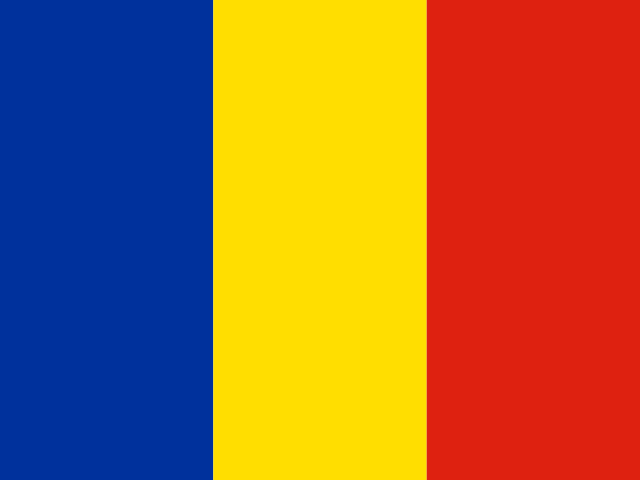
meaning: the colors come from the principalities of Walachia (red and yellow) and Moldavia (red and blue), which united in 1862 to form Romania
history: modeled on the French flag; the national coat of arms that used to be centered on the yellow band has been removed
National symbol(s)
golden eagle
National color(s)
blue, yellow, red
National anthem(s)
lyrics/music: Andrei MURESIANU/Anton PANN
history: adopted 1990; the anthem was written during the 1848 Revolution
National heritage
selected World Heritage Site locales: Danube Delta (n); Churches of Moldavia (c); Monastery of Horezu (c); Villages with Fortified Churches in Transylvania (c); Dacian Fortresses of the Orastie Mountains (c); Historic Center of Sighişoara (c); Wooden Churches of Maramureş (c); Ancient and Primeval Beech Forests of the Carpathians and Other Regions of Europe (n); Roșia Montană Mining Landscape (c); Brâncuși Monumental Ensemble of Târgu Jiu (c); Frontiers of the Roman Empire – Dacia (c)
Economy31
Economic overview
high-income, EU-member economy; euro membership delayed over macroeconomic indicators; persistent inflation, but consumption and EU-funded investments driving recovery; skilled labor shortage; high public debt and budget deficit; challenges include fiscal sustainability and political instability
Real GDP (purchasing power parity)
Real GDP (purchasing power parity) 2023: $768.126 billion (2023 est.)
Real GDP (purchasing power parity) 2022: $750.091 billion (2022 est.)
Real GDP growth rate
Real GDP growth rate 2023: 2.4% (2023 est.)
Real GDP growth rate 2022: 4% (2022 est.)
Real GDP per capita
Real GDP per capita 2023: $40,300 (2023 est.)
Real GDP per capita 2022: $39,400 (2022 est.)
GDP (official exchange rate)
Inflation rate (consumer prices)
Inflation rate (consumer prices) 2023: 10.4% (2023 est.)
Inflation rate (consumer prices) 2022: 13.8% (2022 est.)
GDP - composition, by sector of origin
industry: 25% (2024 est.)
services: 62.5% (2024 est.)
GDP - composition, by end use
household consumption
government consumption
investment in fixed capital
investment in inventories
exports of goods and services
imports of goods and services
Agricultural products
Industries
electric machinery and equipment, auto assembly, textiles and footwear, light machinery, metallurgy, chemicals, food processing, petroleum refining, mining, timber, construction materials
Industrial production growth rate
Labor force
Unemployment rate
Unemployment rate 2023: 5.6% (2023 est.)
Unemployment rate 2022: 5.7% (2022 est.)
Youth unemployment rate (ages 15-24)
male: 21.1% (2024 est.)
female: 21.8% (2024 est.)
Population below poverty line
Gini Index coefficient - distribution of family income
Average household expenditures
on alcohol and tobacco: 6.1% of household expenditures (2023 est.)
Household income or consumption by percentage share
highest 10%: 22.6% (2022 est.)
Remittances
Remittances 2023: 2.8% of GDP (2023 est.)
Remittances 2022: 3% of GDP (2022 est.)
Budget
expenditures: $112.799 billion (2022 est.)
Public debt
Taxes and other revenues
Current account balance
Current account balance 2023: -$24.461 billion (2023 est.)
Current account balance 2022: -$27.326 billion (2022 est.)
Exports
Exports 2023: $136.488 billion (2023 est.)
Exports 2022: $129.286 billion (2022 est.)
Exports - partners
Exports - commodities
Imports
Imports 2023: $153.427 billion (2023 est.)
Imports 2022: $149.209 billion (2022 est.)
Imports - partners
Imports - commodities
Reserves of foreign exchange and gold
Reserves of foreign exchange and gold 2023: $73 billion (2023 est.)
Reserves of foreign exchange and gold 2022: $55.81 billion (2022 est.)
Exchange rates
Currency
Exchange rates 2024
Exchange rates 2023
Exchange rates 2022
Exchange rates 2021
Exchange rates 2020
Energy8
Electricity access
Electricity
consumption: 48.73 billion kWh (2023 est.)
exports: 13.106 billion kWh (2023 est.)
imports: 10.088 billion kWh (2023 est.)
transmission/distribution losses: 5.817 billion kWh (2023 est.)
Electricity generation sources
fossil fuels
nuclear
solar
wind
hydroelectricity
biomass and waste
Nuclear energy
Net capacity of operational nuclear reactors: 1.3GW (2025 est.)
Percent of total electricity production: 18.9% (2023 est.)
Coal
consumption: 15.533 million metric tons (2023 est.)
exports: 290,000 metric tons (2023 est.)
imports: 736,000 metric tons (2023 est.)
proven reserves: 291 million metric tons (2023 est.)
Petroleum
refined petroleum consumption: 220,000 bbl/day (2023 est.)
crude oil estimated reserves: 600 million barrels (2021 est.)
Natural gas
consumption: 9.395 billion cubic meters (2023 est.)
exports: 2.231 billion cubic meters (2023 est.)
imports: 2.793 billion cubic meters (2023 est.)
proven reserves: 105.48 billion cubic meters (2021 est.)
Energy consumption per capita
Communications6
Telephones - fixed lines
subscriptions per 100 inhabitants: 10 (2023 est.)
Telephones - mobile cellular
subscriptions per 100 inhabitants: 118 (2022 est.)
Broadcast media
a mixture of public and private TV stations; 7 public (2 national, 5 regional) and 187 private TV stations using terrestrial broadcasting, plus 11 public and 86 private TV stations using satellite broadcasting; state-owned public radio broadcaster operates 4 national networks, as well as regional and local stations; 502 private radio stations using terrestrial broadcasting, and 26 using satellite broadcasting
Internet country code
.ro
Internet users
Broadband - fixed subscriptions
subscriptions per 100 inhabitants: 35 (2023 est.)
Transportation6
Civil aircraft registration country code prefix
YR
Airports
103 (2025)
Heliports
24 (2025)
Railways
Merchant marine
by type: general cargo 9, oil tanker 7, other 111
Ports
total ports
large
medium
small
very small
ports with oil terminals
key ports
Military & Security7
Military and security forces
Ministry of Internal Affairs: Romanian Police, Romanian Gendarmerie, Romanian Border Police (2025)
Military expenditures
Military Expenditures 2024: 2.2% of GDP (2024 est.)
Military Expenditures 2023: 1.6% of GDP (2023 est.)
Military Expenditures 2022: 1.8% of GDP (2022 est.)
Military Expenditures 2021: 1.9% of GDP (2021 est.)
Military and security service personnel strengths
Military equipment inventories and acquisitions
the military's inventory includes a considerable amount of Soviet-era and older domestically produced weapons systems, although in recent years Romania has launched an effort to acquire more modern and NATO-standard equipment from European countries and the US, including aircraft and armored vehicles (2025)
Military service age and obligation
Military deployments
470 Bosnia Herzegovina (EUFOR); 200 Kosovo (KFOR/NATO); up to 120 Poland (NATO); Romania also has small numbers of military personnel deployed on other international missions under the EU, NATO, and UN (2025)
Military - note
Romania joined NATO in 2004, and its membership forms a key pillar of the country’s defense policy; it hosts a NATO multinational divisional headquarters (Multinational Division Southeast) and a French-led ground force battlegroup as part of NATO's Enhanced Forward Presence initiative in the southeastern part of the Alliance, which came about in response to Russia’s 2022 invasion of Ukraine; NATO allies have also sent detachments of fighters to augment the Romanian Air Force since 2014 because of aggressive Russian activity in the Black Sea region; the Romanian military trains with NATO and its member states and has participated in NATO- and EU-led multinational missions in Bosnia and Herzegovina, Kosovo, and Poland; it also participates in UN peacekeeping missions (2025)
Transnational Issues1
Refugees and internally displaced persons
stateless persons: 297 (2024 est.)