Poland
Republic of Poland
Population
38.75M
Area
312,685 km²
GDP
$914.70B
GDP Per Capita
$45,100
Pop. Density
124/km²
Quick Facts
Currency
złPolish złoty(PLN)
Calling Code
+48
Timezone
UTC+01:00
Languages
Polish+more
Driving Side
right
Demonym
Polish
Background
Historical Trends
GDP (USD)
↑165.3% since 2006Population
↓4.1% since 2006Life Expectancy at Birth
Latest: 78.5 yearsData source: World Bank Open Data
Geography20
Location
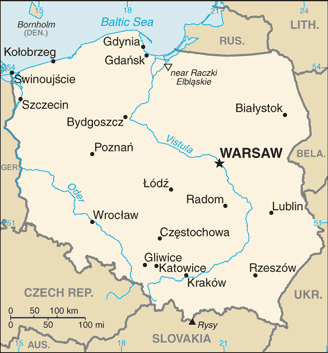
Central Europe, east of Germany
Geographic coordinates
52 00 N, 20 00 E
Map references
Europe
Area
land: 304,255 sq km
water: 8,430 sq km
Area - comparative
about twice the size of Georgia; slightly smaller than New Mexico
Land boundaries
border countries: Belarus 375 km; Czechia 699 km; Germany 467 km; Lithuania 100 km, Russia (Kaliningrad Oblast) 209 km; Slovakia 517 km; Ukraine 498 km
Coastline
440 km
Maritime claims
exclusive economic zone: defined by international treaties
Climate
temperate with cold, cloudy, moderately severe winters with frequent precipitation; mild summers with frequent showers and thundershowers
Terrain
mostly flat plain; mountains along southern border
Elevation
lowest point: near Raczki Elblaskie -2 m
mean elevation: 173 m
Natural resources
coal, sulfur, copper, natural gas, silver, lead, salt, amber, arable land
Land use
agricultural land
agricultural land: arable land
agricultural land: permanent crops
agricultural land: permanent pasture
forest
other
Irrigated land
1,327 sq km (2016)
Major lakes (area sq km)
Major rivers (by length in km)
note: longest river in Poland
Major watersheds (area sq km)
Population distribution
population concentrated in the southern area around Krakow and the central area around Warsaw and Lodz, with an extension to the northern coastal city of Gdansk
Natural hazards
flooding
Geography - note
historically an area of conflict because of flat terrain and the lack of natural barriers on the North European Plain
People & Society34
Population
male: 18,441,415
female: 20,304,895
Nationality
adjective: Polish
Ethnic groups
Languages
major-language sample(s):
Księga Faktów Świata, niezbędne źródło podstawowych informacji. (Polish)
The World Factbook, the indispensable source for basic information.
Religions
Roman Catholic 70.7%, refused to answer 20.9%, no religion 6.9%; less than 1 percent: Orthodox, Jehovah Witness, Evangelic of Augsburg, Greek Catholic, Pentecostal, other Protestant, not stated, old Catholic Mariavite Church, other Christians, Islam, Buddhist, Polish Catholic Church, other, Baptist Union of Poland, Pagan, Seventh Day Adventist, Hindu, other Catholic (2021 est.)
Age structure
15-64 years: 65.9% (male 12,513,402/female 13,036,977)
65 years and over: 19.8% (2024 est.) (male 3,097,965/female 4,591,618)
Dependency ratios
youth dependency ratio: 21.6 (2024 est.)
elderly dependency ratio: 30.1 (2024 est.)
potential support ratio: 3.3 (2024 est.)
Median age
male: 41.5 years
female: 44.3 years
Population growth rate
-0.98% (2025 est.)
Birth rate
8.03 births/1,000 population (2025 est.)
Death rate
11.56 deaths/1,000 population (2025 est.)
Net migration rate
-6.26 migrant(s)/1,000 population (2025 est.)
Population distribution
population concentrated in the southern area around Krakow and the central area around Warsaw and Lodz, with an extension to the northern coastal city of Gdansk
Urbanization
rate of urbanization: -0.16% annual rate of change (2020-25 est.)
Major urban areas - population
1.798 million WARSAW (capital), 769,000 Krakow (2023)
Sex ratio
0-14 years: 1.06 male(s)/female
15-64 years: 0.96 male(s)/female
65 years and over: 0.67 male(s)/female
total population: 0.91 male(s)/female (2024 est.)
Mother's mean age at first birth
27.9 years (2020 est.)
Maternal mortality ratio
2 deaths/100,000 live births (2023 est.)
Infant mortality rate
male: 5.3 deaths/1,000 live births
female: 4.4 deaths/1,000 live births
Life expectancy at birth
male: 72.8 years
female: 80.9 years
Total fertility rate
1.33 children born/woman (2025 est.)
Gross reproduction rate
0.65 (2025 est.)
Drinking water source
improved: urban
improved: rural
improved: total
unimproved: urban
unimproved: rural
unimproved: total
Health expenditure
Health expenditure (as % of national budget): 10.7% of national budget (2022 est.)
Physician density
4.03 physicians/1,000 population (2023)
Hospital bed density
6.1 beds/1,000 population (2020 est.)
Sanitation facility access
improved: urban
improved: rural
improved: total
unimproved: urban
unimproved: rural
unimproved: total
Obesity - adult prevalence rate
23.1% (2016)
Alcohol consumption per capita
beer: 5.72 liters of pure alcohol (2019 est.)
wine: 0.88 liters of pure alcohol (2019 est.)
spirits: 4.36 liters of pure alcohol (2019 est.)
other alcohols: 0 liters of pure alcohol (2019 est.)
Tobacco use
male: 25.6% (2025 est.)
female: 17.8% (2025 est.)
Children under the age of 5 years underweight
0.7% (2019 est.)
Currently married women (ages 15-49)
58.6% (2021 est.)
Education expenditure
Education expenditure (% national budget): 10% national budget (2022 est.)
School life expectancy (primary to tertiary education)
male: 16 years (2023 est.)
female: 18 years (2023 est.)
Government26
Country name
conventional long form
conventional short form
local long form
local short form
former
etymology
Government type
parliamentary republic
Capital
geographic coordinates: 52 15 N, 21 00 E
time difference: UTC+1 (6 hours ahead of Washington, DC, during Standard Time)
daylight saving time: +1hr, begins last Sunday in March; ends last Sunday in October
etymology: the origin of the name is unknown; Warszawa was the name of a fishing village, and several legends link the city's founding to a man named Wars or Warsz
Administrative divisions
Legal system
civil law system; judicial review of legislative, administrative, and other governmental acts; constitutional law rulings of the Constitutional Tribunal are final
Constitution
amendment process: proposed by at least one fifth of Sejm deputies, by the Senate, or by the president of the republic; passage requires at least two-thirds majority vote in the Sejm and absolute majority vote in the Senate; amendments to articles relating to sovereignty, personal freedoms, and constitutional amendment procedures also require passage by majority vote in a referendum
International law organization participation
accepts compulsory ICJ jurisdiction with reservations; accepts ICCt jurisdiction
Citizenship
citizenship by descent only: both parents must be citizens of Poland
dual citizenship recognized: no
residency requirement for naturalization: 5 years
Suffrage
18 years of age; universal
Executive branch
chief of state
head of government
cabinet
election/appointment process
most recent election date
election results
2025: Karol NAWROCKI elected president in second round; percent of vote - Karol NAWROCKI (PiS) 50.9%, Rafal TRZASKOWSKI (KO) 49.1%; NAWROCKI takes office 6 August 2025
2025: First round Rafal TRZASKOWSKI (KO) 31.4%, Karol NAWROCKI 29.5% (PiS), Slawomir MENTZEN 14.8%, Grzegorz BRAUN 6.3%, and Szymon HOLOWNIA 5.0%; second round to be held on 1 June 2025;
2020: Andrzej DUDA reelected president in second round; percent of vote - Andrzej DUDA (independent) 51%, Rafal TRZASKOWSKI (KO) 49%
2015: Andrzej DUDA elected president in second round; percent of vote - Andrzej DUDA (independent) 51.5%, Bronislaw KOMOROWSKI (independent) 48.5%
expected date of next election
Legislative branch
Legislative branch - lower chamber
chamber name
number of seats
electoral system
scope of elections
term in office
most recent election date
parties elected and seats per party
percentage of women in chamber
expected date of next election
Legislative branch - upper chamber
chamber name
number of seats
electoral system
scope of elections
term in office
most recent election date
parties elected and seats per party
percentage of women in chamber
expected date of next election
Judicial branch
judge selection and term of office: president of the Supreme Court nominated by the General Assembly of the Supreme Court and selected by the president of Poland; other judges nominated by the 25-member National Judicial Council and appointed by the president of Poland; judges serve until retirement, usually at age 65, but tenure can be extended; Constitutional Tribunal judges chosen by the Sejm for single 9-year terms
subordinate courts: administrative courts; military courts; local, regional and appellate courts subdivided into military, civil, criminal, labor, and family courts
Political parties
Confederation
Free Republicans
Polish Coalition or PSL
The Left
United Right or PiS
Diplomatic representation in the US
chief of mission
chancery
telephone
FAX
email address and website
consulate(s) general
Diplomatic representation from the US
chief of mission
embassy
mailing address
telephone
FAX
email address and website
consulate(s) general
International organization participation
Arctic Council (observer), Australia Group, BIS, BSEC (observer), CBSS, CD, CE, CEI, CERN, EAPC, EBRD, ECB, EIB, ESA, EU, FAO, IAEA, IBRD, ICAO, ICC (national committees), ICCt, ICRM, IDA, IEA, IFC, IFRCS, IHO, ILO, IMF, IMO, IMSO, Interpol, IOC, IOM, IPU, ISO, ITSO, ITU, ITUC (NGOs), MIGA, MONUSCO, NATO, NEA, NSG, OAS (observer), OECD, OIF (observer), OPCW, OSCE, PCA, Schengen Convention, UN, UNCTAD, UNESCO, UNHCR, UNHRC, UNIDO, UNMIL, UNMISS, UNOCI, UNOOSA, UN Security Council (temporary), UNWTO, UPU, Wassenaar Arrangement, WCO, WFTU (NGOs), WHO, WIPO, WMO, WTO, ZC
Independence
11 November 1918 (republic proclaimed); notable earlier dates: 14 April 966 (adoption of Christianity, traditional founding date), 1 July 1569 (Polish-Lithuanian Commonwealth created)
National holiday
Constitution Day, 3 May (1791)
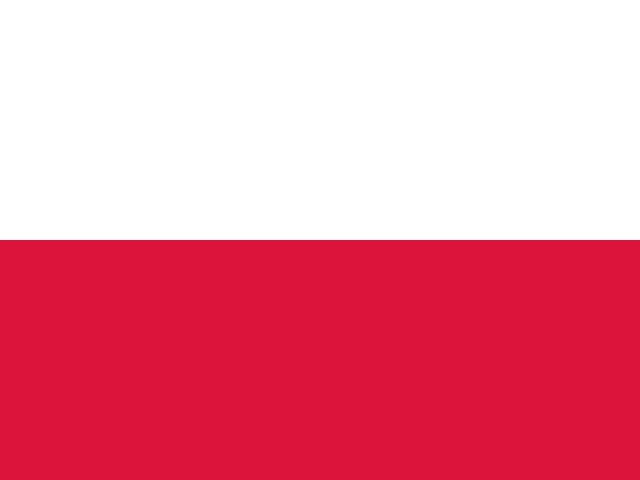
Flag
meaning: colors derive from the Polish emblem, a white eagle on a red field
National symbol(s)
white crowned eagle
National color(s)
white, red
National coat of arms
Poland’s coat of arms was designed in 1927 by noted Polish graphic artist and educator Zygmunt Kaminski. The white crowned eagle is the national symbol, and white and red are the national colors, with white representing purity and truth and red symbolizing courage and the blood shed for freedom.
National anthem(s)
lyrics/music: Jozef WYBICKI/traditional
history: adopted 1927;
National heritage
selected World Heritage Site locales: Historic Krakow (c); Historic Warsaw (c); Medieval Torun (c); Wooden Tserkvas of the Carpathian Region (c); Castle of the Teutonic Order in Malbork (c); Wieliczka and Bochnia Royal Salt Mines (c); Auschwitz Birkenau Concentration Camp (c); Ancient and Primeval Beech Forests of the Carpathians (n); Białowieza Forest (n); Old City of Zamość (c)
Economy31
Economic overview
high-income, diversified, EU-member economy; significant growth in GDP, trade, and investment since joining EU in 2004; private consumption and EU-funded public investments driving GDP growth; increased social spending, flooding recovery costs, and defense spending have added to public debt
Real GDP (purchasing power parity)
Real GDP (purchasing power parity) 2023: $1.602 trillion (2023 est.)
Real GDP (purchasing power parity) 2022: $1.598 trillion (2022 est.)
Real GDP growth rate
Real GDP growth rate 2023: 0.2% (2023 est.)
Real GDP growth rate 2022: 5.3% (2022 est.)
Real GDP per capita
Real GDP per capita 2023: $43,700 (2023 est.)
Real GDP per capita 2022: $43,400 (2022 est.)
GDP (official exchange rate)
Inflation rate (consumer prices)
Inflation rate (consumer prices) 2023: 11.5% (2023 est.)
Inflation rate (consumer prices) 2022: 14.4% (2022 est.)
GDP - composition, by sector of origin
industry: 26.4% (2024 est.)
services: 59.9% (2024 est.)
GDP - composition, by end use
household consumption
government consumption
investment in fixed capital
investment in inventories
exports of goods and services
imports of goods and services
Agricultural products
Industries
machine building, iron and steel, coal mining, chemicals, shipbuilding, food processing, glass, beverages, textiles
Industrial production growth rate
Labor force
Unemployment rate
Unemployment rate 2023: 2.8% (2023 est.)
Unemployment rate 2022: 2.9% (2022 est.)
Youth unemployment rate (ages 15-24)
male: 10.1% (2024 est.)
female: 9.6% (2024 est.)
Population below poverty line
Gini Index coefficient - distribution of family income
Average household expenditures
on alcohol and tobacco: 6.2% of household expenditures (2023 est.)
Household income or consumption by percentage share
highest 10%: 23.1% (2022 est.)
Remittances
Remittances 2023: 1.1% of GDP (2023 est.)
Remittances 2022: 1.1% of GDP (2022 est.)
Budget
expenditures: $328.497 billion (2023 est.)
Public debt
Taxes and other revenues
Current account balance
Current account balance 2023: $14.535 billion (2023 est.)
Current account balance 2022: -$15.822 billion (2022 est.)
Exports
Exports 2023: $471.571 billion (2023 est.)
Exports 2022: $436.388 billion (2022 est.)
Exports - partners
Exports - commodities
Imports
Imports 2023: $423.797 billion (2023 est.)
Imports 2022: $421.765 billion (2022 est.)
Imports - partners
Imports - commodities
Reserves of foreign exchange and gold
Reserves of foreign exchange and gold 2023: $193.783 billion (2023 est.)
Reserves of foreign exchange and gold 2022: $166.664 billion (2022 est.)
Exchange rates
Currency
Exchange rates 2024
Exchange rates 2023
Exchange rates 2022
Exchange rates 2021
Exchange rates 2020
Energy7
Electricity access
Electricity
consumption: 159.639 billion kWh (2023 est.)
exports: 11.403 billion kWh (2023 est.)
imports: 15.14 billion kWh (2023 est.)
transmission/distribution losses: 8.549 billion kWh (2023 est.)
Electricity generation sources
solar: 6.9% of total installed capacity (2023 est.)
wind: 14.4% of total installed capacity (2023 est.)
hydroelectricity: 1.1% of total installed capacity (2023 est.)
biomass and waste: 4.9% of total installed capacity (2023 est.)
Coal
consumption: 99.932 million metric tons (2023 est.)
exports: 10.805 million metric tons (2023 est.)
imports: 10.041 million metric tons (2023 est.)
proven reserves: 27.758 billion metric tons (2023 est.)
Petroleum
refined petroleum consumption: 743,000 bbl/day (2024 est.)
crude oil estimated reserves: 113 million barrels (2021 est.)
Natural gas
consumption: 20.602 billion cubic meters (2023 est.)
exports: 747.124 million cubic meters (2023 est.)
imports: 15.111 billion cubic meters (2023 est.)
proven reserves: 91.492 billion cubic meters (2021 est.)
Energy consumption per capita
Communications6
Telephones - fixed lines
subscriptions per 100 inhabitants: 13 (2023 est.)
Telephones - mobile cellular
subscriptions per 100 inhabitants: 132 (2022 est.)
Broadcast media
state-run public TV operates 2 national channels supplemented by 16 regional and several niche channels; privately owned entities operate several national TV networks and some special interest channels; many privately owned local channels; roughly half of all households are linked to satellite or cable TV systems with access to foreign TV; state-run public radio operates 5 national networks and 17 regional stations; 2 privately owned national radio networks, several commercial stations, and many privately owned local radio stations (2019)
Internet country code
.pl
Internet users
Broadband - fixed subscriptions
subscriptions per 100 inhabitants: 26 (2023 est.)
Transportation6
Civil aircraft registration country code prefix
SP
Airports
318 (2025)
Heliports
16 (2025)
Railways
Merchant marine
by type: general cargo 6, oil tanker 6, other 140
Ports
total ports
large
medium
small
very small
ports with oil terminals
key ports
Military & Security7
Military and security forces
Ministry of Interior and Administration: Polish National Police (Policja); Border Guard (Straż Graniczna or SG) (2025)
Military expenditures
Military Expenditures 2024: 3.8% of GDP (2024 est.)
Military Expenditures 2023: 3.3% of GDP (2023 est.)
Military Expenditures 2022: 2.2% of GDP (2022 est.)
Military Expenditures 2021: 2.2% of GDP (2021 est.)
Military and security service personnel strengths
Military equipment inventories and acquisitions
the military's inventory consists of a mix of some Soviet-era and a growing amount of more modern, NATO-compatible weapons systems; in recent years, significant suppliers of armaments have included Finland, South Korea, and the US; Poland has a domestic defense sector that produces or provides upgrades to various weapons systems, particularly ground systems such as tanks and other armored vehicles; it also cooperates with the European and US defense sectors (2025)
Military service age and obligation
note 2: in 2022, Poland announced a new 12-month voluntary military service program with recruits going through a one-month basic training period with a military unit, followed by 11 months of specialized training; upon completion of service, the volunteers would be allowed to join the Territorial Defense Forces or the active reserve, and have priority to join the professional army and be given preference for employment in the public sector; the program is part of an effort to increase the size of the Polish military
Military deployments
Military - note
since 2014, Poland has hosted several NATO military formations designed to enhance the defense of Poland and NATO’s eastern flank, including a US-led multinational NATO ground force battlegroup as part of the Alliance’s Enhanced Forward Presence initiative, NATO fighter detachments at Malbork Air Base, a NATO-led divisional headquarters (Multinational Division Northeast), which coordinates training and preparation activities of its respective subordinate battlegroups in Poland and Lithuania, and a corps-level NATO field headquarters (Multinational Corps Northeast); Poland also has increased the the US military presence in the country; Poland participates in a variety of EU and NATO military deployments in Africa, the Baltic States, Southern Europe, and the Middle East; Poland also provided support to the NATO mission in Afghanistan (2025)
Transnational Issues2
Refugees and internally displaced persons
stateless persons: 1,486 (2024 est.)
Illicit drugs
major precursor-chemical producer (2025)