
Northern Mariana Islands
Commonwealth of the Northern Mariana Islands
Population
51.1K
Area
464 km²
GDP
$1.10B
GDP Per Capita
N/A
Pop. Density
110/km²
Quick Facts
Currency
$United States dollar(USD)
Calling Code
+1670
Timezone
UTC+10:00
Languages
Carolinian, Chamorro, English+more
Driving Side
right
Demonym
American
Background
Austronesian people settled the Northern Mariana Islands around 1500 B.C. These people became the indigenous Chamorro and were influenced by later migrations, including Micronesians in the first century A.D. and island Southeast Asians around 900. Spanish explorer Ferdinand MAGELLAN sailed through the Mariana Islands in 1521, and Spain claimed them in 1565. Spain formally colonized the Mariana Islands in 1668 and administered the archipelago from Guam. Spain’s brutal repression of the Chamorro, along with new diseases and intermittent warfare, reduced the indigenous population by about 90% in the 1700s. With a similar dynamic occurring on Guam, Spain forced the Chamorro from the Northern Mariana Islands to resettle there. By the time they returned, many other Micronesians, including Chuukese and Yapese, had already settled on their islands.
In 1898, Spain ceded Guam to the US after the Spanish-American War but sold the Northern Mariana Islands to Germany under the German-Spanish Treaty of 1899. Germany administered the territory from German New Guinea but took a hands-off approach to day-to-day life. Following World War I, Japan administered the islands under a League of Nations mandate. Japan focused on sugar production and brought in thousands of Japanese laborers, who quickly outnumbered the Chamorro on the islands. During World War II, Japan invaded Guam from the Northern Mariana Islands and used Marianan Chamorro as translators with Guamanian Chamorro, creating friction between the two Chamorro communities that continues to this day. The US captured the Northern Mariana Islands in 1944 after the Battle of Saipan and later administered them as part of the Trust Territory of the Pacific Islands (TTPI).
On four occasions in the 1950s and 1960s, voters opted for integration with Guam, which Guam rejected in 1969. In 1978, the Northern Mariana Islands was granted self-governance separate from the rest of the TTPI, and in 1986, islanders were granted US citizenship, with the territory coming under US sovereignty as the Commonwealth of the Northern Mariana Islands (CNMI). In 2009, the CNMI became the final US territory to elect a nonvoting delegate to the US Congress.
Geography17
Location
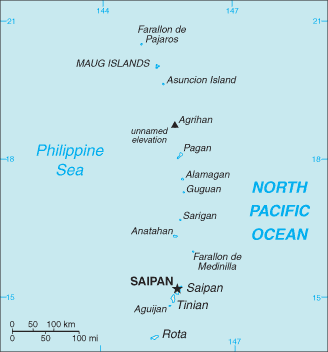
Oceania, islands in the North Pacific Ocean, about three-quarters of the way from Hawaii to the Philippines
Geographic coordinates
15 12 N, 145 45 E
Map references
Oceania
Area
land: 464 sq km
water: 0 sq km
Area - comparative
2.5 times the size of Washington, D.C.
Land boundaries
Coastline
1,482 km
Maritime claims
exclusive economic zone: 200 nm
Climate
tropical marine; moderated by northeast trade winds, little seasonal temperature variation; dry season December to June, rainy season July to October
Terrain
the southern islands in this north-south trending archipelago are limestone, with fringing coral reefs; the northern islands are volcanic, with active volcanoes on several islands
Elevation
lowest point: Pacific Ocean 0 m
Natural resources
arable land, fish
Land use
agricultural land
agricultural land: arable land
agricultural land: permanent crops
agricultural land: permanent pasture
forest
other
Irrigated land
1 sq km (2012)
Population distribution
approximately 90% of the population lives on the island of Saipan
Natural hazards
active volcanoes on Pagan and Agrihan; typhoons (especially August to November)
Geography - note
strategic location in the North Pacific Ocean
People & Society23
Population
male: 27,044
female: 24,074
Nationality
adjective: NA
Ethnic groups
Asian 50% (includes Filipino 35.3%, Chinese 6.8%, Korean 4.2%, and other Asian 3.7%), Native Hawaiian or other Pacific Islander 34.9% (includes Chamorro 23.9%, Carolinian 4.6%, and other Native Hawaiian or Pacific Islander 6.4%), other 2.5%, two or more ethnicities or races 12.7% (2010 est.)
Languages
Philippine languages 32.8%, Chamorro (official) 24.1%, English (official) 17%, other Pacific island languages 10.1% (includes Carolinian (official), Chinese 6.8%, other Asian languages 7.3%, other 1.9% (2010 est.)
Religions
Christian (Roman Catholic majority, although traditional beliefs and taboos may still be found)
Age structure
15-64 years: 67.7% (male 18,206/female 16,377)
65 years and over: 10.2% (2024 est.) (male 2,772/female 2,466)
Dependency ratios
youth dependency ratio: 32.7 (2024 est.)
elderly dependency ratio: 15.1 (2024 est.)
potential support ratio: 6.6 (2024 est.)
Median age
male: 31.8 years
female: 33.2 years
Population growth rate
-0.33% (2025 est.)
Birth rate
15.8 births/1,000 population (2025 est.)
Death rate
5.91 deaths/1,000 population (2025 est.)
Net migration rate
-13.21 migrant(s)/1,000 population (2025 est.)
Population distribution
approximately 90% of the population lives on the island of Saipan
Urbanization
rate of urbanization: 0.36% annual rate of change (2020-25 est.)
Major urban areas - population
51,000 SAIPAN (capital) (2018)
Sex ratio
0-14 years: 1.16 male(s)/female
15-64 years: 1.11 male(s)/female
65 years and over: 1.12 male(s)/female
total population: 1.12 male(s)/female (2024 est.)
Infant mortality rate
male: 14.4 deaths/1,000 live births
female: 9 deaths/1,000 live births
Life expectancy at birth
male: 75 years
female: 79.5 years
Total fertility rate
2.53 children born/woman (2025 est.)
Gross reproduction rate
1.17 (2025 est.)
Drinking water source
unimproved: total: total: 0% of population (2022 est.)
Sanitation facility access
unimproved: total: total: 0.6% of population (2022 est.)
Currently married women (ages 15-49)
38.2% (2020 est.)
Government20
Country name
conventional short form: Northern Mariana Islands
former: Trust Territory of the Pacific Islands, Mariana Islands District
abbreviation: CNMI
etymology: Spain named the islands in 1667 in honor of the Spanish Queen, MARIANA of Austria
Government type
a commonwealth in political union with and under the sovereignty of the US; republican form of government with separate executive, legislative, and judicial branches
Dependency status
commonwealth in political union with and under the sovereignty of the US; federal funds administered by the US Department of the Interior, Office of Insular Affairs
Capital
geographic coordinates: 15 12 N, 145 45 E
time difference: UTC+10 (15 hours ahead of Washington, DC, during Standard Time)
etymology: the origin of the name is unclear; it probably comes from a local word meaning "deserted" or "uninhabited," but stories vary on how it came to be used
Administrative divisions
no first-order administrative divisions as defined by the US government, but 4 municipalities are considered second-order: Northern Islands, Rota, Saipan, Tinian
Legal system
the laws of the US apply, except for customs and some aspects of taxation
Constitution
amendment process: proposed by constitutional convention, by public petition, or by the Legislature; ratification of proposed amendments requires approval by voters at the next general election or special election; amendments proposed by constitutional convention or by petition become effective if approved by a majority of voters and at least two-thirds majority of voters in each of two senatorial districts; amendments proposed by the Legislature are effective if approved by majority vote
Citizenship
see United States
Suffrage
Executive branch
chief of state
head of government
cabinet
election/appointment process
most recent election date
election results
2022: Arnold PALACIOS elected governor in second round; percent of vote in first round - Ralph TORRES (Republican) 38.8%; Arnold PALACIOS (independent) 32.2%, Tina SABLAN (Democrat) 28%; percent of vote in second round - Arnold PALACIOS 54%, Ralph TORRES 46%; David APATANG (independent) elected lieutenant governor
2018: Ralph TORRES elected governor; percent of vote - Ralph TORRES (Republican) 62.2%, Juan BABAUTA (independent) 37.8%; Arnold PALACIOS elected lieutenant governor
expected date of next election
Judicial branch
judge selection and term of office: CNMI Supreme Court judges appointed by the governor and confirmed by the CNMI Senate; judges appointed for 8-year terms and another term if directly elected in a popular election; US Federal District Court judges appointed by the US president and confirmed by the US Senate; judges appointed for renewable 10-year terms
subordinate courts: Superior Court
Political parties
Republican Party
Diplomatic representation from the US
International organization participation
PIF (observer), SPC, UPU
Independence
none (commonwealth in political union with the US)
National holiday
Commonwealth Day, 8 January (1978)
Flag
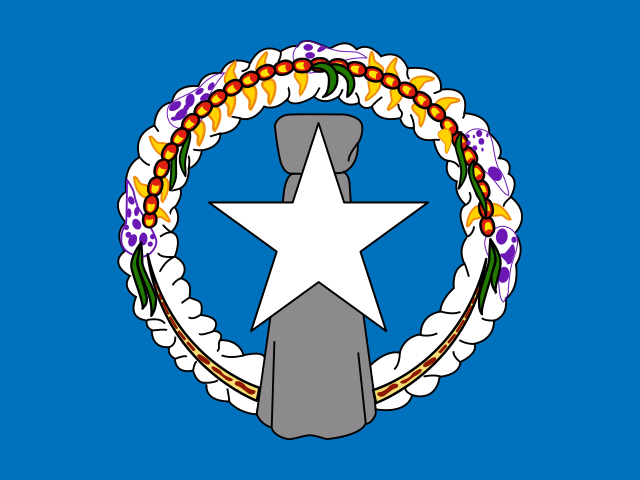
meaning: blue stands for the Pacific Ocean, the star for the Commonwealth, and the latte stone and mwáár for Marianas culture; the mwáár is made from four kinds of flowers: flores mayo (Plumeria), ylang-ylang or langilang (Cananga odorata), angagha or peacock flower (Caesalpinia pulcherrima), and teibwo or Pacific basil (Ocimum tenuiflorum)
National symbol(s)
latte stone
National color(s)
blue, white
National anthem(s)
lyrics/music: Francis Scott KEY/John Stafford SMITH
history: official anthem, as a US commonwealth
Economy14
Economic overview
US Pacific island commonwealth economy; growing Chinese and Korean tourist destination; hit hard by 2018 typhoon; dependent on energy imports; exempt from some US labor and immigration laws; longstanding garment production
Real GDP (purchasing power parity)
Real GDP (purchasing power parity) 2015: $933 million (2015 est.)
Real GDP (purchasing power parity) 2014: $845 million (2014 est.)
Real GDP growth rate
Real GDP growth rate 2021: 5% (2021 est.)
Real GDP growth rate 2020: -29.1% (2020 est.)
GDP (official exchange rate)
Agricultural products
vegetables and melons, fruits and nuts; ornamental plants; livestock, poultry, eggs; fish and aquaculture products
Industries
tourism, banking, construction, fishing, handicrafts, other services
Budget
expenditures: $344 million (2015 est.)
Exports
Exports 2021: $55 million (2021 est.)
Exports 2020: $128 million (2020 est.)
Exports - partners
Exports - commodities
scrap iron, refined petroleum, scrap copper, hydraulic engines, integrated circuits (2021)
Imports
Imports 2021: $666 million (2021 est.)
Imports 2020: $556 million (2020 est.)
Imports - partners
Imports - commodities
refined petroleum, cars, jewelry, trunks and cases, flavored water (2023)
Exchange rates
the US dollar is used
Energy1
Electricity access
Communications5
Telephones - fixed lines
subscriptions per 100 inhabitants: 42 (2022 est.)
Telephones - mobile cellular
subscriptions per 100 inhabitants: 28 (2004)
Broadcast media
1 TV station on Saipan; multi-channel cable TV services are available on Saipan; 9 licensed radio stations (2009)
Internet country code
.mp
Internet users
Transportation3
Airports
4 (2025)
Heliports
7 (2025)
Ports
total ports
large
medium
small
very small
ports with oil terminals
key ports
Military & Security1
Military - note
defense is the responsibility of the US
Compare Northern Mariana Islands
See how Northern Mariana Islands compares to other countries side by side.
Compare Countries