
Nauru
Republic of Nauru
Population
9.9K
Area
21 km²
GDP
$160.35M
GDP Per Capita
$12,600
Pop. Density
473/km²
Quick Facts
Currency
$Australian dollar(AUD)
Calling Code
+674
Timezone
UTC+12:00
Languages
English, Nauru+more
Driving Side
left
Demonym
Nauruan
Background
Australian forces captured Nauru from Germany during World War I, and in 1919, it was placed under a joint Australian-British-New Zealand mandate with Australian administration. Japan occupied Nauru during World War II and used its residents as forced labor elsewhere in the Pacific while destroying much of the infrastructure on the island. After the war, Nauru became a UN trust territory under Australian administration. In 1962, recognizing the phosphate stocks would eventually be depleted, Australian Prime Minister Robert MENZIES offered to resettle all Nauruans on Curtis Island in Queensland, but Nauruans rejected that plan and opted for independence, which was achieved in 1968. In 1970, Nauru purchased the phosphate mining assets, and income from the mines made Nauruans among the richest people in the world. However, a series of unwise investments led to near bankruptcy by 2000. Widespread phosphate mining officially ceased in 2006.
As its economy faltered, Nauru briefly tried to rebrand itself as an offshore banking haven, an initiative that ended in 2005, and the country made a successful bid for Russian humanitarian aid in 2008. In 2001, Australia set up the Nauru Regional Processing Center (NRPC), an offshore refugee detention facility, paying Nauru per person at the center. The NRPC closed in 2008 but reopened in 2012. The number of refugees steadily declined after 2014, and in 2020, the remaining people were moved to Brisbane, Australia, effectively shuttering the NRPC. However, in 2023, Australia agreed to continue funding NRPC for two years and restarted settling asylees in the center in mid-2023. The center remains the Government of Nauru’s largest source of income.
Historical Trends
GDP (USD)
↑456.8% since 2006Population
↑19.1% since 2006Life Expectancy at Birth
Latest: 62.1 yearsData source: World Bank Open Data
Geography17
Location
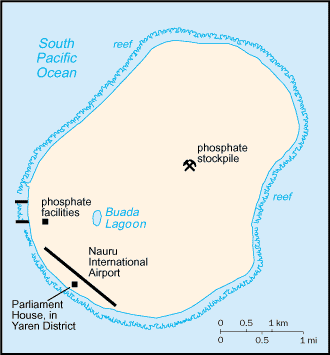
Oceania, island in the South Pacific Ocean, south of the Marshall Islands
Geographic coordinates
0 32 S, 166 55 E
Map references
Oceania
Area
land: 21 sq km
water: 0 sq km
Area - comparative
about 0.1 times the size of Washington, D.C.
Land boundaries
Coastline
30 km
Maritime claims
contiguous zone: 24 nm
exclusive economic zone: 200 nm
Climate
tropical with a monsoonal pattern; rainy season (November to February)
Terrain
sandy beach rises to fertile ring around raised coral reefs with phosphate plateau in center
Elevation
lowest point: Pacific Ocean 0 m
Natural resources
phosphates, fish
Land use
agricultural land
agricultural land: arable land
agricultural land: permanent crops
agricultural land: permanent pasture
forest
other
Irrigated land
0 sq km (2022)
Population distribution
most people live in the fertile coastal areas, especially along the southwest coast
Natural hazards
periodic droughts
Geography - note
Nauru is the third-smallest country in the world behind the Holy See (Vatican City) and Monaco; it is the smallest country in the Pacific Ocean, the smallest country outside Europe, the world's smallest island country, and the world's smallest independent republic; situated just 53 km south of the equator, Nauru is one of the three great phosphate rock islands in the Pacific Ocean -- the others are Banaba (Ocean Island) in Kiribati and Makatea in French Polynesia
People & Society30
Population
male: 4,874
female: 5,056
Nationality
adjective: Nauruan
Ethnic groups
Nauruan 94.6%, I-Kiribati 2.2%, Fijian 1.3%, other 1.9% (2021 est.)
Languages
Religions
Protestant 60.4% (Nauruan Congregational 34.7%, Assemblies of God 11.6%, Pacific Light House 6.3%, Nauru Independent 3.6%, Baptist 1.5, Seventh Day Adventist 1.3%, other Protestant 1.4%), Roman Catholic 33.9%, other 4.2%, none 1.3%, no answer 0.3% (2021 est.)
Age structure
15-64 years: 66% (male 3,220/female 3,309)
65 years and over: 4.4% (2024 est.) (male 143/female 294)
Dependency ratios
youth dependency ratio: 43.7 (2025 est.)
elderly dependency ratio: 7 (2025 est.)
potential support ratio: 14.4 (2025 est.)
Median age
male: 27.3 years
female: 28.4 years
Population growth rate
0.37% (2025 est.)
Birth rate
19.64 births/1,000 population (2025 est.)
Death rate
6.55 deaths/1,000 population (2025 est.)
Net migration rate
-9.37 migrant(s)/1,000 population (2025 est.)
Population distribution
most people live in the fertile coastal areas, especially along the southwest coast
Urbanization
rate of urbanization: 0.18% annual rate of change (2020-25 est.)
Sex ratio
0-14 years: 1.04 male(s)/female
15-64 years: 0.97 male(s)/female
65 years and over: 0.49 male(s)/female
total population: 0.96 male(s)/female (2024 est.)
Maternal mortality ratio
273 deaths/100,000 live births (2023 est.)
Infant mortality rate
male: 9.8 deaths/1,000 live births
female: 5.3 deaths/1,000 live births
Life expectancy at birth
male: 65 years
female: 72.3 years
Total fertility rate
2.52 children born/woman (2025 est.)
Gross reproduction rate
1.24 (2025 est.)
Drinking water source
unimproved: urban: urban: 0% of population
unimproved: total: total: 0% of population (2020 est.)
Health expenditure
Health expenditure (as % of national budget): 11.8% of national budget (2022 est.)
Physician density
1.27 physicians/1,000 population (2015)
Obesity - adult prevalence rate
61% (2016)
Alcohol consumption per capita
beer: 0.54 liters of pure alcohol (2019 est.)
wine: 0.09 liters of pure alcohol (2019 est.)
spirits: 1.81 liters of pure alcohol (2019 est.)
other alcohols: 0 liters of pure alcohol (2019 est.)
Tobacco use
male: 49.3% (2025 est.)
female: 46.1% (2025 est.)
Children under the age of 5 years underweight
3.8% (2023 est.)
Currently married women (ages 15-49)
57.7% (2021 est.)
Education expenditure
Education expenditure (% national budget): 6.6% national budget (2025 est.)
Literacy
male: 93.4% (2023 est.)
female: 99.7% (2023 est.)
Government21
Country name
conventional long form
conventional short form
local long form
local short form
former
etymology
Government type
parliamentary republic
Capital
time difference: UTC+12 (17 hours ahead of Washington, DC, during Standard Time)
Administrative divisions
14 districts; Aiwo, Anabar, Anetan, Anibare, Baitsi, Boe, Buada, Denigomodu, Ewa, Ijuw, Meneng, Nibok, Uaboe, Yaren
Legal system
mixed system of common law based on the English model and customary law
Constitution
amendment process: proposed by Parliament; passage requires two-thirds majority vote of Parliament; amendments to constitutional articles, such as the republican form of government, protection of fundamental rights and freedoms, the structure and authorities of the executive and legislative branches, also require two-thirds majority of votes in a referendum
International law organization participation
has not submitted an ICJ jurisdiction declaration; accepts ICCt jurisdiction
Suffrage
20 years of age; universal and compulsory
Executive branch
chief of state
head of government
cabinet
election/appointment process
most recent election date
election results
2025: David ADEAGN elected president (unopposed)
2023: David ADEAGN elected president over Delvin THOMA, 10-8
expected date of next election
Legislative branch
legislature name
legislative structure
number of seats
electoral system
scope of elections
term in office
most recent election date
percentage of women in chamber
expected date of next election
Judicial branch
judge selection and term of office: judges appointed by the president to serve until age 65
subordinate courts: District Court, Family Court
Political parties
Nauru does not have formal political parties; alliances within the government are often formed based on extended family ties
Diplomatic representation in the US
chancery: 801 2nd Avenue, Third Floor, New York, NY 10017
telephone: [1] (212) 937-0074
FAX: [1] (212) 937-0079
email address and website:
[email protected]
https://www.un.int/nauru/
Diplomatic representation from the US
International organization participation
ACP, ADB, AOSIS, C, FAO, G-77, ICAO, ICCt, IFAD, Interpol, IOC, IOM, ITU, OPCW, PIF, Sparteca, SPC, UN, UNCTAD, UNESCO, UPU, WHO, WMO
Independence
31 January 1968 (from the Australia-, NZ-, and UK-administered UN trusteeship)
National holiday
Independence Day, 31 January (1968)
Flag
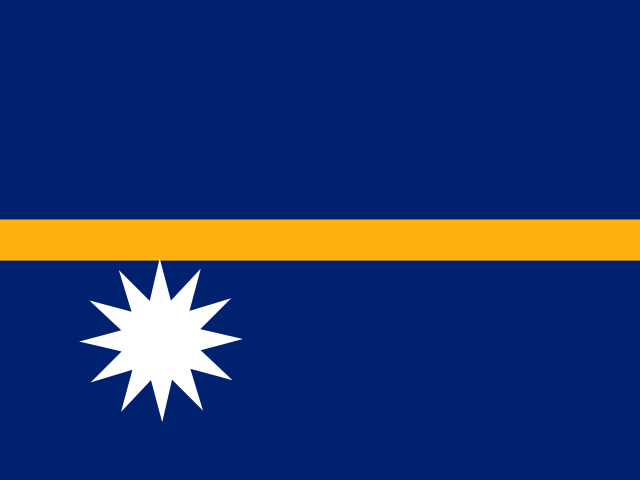
meaning: blue stands for the Pacific Ocean; the star indicates the country's location in relation to the equator (the gold stripe), and the 12 points stand for the original tribes of Nauru; the star's white color represents phosphate, the basis of the island's wealth
National symbol(s)
frigatebird, calophyllum flower
National color(s)
blue, yellow, white
National anthem(s)
lyrics/music: Margaret HENDRIE/Laurence Henry HICKS
history: adopted 1968
Economy20
Economic overview
Real GDP (purchasing power parity)
Real GDP (purchasing power parity) 2023: $147.976 million (2023 est.)
Real GDP (purchasing power parity) 2022: $147.026 million (2022 est.)
Real GDP growth rate
Real GDP growth rate 2023: 0.6% (2023 est.)
Real GDP growth rate 2022: 3% (2022 est.)
Real GDP per capita
Real GDP per capita 2023: $12,500 (2023 est.)
Real GDP per capita 2022: $12,500 (2022 est.)
GDP (official exchange rate)
Inflation rate (consumer prices)
Inflation rate (consumer prices) 2021: 2.4% (2021 est.)
Inflation rate (consumer prices) 2020: 1.8% (2020 est.)
Agricultural products
Industries
phosphate mining, offshore banking, coconut products
Remittances
Remittances 2022: 0.6% of GDP (2022 est.)
Remittances 2021: 0.7% of GDP (2021 est.)
Budget
expenditures: $157.86 million (2020 est.)
Public debt
Taxes and other revenues
Current account balance
Current account balance 2022: $2.966 million (2022 est.)
Current account balance 2021: $6.597 million (2021 est.)
Exports
Exports 2022: $78.383 million (2022 est.)
Exports 2021: $54.403 million (2021 est.)
Exports - partners
Exports - commodities
Imports
Imports 2022: $165.371 million (2022 est.)
Imports 2021: $141.185 million (2021 est.)
Imports - partners
Imports - commodities
Exchange rates
Currency
Exchange rates 2024
Exchange rates 2023
Exchange rates 2022
Exchange rates 2021
Exchange rates 2020
Energy4
Electricity access
Electricity
consumption: 37.893 million kWh (2023 est.)
transmission/distribution losses: 3.922 million kWh (2023 est.)
Electricity generation sources
solar: 12% of total installed capacity (2023 est.)
Petroleum
Communications6
Telephones - fixed lines
subscriptions per 100 inhabitants: (2022 est.) less than 1
Telephones - mobile cellular
subscriptions per 100 inhabitants: 87 (2022 est.)
Broadcast media
1 state-owned TV station broadcasting programs from New Zealand; 1 state-owned radio station, broadcasting on AM and FM, uses Australian and British programs (2019)
Internet country code
.nr
Internet users
Broadband - fixed subscriptions
subscriptions per 100 inhabitants: 10 (2022 est.)
Transportation4
Civil aircraft registration country code prefix
C2
Airports
1 (2025)
Merchant marine
by type: other 6
Ports
total ports
large
medium
small
very small
ports with oil terminals
key ports
Military & Security2
Military and security forces
no regular military forces; Nauru Police Force
Military - note
Nauru has a "shiprider" agreement with the US, which allows local maritime law enforcement officers to embark on US Coast Guard (USCG) and US Navy (USN) vessels, including to board and search vessels suspected of violating laws or regulations within Nauru's designated exclusive economic zone (EEZ) or on the high seas; "shiprider" agreements also enable USCG personnel and USN vessels with embarked USCG law enforcement personnel to work with host nations to protect critical regional resources (2025)