
Moldova
Republic of Moldova
Population
3.58M
Area
33,851 km²
GDP
$18.20B
GDP Per Capita
$16,500
Pop. Density
106/km²
Quick Facts
Currency
LMoldovan leu(MDL)
Calling Code
+373
Timezone
UTC+02:00
Languages
Romanian+more
Driving Side
right
Demonym
Moldovan
Background
A large portion of present-day Moldovan territory became a province of the Russian Empire in 1812 and then unified with Romania in 1918 in the aftermath of World War I. This territory was then incorporated into the Soviet Union at the close of World War II. Although Moldova has been independent from the Soviet Union since 1991, Russian forces have remained on Moldovan territory east of the Nistru River in the breakaway region of Transnistria.
Years of Communist Party rule in Moldova from 2001 to 2009 ultimately ended with election-related violent protests and a rerun of parliamentary elections in 2009. A series of pro-Europe ruling coalitions governed Moldova from 2010 to 2019, but pro-Russia candidate Igor DODON won the presidency in 2016, and his Socialist Party of the Republic of Moldova won a plurality in the legislative election in 2019. Pro-EU reformist candidate Maia SANDU defeated DODON in his reelection bid in 2020, and SANDU's Party of Action and Solidarity won a parliamentary majority in an early legislative election in 2021. Prime Minister Natalia GAVRILITA and her cabinet took office in 2021. In early 2023, Moldova's parliament confirmed a new cabinet led by Prime Minister Dorin RECEAN, which retained the majority of the former ministers.
Historical Trends
GDP (USD)
↑434.0% since 2006Population
↓16.6% since 2006Life Expectancy at Birth
Latest: 71.2 yearsData source: World Bank Open Data
Geography19
Location
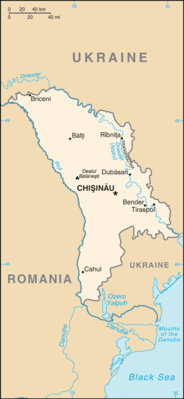
Eastern Europe, northeast of Romania
Geographic coordinates
47 00 N, 29 00 E
Map references
Europe
Area
land: 32,891 sq km
water: 960 sq km
Area - comparative
slightly larger than Maryland
Land boundaries
border countries: Romania 683 km; Ukraine 1202 km
Coastline
0 km (landlocked)
Maritime claims
none (landlocked)
Climate
moderate winters, warm summers
Terrain
rolling steppe, gradual slope south to Black Sea
Elevation
lowest point: Dniester (Nistru) 2 m
mean elevation: 139 m
Natural resources
lignite, phosphorites, gypsum, limestone, arable land
Land use
agricultural land
agricultural land: arable land
agricultural land: permanent crops
agricultural land: permanent pasture
forest
other
Irrigated land
2,150 sq km (2022)
Major rivers (by length in km)
Dunărea (Danube) (shared with Germany [s], Austria, Slovakia, Hungary, Croatia, Serbia, Bulgaria, Ukraine, and Romania [m]) - 2,888 km; Nistru (Dniester) (shared with Ukraine [s/m]) - 1,411 km
note: [s] after country name indicates river source; [m] after country name indicates river mouth
Major watersheds (area sq km)
Population distribution
pockets of agglomeration exist throughout the country, with the largest in the center of the country around the capital of Chisinau, followed by Tiraspol and Balti
Natural hazards
landslides
Geography - note
landlocked; has many types of sedimentary rocks and minerals, including sand, gravel, gypsum, and limestone
People & Society33
Population
male: 1,687,496
female: 1,891,434
Nationality
adjective: Moldovan
Ethnic groups
Moldovan 75.1%, Romanian 7%, Ukrainian 6.6%, Gagauz 4.6%, Russian 4.1%, Bulgarian 1.9%, other 0.8% (2014 est.)
Languages
major-language sample(s):
Cartea informativa a lumii, sursa indispensabila pentru informatii de baza. (Moldovan/Romanian)
The World Factbook, the indispensable source for basic information.
Religions
Age structure
15-64 years: 70.2% (male 1,225,535/female 1,300,640)
65 years and over: 15% (2024 est.) (male 206,221/female 334,473)
Dependency ratios
youth dependency ratio: 20.8 (2025 est.)
elderly dependency ratio: 22.2 (2025 est.)
potential support ratio: 4.5 (2025 est.)
Median age
male: 38.6 years
female: 41.3 years
Population growth rate
-0.57% (2025 est.)
Birth rate
8.35 births/1,000 population (2025 est.)
Death rate
14.06 deaths/1,000 population (2025 est.)
Net migration rate
0 migrant(s)/1,000 population (2025 est.)
Population distribution
pockets of agglomeration exist throughout the country, with the largest in the center of the country around the capital of Chisinau, followed by Tiraspol and Balti
Urbanization
rate of urbanization: 0.09% annual rate of change (2020-25 est.)
Major urban areas - population
488,000 CHISINAU (capital) (2023)
Sex ratio
0-14 years: 1 male(s)/female
15-64 years: 0.94 male(s)/female
65 years and over: 0.62 male(s)/female
total population: 0.89 male(s)/female (2024 est.)
Mother's mean age at first birth
25.2 years (2019 est.)
Maternal mortality ratio
19 deaths/100,000 live births (2023 est.)
Infant mortality rate
male: 16 deaths/1,000 live births
female: 11.5 deaths/1,000 live births
Life expectancy at birth
male: 66.1 years
female: 74.4 years
Total fertility rate
1.27 children born/woman (2025 est.)
Gross reproduction rate
0.61 (2025 est.)
Drinking water source
improved: urban
improved: rural
improved: total
unimproved: urban
unimproved: rural
unimproved: total
Health expenditure
Health expenditure (as % of national budget): 12.3% of national budget (2022 est.)
Physician density
4.02 physicians/1,000 population (2023)
Hospital bed density
5.7 beds/1,000 population (2021 est.)
Sanitation facility access
improved: urban
improved: rural
improved: total
unimproved: urban
unimproved: rural
unimproved: total
Obesity - adult prevalence rate
18.9% (2016)
Alcohol consumption per capita
beer: 1.53 liters of pure alcohol (2019 est.)
wine: 3.57 liters of pure alcohol (2019 est.)
spirits: 2.25 liters of pure alcohol (2019 est.)
other alcohols: 0.1 liters of pure alcohol (2019 est.)
Tobacco use
male: 54.2% (2025 est.)
female: 6.4% (2025 est.)
Currently married women (ages 15-49)
68.7% (2020 est.)
Education expenditure
Education expenditure (% national budget): 16% national budget (2024 est.)
School life expectancy (primary to tertiary education)
male: 15 years (2023 est.)
female: 15 years (2023 est.)
Government23
Country name
conventional long form
conventional short form
local long form
local short form
former
etymology
Government type
parliamentary republic
Capital
geographic coordinates: 47 00 N, 28 51 E
time difference: UTC+2 (7 hours ahead of Washington, DC, during Standard Time)
daylight saving time: +1hr, begins last Sunday in March; ends last Sunday in October
etymology: origin unclear but may derive from the Old Moldovan word kishineu ("spring" or "artesian well")
Administrative divisions
districts: Anenii Noi, Basarabeasca, Briceni, Cahul, Cantemir, Calarasi, Causeni, Cimislia, Criuleni, Donduseni, Drochia, Dubasari, Edinet, Falesti, Floresti, Glodeni, Hincesti, Ialoveni, Leova, Nisporeni, Ocnita, Orhei, Rezina, Riscani, Singerei, Soldanesti, Soroca, Stefan Voda, Straseni, Taraclia, Telenesti, Ungheni
municipalities: Balti, Bender, Chisinau
autonomous territorial unit: Gagauzia
territorial unit: Stinga Nistrului (Transnistria)
Legal system
civil law system with Germanic law influences; Constitutional Court reviews legislative acts
Constitution
amendment process: proposed by voter petition (at least 200,000 eligible voters), by at least one third of Parliament members, or by the government; passage requires two-thirds majority vote of Parliament within one year of initial proposal; revisions to constitutional articles on sovereignty, independence, and neutrality require majority vote by referendum; articles on fundamental rights and freedoms cannot be amended
International law organization participation
has not submitted an ICJ jurisdiction declaration; accepts ICCt jurisdiction
Citizenship
citizenship by descent only: at least one parent must be a citizen of Moldova
dual citizenship recognized: no
residency requirement for naturalization: 10 years
Suffrage
18 years of age; universal
Executive branch
chief of state
head of government
cabinet
election/appointment process
most recent election date
election results
2024: In the second round of presidential elections, incumbent Maia SANDU (PAS) wins 55.4% of the vote, Alexandr STOIANOGLO (PSRM) 44.6; turnout is 54.3%
2020: Maia SANDU elected president in second round; percent of vote in second round - Maia SANDU (PAS) 57.7%, Igor DODON (PSRM) 42.3%
expected date of next election
Legislative branch
legislature name
legislative structure
number of seats
electoral system
scope of elections
term in office
most recent election date
parties elected and seats per party
percentage of women in chamber
expected date of next election
Judicial branch
judge selection and term of office: Supreme Court of Justice judges appointed by the president on the recommendation of the Superior Council of Magistracy, an 11-member body of judicial officials; all judges serve 4-year renewable terms; Constitutional Court judges appointed 2 each by Parliament, the president, and the Higher Council of Magistracy for 6-year terms; court president elected by other court judges for a 3-year term
subordinate courts: Courts of Appeal; Court of Business Audit; municipal courts
Political parties
Democracy at Home Party or PPDA
Future of Moldova Party or PVM
National Alternative Movement or MAN
Our Party or PN
Party of Action and Solidarity or PAS
Party of Communists of the Republic of Moldova or PCRM
Party of Development and Consolidation of Moldova or PDCM
Party of Socialists of the Republic of Moldova or PSRM
Diplomatic representation in the US
chancery: 2101 S Street NW, Washington, DC 20008
telephone: [1] (202) 667-1130
FAX: [1] (202) 667-2624
email address and website:
[email protected]
https://sua.mfa.gov.md/en
Diplomatic representation from the US
chief of mission
embassy
mailing address
telephone
FAX
email address and website
International organization participation
Independence
27 August 1991 (from the Soviet Union)
National holiday
Independence Day, 27 August (1991)
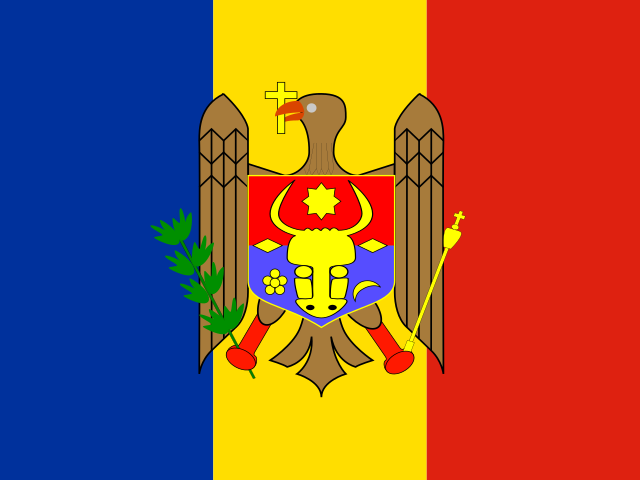
Flag
history: replaced the communist flag in 1990; the coat of arms is based on traditional designs
note 2: one of three national flags that differ on each side -- the others are Paraguay and Saudi Arabia
National symbol(s)
aurochs (type of wild cattle)
National color(s)
blue, yellow, red
National anthem(s)
lyrics/music: Alexei MATEEVICI/Alexandru CRISTEA
history: adopted 1994; originally a 12-verse poem, but only stanzas 1, 2, 5, 9, and 12 are included in the anthem
National heritage
selected World Heritage Site locales: Struve Geodetic Arc
Economy31
Economic overview
upper middle-income Eastern European economy; sustained growth reversed by COVID-19; significant remittances; Russian energy and regional dependence; agricultural exporter; declining workforce due to emigration and low fertility
Real GDP (purchasing power parity)
Real GDP (purchasing power parity) 2023: $39.301 billion (2023 est.)
Real GDP (purchasing power parity) 2022: $38.835 billion (2022 est.)
Real GDP growth rate
Real GDP growth rate 2023: 1.2% (2023 est.)
Real GDP growth rate 2022: -4.6% (2022 est.)
Real GDP per capita
Real GDP per capita 2023: $16,000 (2023 est.)
Real GDP per capita 2022: $15,400 (2022 est.)
GDP (official exchange rate)
Inflation rate (consumer prices)
Inflation rate (consumer prices) 2023: 13.4% (2023 est.)
Inflation rate (consumer prices) 2022: 28.7% (2022 est.)
GDP - composition, by sector of origin
industry: 16.8% (2024 est.)
services: 62.3% (2024 est.)
GDP - composition, by end use
household consumption
government consumption
investment in fixed capital
investment in inventories
exports of goods and services
imports of goods and services
Agricultural products
Industries
sugar processing, vegetable oil, food processing, agricultural machinery; foundry equipment, refrigerators and freezers, washing machines; hosiery, shoes, textiles
Industrial production growth rate
Labor force
Unemployment rate
Unemployment rate 2023: 1.6% (2023 est.)
Unemployment rate 2022: 0.9% (2022 est.)
Youth unemployment rate (ages 15-24)
male: 3.4% (2024 est.)
female: 3.3% (2024 est.)
Population below poverty line
Gini Index coefficient - distribution of family income
Household income or consumption by percentage share
highest 10%: 22.5% (2022 est.)
Remittances
Remittances 2023: 12% of GDP (2023 est.)
Remittances 2022: 14% of GDP (2022 est.)
Budget
expenditures: $6.037 billion (2023 est.)
Public debt
Taxes and other revenues
Current account balance
Current account balance 2023: -$1.893 billion (2023 est.)
Current account balance 2022: -$2.482 billion (2022 est.)
Exports
Exports 2023: $5.866 billion (2023 est.)
Exports 2022: $5.981 billion (2022 est.)
Exports - partners
Exports - commodities
Imports
Imports 2023: $9.84 billion (2023 est.)
Imports 2022: $10.265 billion (2022 est.)
Imports - partners
Imports - commodities
Reserves of foreign exchange and gold
Reserves of foreign exchange and gold 2023: $5.453 billion (2023 est.)
Reserves of foreign exchange and gold 2022: $4.474 billion (2022 est.)
Debt - external
Exchange rates
Currency
Exchange rates 2024
Exchange rates 2023
Exchange rates 2022
Exchange rates 2021
Exchange rates 2020
Energy7
Electricity access
Electricity
consumption: 5.674 billion kWh (2023 est.)
exports: 94 million kWh (2023 est.)
imports: 1.264 billion kWh (2023 est.)
transmission/distribution losses: 550.069 million kWh (2023 est.)
Electricity generation sources
solar: 1.7% of total installed capacity (2023 est.)
wind: 3.8% of total installed capacity (2023 est.)
hydroelectricity: 6.3% of total installed capacity (2023 est.)
biomass and waste: 0.2% of total installed capacity (2023 est.)
Coal
imports: 86,000 metric tons (2023 est.)
Petroleum
Natural gas
consumption: 2.223 billion cubic meters (2023 est.)
imports: 2.223 billion cubic meters (2023 est.)
Energy consumption per capita
Communications6
Telephones - fixed lines
subscriptions per 100 inhabitants: 28 (2023 est.)
Telephones - mobile cellular
subscriptions per 100 inhabitants: 120 (2024 est.)
Broadcast media
state-owned national radio-TV broadcaster operates 1 TV and 1 radio station; total of nearly 70 terrestrial TV channels and about 50 radio stations; Russian and Romanian channels are available (2019)
Internet country code
.md
Internet users
Broadband - fixed subscriptions
subscriptions per 100 inhabitants: 27 (2023 est.)
Transportation5
Civil aircraft registration country code prefix
ER
Airports
10 (2025)
Heliports
1 (2025)
Railways
standard gauge: 14 km (2014) 1.435-m gauge
broad gauge: 1,157 km (2014) 1.520-m gauge
Merchant marine
by type: bulk carrier 1, container ship 1, general cargo 44, oil tanker 7, other 22
Military & Security6
Military and security forces
Ministry of Internal Affairs: General Inspectorate of Police (GPI), Border Police Department, Carabinieri Troops Department (2025)
Military expenditures
Military Expenditures 2023: 0.6% of GDP (2023 est.)
Military Expenditures 2022: 0.4% of GDP (2022 est.)
Military Expenditures 2021: 0.4% of GDP (2021 est.)
Military Expenditures 2020: 0.4% of GDP (2020 est.)
Military and security service personnel strengths
approximately 6,500 Moldovan Armed Forces (2025)
Military equipment inventories and acquisitions
the military's inventory is limited and almost entirely comprised of Soviet-era equipment; in recent years, it has received small amounts of donated equipment from some Western European nations and the US (2025)
Military service age and obligation
Military - note
Moldova is constitutionally neutral but has maintained a relationship with NATO since 1992 and since 2022 has enhanced bilateral security cooperation with some NATO members; it has contributed small numbers of troops to NATO’s Kosovo Force (KFOR) since 2014, and a civilian NATO liaison office was established in Moldova in 2017 at the request of the Moldovan Government to promote practical cooperation and facilitate support; in 2024, Moldova signed a security and defense partnership agreement with the EU; it maintains close security relations with Romania, a member of the EU and NATO (2025)
Transnational Issues1
Refugees and internally displaced persons
IDPs: 6 (2024 est.)
stateless persons: 3,164 (2024 est.)