

Lithuania
Republic of Lithuania
Population
2.82M
Area
65,300 km²
GDP
$84.87B
GDP Per Capita
$47,200
Pop. Density
43/km²
Quick Facts
Currency
€euro(EUR)
Calling Code
+370
Timezone
UTC+02:00
Languages
Lithuanian+more
Driving Side
right
Demonym
Lithuanian
Background
Historical Trends
GDP (USD)
↑181.8% since 2006Population
↓11.7% since 2006Life Expectancy at Birth
Latest: 77.0 yearsData source: World Bank Open Data
Geography18
Location
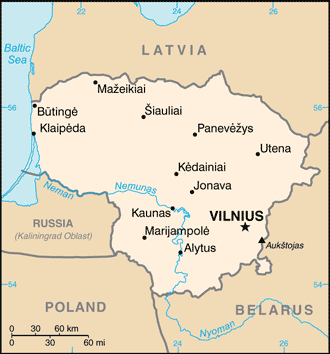
Eastern Europe, bordering the Baltic Sea, between Latvia and Russia, west of Belarus
Geographic coordinates
56 00 N, 24 00 E
Map references
Europe
Area
land: 62,680 sq km
water: 2,620 sq km
Area - comparative
slightly larger than West Virginia
Land boundaries
border countries: Belarus 640 km; Latvia 544 km; Poland 100 km; Russia (Kaliningrad) 261 km
Coastline
90 km
Maritime claims
Climate
transitional, between maritime and continental; wet, moderate winters and summers
Terrain
lowland, many scattered small lakes, fertile soil
Elevation
lowest point: Baltic Sea 0 m
mean elevation: 110 m
Natural resources
peat, arable land, amber
Land use
agricultural land
agricultural land: arable land
agricultural land: permanent crops
agricultural land: permanent pasture
forest
other
Irrigated land
61 sq km (2020)
Major lakes (area sq km)
Population distribution
fairly even population distribution throughout the country, but somewhat greater concentrations in the southern cities of Vilnius and Kaunas, as well as the western port of Klaipeda
Natural hazards
occasional floods, droughts
Geography - note
fertile central plains are separated by hilly uplands that are ancient glacial deposits
People & Society35
Population
male: 1,334,600
female: 1,481,087
Nationality
adjective: Lithuanian
Ethnic groups
Lithuanian 84.6%, Polish 6.5%, Russian 5%, Belarusian 1%, other 1.1%, unspecified 1.8% (2021 est.)
Languages
major-language sample(s):
Pasaulio enciklopedija – naudingas bendrosios informacijos šaltinis. (Lithuanian)
The World Factbook, the indispensable source for basic information.
Religions
Roman Catholic 74.2%, Russian Orthodox 3.7%, Old Believer 0.6%, Evangelical Lutheran 0.6%, Evangelical Reformist 0.2%, other (including Sunni Muslim, Jewish, Greek Catholic, and Karaite) 0.9%, none 6.1%, unspecified 13.7% (2021 est.)
Age structure
15-64 years: 62.6% (male 808,435/female 837,908)
65 years and over: 22.2% (2024 est.) (male 201,405/female 380,898)
Dependency ratios
youth dependency ratio: 23.3 (2025 est.)
elderly dependency ratio: 33.3 (2025 est.)
potential support ratio: 3 (2025 est.)
Median age
male: 40.9 years
female: 49.2 years
Population growth rate
-0.71% (2025 est.)
Birth rate
7.01 births/1,000 population (2025 est.)
Death rate
14.1 deaths/1,000 population (2025 est.)
Net migration rate
0 migrant(s)/1,000 population (2025 est.)
Population distribution
fairly even population distribution throughout the country, but somewhat greater concentrations in the southern cities of Vilnius and Kaunas, as well as the western port of Klaipeda
Urbanization
rate of urbanization: -0.12% annual rate of change (2020-25 est.)
Major urban areas - population
541,000 VILNIUS (capital) (2023)
Sex ratio
0-14 years: 1.06 male(s)/female
15-64 years: 0.96 male(s)/female
65 years and over: 0.53 male(s)/female
total population: 0.86 male(s)/female (2024 est.)
Mother's mean age at first birth
28.2 years (2020 est.)
Maternal mortality ratio
8 deaths/100,000 live births (2023 est.)
Infant mortality rate
male: 4 deaths/1,000 live births
female: 3.1 deaths/1,000 live births
Life expectancy at birth
male: 70.8 years
female: 81.7 years
Total fertility rate
1.22 children born/woman (2025 est.)
Gross reproduction rate
0.6 (2025 est.)
Drinking water source
improved: urban
improved: rural
improved: total
unimproved: urban
unimproved: rural
unimproved: total
Health expenditure
Health expenditure (as % of national budget): 13% of national budget (2022 est.)
Physician density
6.1 physicians/1,000 population (2023)
Hospital bed density
6 beds/1,000 population (2020 est.)
Sanitation facility access
improved: urban
improved: rural
improved: total
unimproved: urban
unimproved: rural
unimproved: total
Obesity - adult prevalence rate
26.3% (2016)
Alcohol consumption per capita
beer: 4.61 liters of pure alcohol (2019 est.)
wine: 0.88 liters of pure alcohol (2019 est.)
spirits: 4.96 liters of pure alcohol (2019 est.)
other alcohols: 1.48 liters of pure alcohol (2019 est.)
Tobacco use
male: 38% (2025 est.)
female: 16.7% (2025 est.)
Children under the age of 5 years underweight
1.1% (2021 est.)
Currently married women (ages 15-49)
51.8% (2024 est.)
Child marriage
women married by age 18: 0.2% (2022)
Education expenditure
Education expenditure (% national budget): 11.8% national budget (2022 est.)
School life expectancy (primary to tertiary education)
male: 16 years (2022 est.)
female: 17 years (2022 est.)
Government23
Country name
conventional long form
conventional short form
local long form
local short form
former
etymology
Government type
semi-presidential republic
Capital
geographic coordinates: 54 41 N, 25 19 E
time difference: UTC+2 (7 hours ahead of Washington, DC, during Standard Time)
daylight saving time: +1hr, begins last Sunday in March; ends last Sunday in October
etymology: named after the Vilnia River; the river name is said to derive from the Lithuanian word vilnis, meaning "wave"
Administrative divisions
Legal system
civil law system; legislative acts can be appealed to the Constitutional Court
Constitution
amendment process: proposed by at least one fourth of all Parliament members or by petition of at least 300,000 voters; passage requires two-thirds majority vote of Parliament in each of two readings three months apart and a presidential signature; amendments to constitutional articles on national sovereignty and constitutional amendment procedure also require three-fourths voter approval in a referendum
International law organization participation
accepts compulsory ICJ jurisdiction with reservations; accepts ICCt jurisdiction
Citizenship
citizenship by descent only: at least one parent must be a citizen of Lithuania
dual citizenship recognized: no
residency requirement for naturalization: 10 years
Suffrage
18 years of age; universal
Executive branch
chief of state
head of government
cabinet
election/appointment process
most recent election date
election results
2024: Gitanas NAUSEDA elected president in second round; percent of vote -Gitanas NAUSEDA (independent) 75.6%, Ingrida SIMONYTE (TS-LKD) 24.4%
2019: Gitanas NAUSEDA elected president in second round; percent of vote - Gitanas NAUSEDA (independent) 66.7%, Ingrida SIMONYTE (independent) 33.3%
expected date of next election
Legislative branch
legislature name
legislative structure
number of seats
electoral system
scope of elections
term in office
most recent election date
parties elected and seats per party
percentage of women in chamber
expected date of next election
Judicial branch
judge selection and term of office: Supreme Court judges nominated by the president and appointed by the Seimas; judges serve 5-year renewable terms; Constitutional Court judges appointed by the Seimas from nominations - 3 each by the president of the republic, the Seimas speaker, and the Supreme Court president; judges serve 9-year, nonrenewable terms; one third of membership reconstituted every 3 years
subordinate courts: Court of Appeals; district and local courts
Political parties
Dawn of Nemunas or PPNA
Electoral Action of Poles in Lithuania - Christian Families Alliance or LLRA–KŠS
Homeland Union or TS-LKD
Lithuanian Farmers and Greens Union or LVŽS
Liberals' Movement or LRLS
National Alliance or NS
Social Democratic Party of Lithuania or LSDP
Union of Democrats for Lithuania or DSVL
Diplomatic representation in the US
chief of mission
chancery
telephone
FAX
email address and website
consulate(s) general
Diplomatic representation from the US
chief of mission
embassy
mailing address
telephone
FAX
email address and website
International organization participation
Australia Group, BA, BIS, CBSS, CD, CE, EAPC, EBRD, ECB, EIB, EU, FAO, IAEA, IBRD, ICAO, ICC (national committees), ICCt, ICRM, IDA, IFC, IFRCS, ILO, IMF, IMO, Interpol, IOC, IOM, IPU, ISO, ITU, ITUC (NGOs), MIGA, NATO, NIB, NSG, OAS (observer), OECD, OIF (observer), OPCW, OSCE, PCA, Schengen Convention, UN, UNCTAD, UNESCO, UNHRC, UNIDO, UNWTO, UPU, Wassenaar Arrangement, WCO, WHO, WIPO, WMO, WTO
Independence
16 February 1918 (from Soviet Russia and Germany); 11 March 1990 (declared from the Soviet Union); 6 September 1991 (recognized by the Soviet Union); notable earlier dates: 6 July 1253 (coronation of MINDAUGAS, traditional founding date); 1 July 1569 (Polish-Lithuanian Commonwealth created)
National holiday
Flag
meaning: yellow stands for golden fields, the sun, light, and goodness; green for the forests, nature, freedom, and hope; red for courage and the blood spilled in defense of the homeland
National symbol(s)
mounted knight known as Vytis (the Chaser), white stork
National color(s)
yellow, green, red
National anthem(s)
lyrics/music: Vincas KUDIRKA
history: adopted 1918, restored 1990; written in 1898 when Lithuania was part of Russia; banned during the Soviet occupation from 1940 to 1990
National heritage
selected World Heritage Site locales: Vilnius Historic Center; Curonian Spit; Kernavė Archaeological Site; Struve Geodetic Arc; Modernist Kaunas: Architecture of Optimism, 1919-1939
Economy31
Economic overview
high-income EU and eurozone member, largest Baltic economy; recovery supported by private consumption and EU fund-driven investments; structural challenges include pension reform, aging workforce, and high energy-import costs
Real GDP (purchasing power parity)
Real GDP (purchasing power parity) 2023: $132.552 billion (2023 est.)
Real GDP (purchasing power parity) 2022: $132.099 billion (2022 est.)
Real GDP growth rate
Real GDP growth rate 2023: 0.3% (2023 est.)
Real GDP growth rate 2022: 2.5% (2022 est.)
Real GDP per capita
Real GDP per capita 2023: $46,200 (2023 est.)
Real GDP per capita 2022: $46,700 (2022 est.)
GDP (official exchange rate)
Inflation rate (consumer prices)
Inflation rate (consumer prices) 2023: 9.1% (2023 est.)
Inflation rate (consumer prices) 2022: 19.7% (2022 est.)
GDP - composition, by sector of origin
industry: 23.4% (2024 est.)
services: 63.6% (2024 est.)
GDP - composition, by end use
household consumption
government consumption
investment in fixed capital
investment in inventories
exports of goods and services
imports of goods and services
Agricultural products
Industries
metal-cutting machine tools, electric motors, televisions, refrigerators and freezers, petroleum refining, shipbuilding (small ships), furniture, textiles, food processing, fertilizer, agricultural machinery, optical equipment, lasers, electronic components, computers, amber jewelry, information technology, video game development, app/software development, biotechnology
Industrial production growth rate
Labor force
Unemployment rate
Unemployment rate 2023: 6.9% (2023 est.)
Unemployment rate 2022: 6% (2022 est.)
Youth unemployment rate (ages 15-24)
male: 16.3% (2024 est.)
female: 11.7% (2024 est.)
Population below poverty line
Gini Index coefficient - distribution of family income
Average household expenditures
on alcohol and tobacco: 5.5% of household expenditures (2023 est.)
Household income or consumption by percentage share
highest 10%: 28.7% (2022 est.)
Remittances
Remittances 2023: 1.2% of GDP (2023 est.)
Remittances 2022: 1% of GDP (2022 est.)
Budget
expenditures: $28.68 billion (2023 est.)
Public debt
Taxes and other revenues
Current account balance
Current account balance 2023: $878.388 million (2023 est.)
Current account balance 2022: -$4.322 billion (2022 est.)
Exports
Exports 2023: $61.02 billion (2023 est.)
Exports 2022: $61.448 billion (2022 est.)
Exports - partners
Exports - commodities
Imports
Imports 2023: $57.899 billion (2023 est.)
Imports 2022: $62.916 billion (2022 est.)
Imports - partners
Imports - commodities
Reserves of foreign exchange and gold
Reserves of foreign exchange and gold 2023: $6.168 billion (2023 est.)
Reserves of foreign exchange and gold 2022: $5.365 billion (2022 est.)
Exchange rates
Currency
Exchange rates 2024
Exchange rates 2023
Exchange rates 2022
Exchange rates 2021
Exchange rates 2020
Energy8
Electricity access
Electricity
consumption: 10.992 billion kWh (2023 est.)
exports: 3.98 billion kWh (2023 est.)
imports: 10.91 billion kWh (2023 est.)
transmission/distribution losses: 829.9 million kWh (2023 est.)
Electricity generation sources
solar: 14.1% of total installed capacity (2023 est.)
wind: 51% of total installed capacity (2023 est.)
hydroelectricity: 4.8% of total installed capacity (2023 est.)
biomass and waste: 13.8% of total installed capacity (2023 est.)
Nuclear energy
Coal
exports: 78,000 metric tons (2023 est.)
imports: 149,000 metric tons (2023 est.)
Petroleum
refined petroleum consumption: 67,000 bbl/day (2024 est.)
crude oil estimated reserves: 12 million barrels (2021 est.)
Natural gas
exports: 1.867 billion cubic meters (2023 est.)
imports: 3.282 billion cubic meters (2023 est.)
Energy consumption per capita
Communications6
Telephones - fixed lines
subscriptions per 100 inhabitants: 8 (2023 est.)
Telephones - mobile cellular
subscriptions per 100 inhabitants: 139 (2024 est.)
Broadcast media
Internet country code
.lt
Internet users
Broadband - fixed subscriptions
subscriptions per 100 inhabitants: 28 (2023 est.)
Transportation6
Civil aircraft registration country code prefix
LY
Airports
64 (2025)
Heliports
2 (2025)
Railways
Merchant marine
by type: container ship 3, general cargo 19, oil tanker 2, other 35
Ports
total ports
large
medium
small
very small
ports with oil terminals
key ports
Military & Security7
Military and security forces
note 2: the Lithuanian Police and State Border Guard Service are under the Ministry of Interior; in wartime, the State Border Guard Service becomes part of the armed forces
Military expenditures
Military Expenditures 2024: 3.1% of GDP (2024 est.)
Military Expenditures 2023: 2.7% of GDP (2023 est.)
Military Expenditures 2022: 2.4% of GDP (2022 est.)
Military Expenditures 2021: 2% of GDP (2021 est.)
Military and security service personnel strengths
approximately 20,000 active-duty military personnel (2025)
Military equipment inventories and acquisitions
the military's inventory is a mix of mostly European and US armaments (2025)
Military service age and obligation
note 2: as of 2020, women comprised about 12% of the military's full-time personnel
Military deployments
Military - note
since 2017, Lithuania has hosted a German-led multinational NATO ground force battlegroup as part of the Alliance’s Enhanced Forward Presence initiative; NATO has also provided air protection for Lithuania since 2004 through its Baltic Air Policing mission; NATO fighter aircraft are hosted at Lithuania’s Šiauliai Air Base (2025)
Transnational Issues1
Refugees and internally displaced persons
stateless persons: 2,236 (2024 est.)