
Liechtenstein
Principality of Liechtenstein
Population
40.5K
Area
160 km²
GDP
$8.39B
GDP Per Capita
$210,600
Pop. Density
253/km²
Quick Facts
Currency
FrSwiss franc(CHF)
Calling Code
+423
Timezone
UTC+01:00
Languages
German+more
Driving Side
right
Demonym
Liechtensteiner
Background
Historical Trends
GDP (USD)
↑106.0% since 2006Population
↑15.4% since 2006Life Expectancy at Birth
Latest: 84.8 yearsData source: World Bank Open Data
Geography18
Location
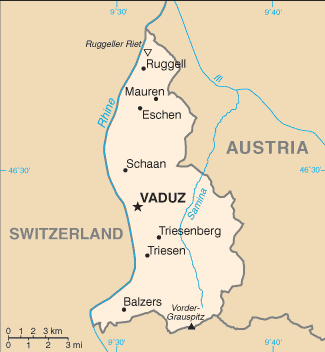
Central Europe, between Austria and Switzerland
Geographic coordinates
47 16 N, 9 32 E
Map references
Europe
Area
land: 160 sq km
water: 0 sq km
Area - comparative
about 0.9 times the size of Washington, D.C.
Land boundaries
border countries: Austria 34 km; Switzerland 41 km
Coastline
0 km (doubly landlocked)
Maritime claims
none (landlocked)
Climate
continental; cold, cloudy winters with frequent snow or rain; cool to moderately warm, cloudy, humid summers
Terrain
mostly mountainous (Alps) with Rhine Valley in western third
Elevation
lowest point: Ruggeller Riet 430 m
Natural resources
hydroelectric potential, arable land
Land use
agricultural land
agricultural land: arable land
agricultural land: permanent crops
agricultural land: permanent pasture
forest
other
Irrigated land
0 sq km (2012)
Major watersheds (area sq km)
Population distribution
most of the population is found in the western half of the country along the Rhine River
Natural hazards
avalanches, landslides
Geography - note
along with Uzbekistan, one of only two doubly landlocked countries in the world; variety of microclimatic variations based on elevation
People & Society27
Population
male: 20,215
female: 20,332
Nationality
adjective: Liechtenstein
Ethnic groups
Languages
major-language sample(s):
Das World Factbook, die unverzichtbare Quelle für grundlegende Informationen. (German)
The World Factbook, the indispensable source for basic information.
Religions
Roman Catholic (official) 73.4%, Protestant Reformed 6.3%, Muslim 5.9%, Christian Orthodox 1.3%, Lutheran 1.2%, other Protestant 0.7%, other Christian 0.3%, other 0.8%, none 7%, unspecified 3.3% (2015 est.)
Age structure
15-64 years: 63.9% (male 12,814/female 12,921)
65 years and over: 20.8% (2024 est.) (male 3,846/female 4,547)
Dependency ratios
youth dependency ratio: 23.9 (2025 est.)
elderly dependency ratio: 33.6 (2025 est.)
potential support ratio: 3 (2025 est.)
Median age
male: 42.4 years
female: 46.1 years
Population growth rate
0.68% (2025 est.)
Birth rate
10.31 births/1,000 population (2025 est.)
Death rate
8.24 deaths/1,000 population (2025 est.)
Net migration rate
4.71 migrant(s)/1,000 population (2025 est.)
Population distribution
most of the population is found in the western half of the country along the Rhine River
Urbanization
rate of urbanization: 1.15% annual rate of change (2020-25 est.)
Major urban areas - population
5,000 VADUZ (capital) (2018)
Sex ratio
0-14 years: 1.25 male(s)/female
15-64 years: 0.99 male(s)/female
65 years and over: 0.85 male(s)/female
total population: 0.99 male(s)/female (2024 est.)
Mother's mean age at first birth
31.3 years (2017)
Infant mortality rate
male: 4.3 deaths/1,000 live births
female: 3.5 deaths/1,000 live births
Life expectancy at birth
male: 80.7 years
female: 85.8 years
Total fertility rate
1.69 children born/woman (2025 est.)
Gross reproduction rate
0.75 (2025 est.)
Drinking water source
unimproved: total: total: 0% of population (2022 est.)
Physician density
1.3 physicians/1,000 population (2022)
Sanitation facility access
unimproved: urban: urban: NA
unimproved: total: total: 0% of population (2022 est.)
Currently married women (ages 15-49)
64.7% (2020 est.)
Education expenditure
2.6% of GDP (2011 est.)
School life expectancy (primary to tertiary education)
male: 16 years (2021 est.)
female: 14 years (2021 est.)
Government23
Country name
conventional short form: Liechtenstein
local long form: Fuerstentum Liechtenstein
local short form: Liechtenstein
etymology: named after the Liechtenstein family that purchased and united the counties of Schellenburg and Vaduz in 1719; the family name was taken from its Austrian castle of the same name, which in German means "light stone"
Government type
constitutional monarchy
Capital
geographic coordinates: 47 08 N, 9 31 E
time difference: UTC+1 (6 hours ahead of Washington, DC, during Standard Time)
daylight saving time: +1hr, begins last Sunday in March; ends last Sunday in October
etymology: may be a conflation from the Latin vallis (valley) and the Old German dutsch (German) to produce Valdutsch ("German valley"), which was simplified over time to Vaduz
Administrative divisions
Legal system
civil law system influenced by Swiss, Austrian, and German law
Constitution
amendment process: proposed by Parliament, by the reigning prince (in the form of "Government" proposals), by petition of at least 1,500 qualified voters, or by at least four communes; passage requires unanimous approval of Parliament members in one sitting or three-quarters majority vote in two successive sittings; referendum required only if petitioned by at least 1,500 voters or by at least four communes; passage by referendum requires absolute majority of votes cast
International law organization participation
accepts compulsory ICJ jurisdiction with reservations; accepts ICCt jurisdiction
Citizenship
citizenship by descent only: the father must be a citizen of Liechtenstein; in the case of a child born out of wedlock, the mother must be a citizen
dual citizenship recognized: no
residency requirement for naturalization: 5 years
Suffrage
18 years of age; universal
Executive branch
head of government: Prime Minister Brigitte HAAS (since 10 April 2025)
cabinet: Cabinet elected by the Parliament, confirmed by the monarch
election/appointment process: the monarchy is hereditary; following legislative elections, the monarch usually appoints the leader of the majority party in Parliament as the head of government, and also appoints the leader of the largest minority party in Parliament as the deputy head of government if there is a coalition government
Legislative branch
legislature name
legislative structure
number of seats
electoral system
scope of elections
term in office
most recent election date
parties elected and seats per party
percentage of women in chamber
expected date of next election
Judicial branch
judge selection and term of office: judges of both courts elected by the Landtag and appointed by the monarch; Supreme Court judges serve 4-year renewable terms; Constitutional Court judges appointed for renewable 5-year terms
subordinate courts: Court of Appeal (second instance), Regional Court (first instance), Administrative Court, Tribunal Court, district courts
Political parties
Fatherland Union (Vaterlaendische Union) or VU
Progressive Citizens' Party (Fortschrittliche Buergerpartei) or FBP
The Free List (Die Freie Liste) or FL
The Independents (Die Unabhaengigen) or DU
Diplomatic representation in the US
chancery: 2900 K Street NW, Suite 602B, Washington, DC 20007
telephone: [1] (202) 331-0590
FAX: [1] (202) 331-3221
email address and website:
[email protected]
https://www.liechtensteinusa.org/
Diplomatic representation from the US
International organization participation
CD, CE, EBRD, EFTA, IAEA, ICCt, ICRM, IFRCS, Interpol, IOC, IPU, ITSO, ITU, ITUC (NGOs), OAS (observer), OPCW, OSCE, PCA, Schengen Convention, UN, UNCTAD, UPU, WIPO, WTO
Independence
23 January 1719 (Principality of Liechtenstein established); 12 July 1806 (independence from the Holy Roman Empire); 24 August 1866 (independence from the German Confederation)
National holiday
Flag
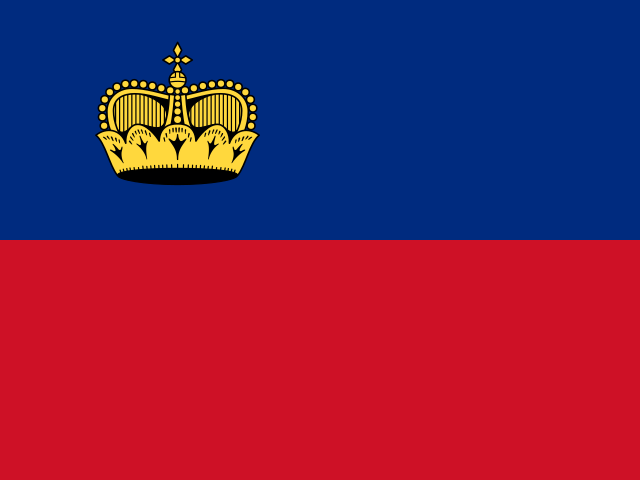
history: the colors may derive from the blue-and-red livery used in the principality's household in the 18th century; the prince's crown was added in 1937 to distinguish it from Haiti's flag
National symbol(s)
princely hat (crown)
National color(s)
blue, red
National coat of arms
National anthem(s)
lyrics/music: Jakob Joseph JAUCH/Josef FROMMELT
history: adopted 1850, revised 1963; uses the tune of the United Kingdom's anthem, "God Save the King"
Economy12
Economic overview
high-income European economy; Schengen Area participant; key European financial leader; integrated with Swiss economy and franc currency user; one of the highest GDP per capita countries; relies on US and Eurozone markets for exports
Real GDP (purchasing power parity)
Real GDP (purchasing power parity) 2023: $7.031 billion (2023 est.)
Real GDP (purchasing power parity) 2022: $6.885 billion (2022 est.)
Real GDP per capita
Real GDP per capita 2023: $201,200 (2023 est.)
Real GDP per capita 2022: $187,700 (2022 est.)
GDP (official exchange rate)
Inflation rate (consumer prices)
Inflation rate (consumer prices) 2021: 0.6% (2021 est.)
Inflation rate (consumer prices) 2020: -0.7% (2020 est.)
GDP - composition, by sector of origin
industry: 40.6% (2022 est.)
services: 55.6% (2022 est.)
Agricultural products
wheat, barley, corn, potatoes; livestock, dairy products
Industries
electronics, metal manufacturing, dental products, ceramics, pharmaceuticals, food products, precision instruments, tourism, optical instruments
Exports
Exports 2014: $3.774 billion (2014 est.)
Exports - commodities
small specialty machinery, connectors for audio and video, parts for motor vehicles, dental products, hardware
Imports - commodities
agricultural products, raw materials, energy products, machinery, metal goods, textiles, foodstuffs, motor vehicles
Exchange rates
Currency
Exchange rates 2024
Exchange rates 2023
Exchange rates 2022
Exchange rates 2021
Exchange rates 2020
Energy1
Electricity access
Communications6
Telephones - fixed lines
subscriptions per 100 inhabitants: 26 (2023 est.)
Telephones - mobile cellular
subscriptions per 100 inhabitants: 129 (2024 est.)
Broadcast media
relies on foreign terrestrial and satellite broadcasters for most broadcast media services; first Liechtenstein-based TV station established in 2008; Radio Liechtenstein operates multiple radio stations; a Swiss-based broadcaster operates one radio station
Internet country code
.li
Internet users
Broadband - fixed subscriptions
subscriptions per 100 inhabitants: 50 (2023 est.)
Transportation4
Civil aircraft registration country code prefix
HB
Heliports
2 (2025)
Railways
standard gauge: 9 km (2018) 1.435-m gauge (electrified)
Merchant marine
by type: bulk carrier 14, general cargo 1, other 2 (includes Switzerland)
Military & Security1
Military and security forces
Transnational Issues1
Refugees and internally displaced persons
Compare Liechtenstein
See how Liechtenstein compares to other countries side by side.
Compare Countries