

Latvia
Republic of Latvia
Population
1.89M
Area
64,589 km²
GDP
$43.52B
GDP Per Capita
$38,900
Pop. Density
29/km²
Quick Facts
Currency
€euro(EUR)
Calling Code
+371
Timezone
UTC+02:00
Languages
Latvian+more
Driving Side
right
Demonym
Latvian
Background
Historical Trends
GDP (USD)
↑113.8% since 2006Population
↓15.9% since 2006Life Expectancy at Birth
Latest: 75.7 yearsData source: World Bank Open Data
Geography17
Location
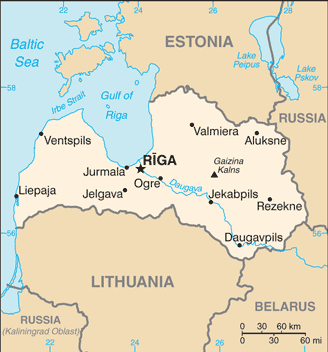
Eastern Europe, bordering the Baltic Sea, between Estonia and Lithuania
Geographic coordinates
57 00 N, 25 00 E
Map references
Europe
Area
land: 62,249 sq km
water: 2,340 sq km
Area - comparative
slightly larger than West Virginia
Land boundaries
border countries: Belarus 161 km; Estonia 333 km; Lithuania 544 km; Russia 332 km
Coastline
498 km
Maritime claims
exclusive economic zone: limits as agreed to by Estonia, Finland, Latvia, Sweden, and Russia
continental shelf: 200 m depth or to the depth of exploitation
Climate
maritime; wet, moderate winters
Terrain
low plain
Elevation
lowest point: Baltic Sea 0 m
mean elevation: 87 m
Natural resources
peat, limestone, dolomite, amber, hydropower, timber, arable land
Land use
agricultural land
agricultural land: arable land
agricultural land: permanent crops
agricultural land: permanent pasture
forest
other
Irrigated land
Population distribution
largest concentration of people is found in and around the port and capital city of Riga; small agglomerations are scattered throughout the country
Natural hazards
large percentage of agricultural fields can become waterlogged and require drainage
Geography - note
most of the country is composed of fertile low-lying plains with some hills in the east
People & Society33
Population
male: 876,654
female: 1,011,785
Nationality
adjective: Latvian
Ethnic groups
Latvian 62.7%, Russian 24.5%, Belarusian 3.1%, Ukrainian 2.2%, Polish 2%, Lithuanian 1.1%, other 1.8%, unspecified 2.6% (2021 est.)
Languages
major-language sample(s):
World Factbook, neaizstājams avots pamata informāciju. (Latvian)
The World Factbook, the indispensable source for basic information.
Religions
Lutheran 36.2%, Roman Catholic 19.5%, Orthodox 19.1%, other Christian 1.6%, other 0.1%, unspecified/none 23.5% (2017 est.)
Age structure
15-64 years: 63% (male 562,754/female 572,850)
65 years and over: 22.2% (2024 est.) (male 137,746/female 262,922)
Dependency ratios
youth dependency ratio: 23.3 (2025 est.)
elderly dependency ratio: 33 (2025 est.)
potential support ratio: 3 (2025 est.)
Median age
male: 41.6 years
female: 49.2 years
Population growth rate
-1.27% (2025 est.)
Birth rate
7.24 births/1,000 population (2025 est.)
Death rate
14.68 deaths/1,000 population (2025 est.)
Net migration rate
-5.3 migrant(s)/1,000 population (2025 est.)
Population distribution
largest concentration of people is found in and around the port and capital city of Riga; small agglomerations are scattered throughout the country
Urbanization
rate of urbanization: -0.68% annual rate of change (2020-25 est.)
Major urban areas - population
621,000 RIGA (capital) (2023)
Sex ratio
0-14 years: 1.06 male(s)/female
15-64 years: 0.98 male(s)/female
65 years and over: 0.52 male(s)/female
total population: 0.87 male(s)/female (2024 est.)
Mother's mean age at first birth
27.3 years (2020 est.)
Maternal mortality ratio
19 deaths/100,000 live births (2023 est.)
Infant mortality rate
male: 5.1 deaths/1,000 live births
female: 4.3 deaths/1,000 live births
Life expectancy at birth
male: 72 years
female: 81 years
Total fertility rate
1.25 children born/woman (2025 est.)
Gross reproduction rate
0.61 (2025 est.)
Drinking water source
improved: urban
improved: rural
improved: total
unimproved: urban
unimproved: rural
unimproved: total
Health expenditure
Health expenditure (as % of national budget): 12.1% of national budget (2022 est.)
Physician density
3.4 physicians/1,000 population (2022)
Hospital bed density
5.3 beds/1,000 population (2020 est.)
Obesity - adult prevalence rate
23.6% (2016)
Alcohol consumption per capita
beer: 4.9 liters of pure alcohol (2019 est.)
wine: 1.7 liters of pure alcohol (2019 est.)
spirits: 5.3 liters of pure alcohol (2019 est.)
other alcohols: 1 liters of pure alcohol (2019 est.)
Tobacco use
male: 43.5% (2025 est.)
female: 16.4% (2025 est.)
Children under the age of 5 years underweight
0.3% (2021 est.)
Currently married women (ages 15-49)
49.6% (2021 est.)
Education expenditure
Education expenditure (% national budget): 9.9% national budget (2022 est.)
School life expectancy (primary to tertiary education)
male: 15 years (2023 est.)
female: 17 years (2023 est.)
Government23
Country name
conventional long form
conventional short form
local long form
local short form
former
etymology
Government type
parliamentary republic
Capital
geographic coordinates: 56 57 N, 24 06 E
time difference: UTC+2 (7 hours ahead of Washington, DC, during Standard Time)
daylight saving time: +1hr, begins last Sunday in March; ends last Sunday in October
etymology: the name's origin is unclear; it may derive from the Old Lithuanian word ringa, meaning "bend" or "curve" and referring to the city's location on the Western Dvina River; alternatively, it may come from the Latvian word ridzina, meaning "stream"
Administrative divisions
municipalities: Adazi, Aizkraukle, Aluksne, Augsdaugava, Balvi, Bauska, Cesis, Dienvidkurzeme, Dobele, Gulbene, Jekabpils, Jelgava, Kekava, Kraslava, Kuldiga, Limbazi, Livani, Ludza, Madona, Marupe, Ogre, Olaine, Preili, Rezekne, Ropazi, Salaspils, Saldus, Saulkrasti, Sigulda, Smiltene, Talsi, Tukums, Valka, Valmiera, Varaklani, Ventspils
cities: Daugavpils, Jelgava, Jurmala, Liepaja, Rezekne, Riga, Ventspils
Legal system
civil law system with traces of socialist legal traditions and practices
Constitution
amendment process: proposed by two thirds of Parliament members or by petition of one tenth of qualified voters submitted through the president; passage requires at least two-thirds majority vote of Parliament in each of three readings; amendment of constitutional articles, including national sovereignty, language, the parliamentary electoral system, and constitutional amendment procedures, requires passage in a referendum by majority vote of at least one half of the electorate
International law organization participation
has not submitted an ICJ jurisdiction declaration; accepts ICCt jurisdiction
Citizenship
citizenship by descent only: at least one parent must be a citizen of Latvia
dual citizenship recognized: no
residency requirement for naturalization: 5 years
Suffrage
18 years of age; universal
Executive branch
chief of state
head of government
cabinet
election/appointment process
most recent election date
election results
2023: Edgars RINKEVICS elected president in the third round; Parliament vote - Edgars RINKEVICS (Unity Party) 52, Uldis Pīlēns (independent) 25; Evika SILINA confirmed as prime minister 53-39
2019: Egils LEVITS elected president; Parliament vote - Egils LEVITS (independent) 61, Didzis SMITS (KPV LV) 24, Juris JANSONS (independent) 8; Krisjanis KARINS confirmed as prime minister 61-39
expected date of next election
Legislative branch
legislature name
legislative structure
number of seats
electoral system
scope of elections
term in office
most recent election date
parties elected and seats per party
percentage of women in chamber
expected date of next election
Judicial branch
judge selection and term of office: Supreme Court judges nominated by chief justice and confirmed by the Saeima; judges serve until age 70, but term can be extended 2 years; Constitutional Court judges - 3 nominated by Saeima members, 2 by Cabinet ministers, and 2 by plenum of Supreme Court; all judges confirmed by Saeima majority vote; Constitutional Court president and vice president serve in their positions for 3 years; all judges serve 10-year terms; mandatory retirement at age 70
subordinate courts: district (city) and regional courts
Political parties
For Latvia's Development or LA
Harmony or S
Honor to Serve Riga! or GKR
Latvia First or LPV
National Alliance or NA
New Unity or JV
People. Land. Statehood. or TZV
The Progressives or PRO
Union of Greens and Farmers or ZZS
United List or AS
We for Talsi and Municipality or MTuN
Diplomatic representation in the US
chancery: 2306 Massachusetts Avenue NW, Washington, DC 20008
telephone: [1] (202) 328-2840
FAX: [1] (202) 328-2860
email address and website:
[email protected]
https://www2.mfa.gov.lv/en/usa
Diplomatic representation from the US
chief of mission
embassy
mailing address
telephone
FAX
email address and website
International organization participation
Australia Group, BA, BIS, CBSS, CD, CE, EAPC, EBRD, ECB, EIB, EMU, ESA (cooperating state), EU, FAO, IAEA, IBRD, ICAO, ICC (NGOs), ICCt, ICRM, IDA, IFC, IFRCS, IHO, ILO, IMF, IMO, IMSO, Interpol, IOC, IOM, IPU, ISO (correspondent), ITU, ITUC (NGOs), MIGA, NATO, NIB, NSG, OAS (observer), OIF (observer), OPCW, OSCE, PCA, Schengen Convention, UN, UNCTAD, UNESCO, UNHCR, UNWTO, UPU, Wassenaar Arrangement, WCO, WHO, WIPO, WMO, WTO
Independence
18 November 1918 (from Soviet Russia); 4 May 1990 (declared from the Soviet Union); 6 September 1991 (recognized by the Soviet Union)
National holiday
Flag
history: the flag is one of the older banners in the world -- a medieval chronicle mentions Latvian tribes using a red standard with a white stripe around 1280
National symbol(s)
white wagtail (bird)
National color(s)
maroon, white
National anthem(s)
lyrics/music: Karlis BAUMANIS
history: adopted 1920, restored 1990; first performed in 1873 when Latvia was part of Russia; banned during the Soviet occupation from 1940 to 1990
National heritage
selected World Heritage Site locales: Historic Center of Riga; Struve Geodetic Arc; Old town of Kuldīga
Economy31
Economic overview
high-income EU and eurozone member; weak recovery following economic contraction, with slight increase in private consumption and uncertain trade environment; challenges from skilled-labor shortages, capital market access, large informal sector, and green and digital transitions
Real GDP (purchasing power parity)
Real GDP (purchasing power parity) 2023: $72.838 billion (2023 est.)
Real GDP (purchasing power parity) 2022: $70.817 billion (2022 est.)
Real GDP growth rate
Real GDP growth rate 2023: 2.9% (2023 est.)
Real GDP growth rate 2022: 1.8% (2022 est.)
Real GDP per capita
Real GDP per capita 2023: $38,800 (2023 est.)
Real GDP per capita 2022: $37,700 (2022 est.)
GDP (official exchange rate)
Inflation rate (consumer prices)
Inflation rate (consumer prices) 2023: 8.9% (2023 est.)
Inflation rate (consumer prices) 2022: 17.3% (2022 est.)
GDP - composition, by sector of origin
industry: 19.9% (2024 est.)
services: 63.1% (2024 est.)
GDP - composition, by end use
household consumption
government consumption
investment in fixed capital
investment in inventories
exports of goods and services
imports of goods and services
Agricultural products
Industries
processed foods, processed wood products, textiles, processed metals, pharmaceuticals, railroad cars, synthetic fibers, electronics
Industrial production growth rate
Labor force
Unemployment rate
Unemployment rate 2023: 6.5% (2023 est.)
Unemployment rate 2022: 6.9% (2022 est.)
Youth unemployment rate (ages 15-24)
male: 13% (2024 est.)
female: 11.9% (2024 est.)
Population below poverty line
Gini Index coefficient - distribution of family income
Average household expenditures
on alcohol and tobacco: 7.1% of household expenditures (2023 est.)
Household income or consumption by percentage share
highest 10%: 25.8% (2022 est.)
Remittances
Remittances 2023: 2.9% of GDP (2023 est.)
Remittances 2022: 3.4% of GDP (2022 est.)
Budget
expenditures: $15.432 billion (2023 est.)
Public debt
Taxes and other revenues
Current account balance
Current account balance 2023: -$1.663 billion (2023 est.)
Current account balance 2022: -$2.082 billion (2022 est.)
Exports
Exports 2023: $28.294 billion (2023 est.)
Exports 2022: $29.364 billion (2022 est.)
Exports - partners
Exports - commodities
Imports
Imports 2023: $29.875 billion (2023 est.)
Imports 2022: $31.206 billion (2022 est.)
Imports - partners
Imports - commodities
Reserves of foreign exchange and gold
Reserves of foreign exchange and gold 2023: $4.957 billion (2023 est.)
Reserves of foreign exchange and gold 2022: $4.46 billion (2022 est.)
Exchange rates
Currency
Exchange rates 2024
Exchange rates 2023
Exchange rates 2022
Exchange rates 2021
Exchange rates 2020
Energy7
Electricity access
Electricity
consumption: 6.822 billion kWh (2023 est.)
exports: 3.271 billion kWh (2023 est.)
imports: 4.075 billion kWh (2023 est.)
transmission/distribution losses: 342.238 million kWh (2023 est.)
Electricity generation sources
solar: 3.8% of total installed capacity (2023 est.)
wind: 4.2% of total installed capacity (2023 est.)
hydroelectricity: 59.3% of total installed capacity (2023 est.)
biomass and waste: 10.4% of total installed capacity (2023 est.)
Coal
exports: 12,000 metric tons (2023 est.)
imports: 39,000 metric tons (2023 est.)
Petroleum
refined petroleum consumption: 33,000 bbl/day (2024 est.)
Natural gas
imports: 786.523 million cubic meters (2023 est.)
Energy consumption per capita
Communications6
Telephones - fixed lines
subscriptions per 100 inhabitants: 8 (2023 est.)
Telephones - mobile cellular
subscriptions per 100 inhabitants: 121 (2024 est.)
Broadcast media
several national and regional commercial TV stations are foreign-owned, 2 national TV stations are publicly owned; system supplemented by privately owned regional and local TV stations; cable and satellite multi-channel TV services with domestic and foreign broadcasts available; publicly owned broadcaster operates 4 radio networks with dozens of stations; dozens of private broadcasters also operate radio stations
Internet country code
.lv
Internet users
Broadband - fixed subscriptions
subscriptions per 100 inhabitants: 26 (2023 est.)
Transportation6
Civil aircraft registration country code prefix
YL
Airports
55 (2025)
Heliports
5 (2025)
Railways
Merchant marine
by type: container ship 2, general cargo 30, oil tanker 10, other 41
Ports
total ports
large
medium
small
very small
ports with oil terminals
key ports
Military & Security7
Military and security forces
Ministry of Interior: State Police, State Border Guards, State Security Service (2025)
Military expenditures
Military Expenditures 2024: 3.4% of GDP (2024 est.)
Military Expenditures 2023: 3% of GDP (2023 est.)
Military Expenditures 2022: 2.3% of GDP (2022 est.)
Military Expenditures 2021: 2.2% of GDP (2021 est.)
Military and security service personnel strengths
approximately 9,000 active-duty military personnel (2025)
Military equipment inventories and acquisitions
the Latvian military's inventory consists of European and US armaments (2025)
Military service age and obligation
note 2: as of 2024, women comprised about 16.5% of the military's full-time personnel
Military deployments
140 Kosovo (KFOR/NATO) (2025)
Military - note
in 2004, Latvia joined NATO and the EU, both of which it depends on to play a decisive role in Latvia’s security policy; the Latvian military has participated in EU and NATO missions abroad and regularly conducts training and exercises with EU and NATO partner forces; Latvia also hosts NATO partner forces; since 2017, it has hosted a Canadian-led multinational NATO ground force battlegroup as part of the Alliance’s Enhanced Forward Presence initiative; in addition, NATO has provided air protection for Latvia since 2004 through its Baltics Air Policing mission
Latvia is a member of the UK-led Joint Expeditionary Force, a pool of high-readiness military forces from 10 Baltic and Scandinavian countries designed to respond to a wide range of contingencies in the North Atlantic, Baltic Sea, and High North regions (2025)
Transnational Issues1
Refugees and internally displaced persons
stateless persons: 173,891 (2024 est.)