
Jordan
Hashemite Kingdom of Jordan
Population
11.31M
Area
89,342 km²
GDP
$53.35B
GDP Per Capita
$9,500
Pop. Density
127/km²
Quick Facts
Currency
د.اJordanian dinar(JOD)
Calling Code
+962
Timezone
UTC+03:00
Languages
Arabic+more
Driving Side
right
Demonym
Jordanian
Background
After World War I and the dissolution of the Ottoman Empire, the League of Nations awarded Britain the mandate to govern much of the Middle East. In 1921, Britain demarcated from Palestine a semi-autonomous region of Transjordan and recognized ABDALLAH I from the Hashemite family as the country's first leader. The Hashemites also controlled the Hijaz, or the western coastal area of modern-day Saudi Arabia, until 1925, when IBN SAUD and Wahhabi tribes pushed them out. The country gained its independence in 1946 and thereafter became the Hashemite Kingdom of Jordan.
The country has had four kings. Long-time ruler King HUSSEIN (r. 1953-99) successfully navigated competing pressures from the major powers (US, UK, and Soviet Union), various Arab states, Israel, and Palestinian militants, the latter of which led to a brief civil war in 1970 that is known as "Black September" and ended in King HUSSEIN ousting the militants.Jordan's borders have changed since it gained independence. In 1948, Jordan took control of the West Bank and East Jerusalem in the first Arab-Israeli War, eventually annexing those territories in 1950 and granting its new Palestinian residents Jordanian citizenship. In 1967, Jordan lost the West Bank and East Jerusalem to Israel in the Six-Day War but retained administrative claims to the West Bank until 1988, when King HUSSEIN permanently relinquished Jordanian claims to the West Bank in favor of the Palestine Liberation Organization (PLO). King HUSSEIN signed a peace treaty with Israel in 1994, after Israel and the PLO signed the Oslo Accords in 1993.
Jordanian kings continue to claim custodianship of the Muslim holy sites in Jerusalem by virtue of their Hashemite heritage as descendants of the Prophet Mohammad and agreements with Israel and Jerusalem-based religious and Palestinian leaders. After Israel captured East Jerusalem in the 1967 War, it authorized the Jordanian-controlled Islamic Trust, or Waqf, to continue administering the Al Haram ash Sharif/Temple Mount holy compound, and the Jordan-Israel peace treaty reaffirmed Jordan's "special role" in administering the Muslim holy shrines in Jerusalem. Jordanian kings claim custodianship of the Christian sites in Jerusalem on the basis of the 7th-century Pact of Omar, when the Muslim leader, after conquering Jerusalem, agreed to permit Christian worship.
King HUSSEIN died in 1999 and was succeeded by his eldest son and current King ABDALLAH II. In 2009, ABDALLAH II designated his son HUSSEIN as the Crown Prince. During his reign, ABDALLAH II has contended with a series of challenges, including the Arab Spring influx of refugees from neighboring states, the COVID-19 pandemic, the effects of the war in Ukraine, a perennially weak economy, and the Israel-HAMAS conflict that began in October 2023.
Historical Trends
GDP (USD)
↑254.3% since 2006Population
↑79.7% since 2006Life Expectancy at Birth
Latest: 77.8 yearsData source: World Bank Open Data
Geography20
Location
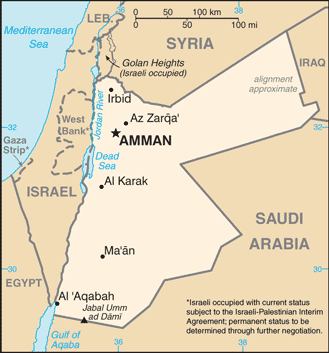
Middle East, northwest of Saudi Arabia, between Israel (to the west) and Iraq
Geographic coordinates
31 00 N, 36 00 E
Map references
Middle East
Area
land: 88,802 sq km
water: 540 sq km
Area - comparative
about three-quarters the size of Pennsylvania; slightly smaller than Indiana
Land boundaries
border countries: Iraq 179 km; Israel 307 km; Saudi Arabia 731 km; Syria 379 km; West Bank 148 km
Coastline
26 km
Maritime claims
Climate
mostly arid desert; rainy season in west (November to April)
Terrain
mostly arid desert plateau; a great north-south geological rift along the west of the country is the dominant topographical feature and includes the Jordan River Valley, the Dead Sea, and the Jordanian Highlands
Elevation
lowest point: Dead Sea -431 m
mean elevation: 812 m
Natural resources
phosphates, potash, shale oil
Land use
agricultural land
agricultural land: arable land
agricultural land: permanent crops
agricultural land: permanent pasture
forest
other
Irrigated land
875 sq km (2022)
Major lakes (area sq km)
note - endorheic hypersaline lake; 9.6 times saltier than the ocean; lake shore is 431 meters below sea level
Major watersheds (area sq km)
Major aquifers
Arabian Aquifer System
Population distribution
population heavily concentrated in the west, and particularly the northwest, in and around the capital of Amman; a sizeable but smaller population is located in the southwest along the shore of the Gulf of Aqaba
Natural hazards
droughts; periodic earthquakes; flash floods
Geography - note
strategic location at the head of the Gulf of Aqaba; the Arab country that shares the longest border with Israel and the West Bank; the Dead Sea, the lowest point in Asia and the second saltiest body of water in the world (after Lac Assal in Djibouti), lies on Jordan's western border with Israel and the West Bank; Jordan is almost landlocked but does have a 26 km southwestern coastline with a single port, Al 'Aqabah (Aqaba)
People & Society36
Population
male: 5,908,853
female: 5,403,654
Nationality
adjective: Jordanian
Ethnic groups
Languages
major-language sample(s):
كتاب حقائق العالم، المصدر الذي لا يمكن الاستغناء عنه للمعلومات الأساسية (Arabic)
The World Factbook, the indispensable source for basic information.
Religions
Age structure
15-64 years: 64.9% (male 3,844,575/female 3,409,164)
65 years and over: 4.2% (2024 est.) (male 228,564/female 241,703)
Dependency ratios
youth dependency ratio: 46.6 (2025 est.)
elderly dependency ratio: 6.7 (2025 est.)
potential support ratio: 14.9 (2025 est.)
Median age
male: 25.5 years
female: 24.4 years
Population growth rate
1.68% (2025 est.)
Birth rate
21.9 births/1,000 population (2025 est.)
Death rate
3.5 deaths/1,000 population (2025 est.)
Net migration rate
-1.59 migrant(s)/1,000 population (2025 est.)
Population distribution
population heavily concentrated in the west, and particularly the northwest, in and around the capital of Amman; a sizeable but smaller population is located in the southwest along the shore of the Gulf of Aqaba
Urbanization
rate of urbanization: 0.98% annual rate of change (2020-25 est.)
Major urban areas - population
2.232 million AMMAN (capital) (2023)
Sex ratio
0-14 years: 1.06 male(s)/female
15-64 years: 1.13 male(s)/female
65 years and over: 0.95 male(s)/female
total population: 1.1 male(s)/female (2024 est.)
Mother's mean age at first birth
Maternal mortality ratio
31 deaths/100,000 live births (2023 est.)
Infant mortality rate
male: 14.3 deaths/1,000 live births
female: 12.1 deaths/1,000 live births
Life expectancy at birth
male: 75 years
female: 78.1 years
Total fertility rate
2.83 children born/woman (2025 est.)
Gross reproduction rate
1.37 (2025 est.)
Drinking water source
improved: urban
improved: rural
improved: total
unimproved: urban
unimproved: rural
unimproved: total
Health expenditure
Health expenditure (as % of national budget): 7.6% of national budget (2022 est.)
Physician density
2.85 physicians/1,000 population (2022)
Hospital bed density
1.4 beds/1,000 population (2021 est.)
Sanitation facility access
improved: urban
improved: rural
improved: total
unimproved: urban
unimproved: rural
unimproved: total
Obesity - adult prevalence rate
35.5% (2016)
Alcohol consumption per capita
beer: 0.06 liters of pure alcohol (2019 est.)
wine: 0 liters of pure alcohol (2019 est.)
spirits: 0.19 liters of pure alcohol (2019 est.)
other alcohols: 0 liters of pure alcohol (2019 est.)
Tobacco use
male: 58.6% (2025 est.)
female: 13.9% (2025 est.)
Children under the age of 5 years underweight
2.5% (2023 est.)
Currently married women (ages 15-49)
56% (2018 est.)
Child marriage
women married by age 18: 9.7% (2018)
men married by age 18: 0.1% (2018)
Education expenditure
Education expenditure (% national budget): 11.7% national budget (2024 est.)
Literacy
male: 97.5% (2023 est.)
female: 92.3% (2023 est.)
School life expectancy (primary to tertiary education)
male: 13 years (2023 est.)
female: 14 years (2023 est.)
Government25
Country name
conventional long form
conventional short form
local long form
local short form
former
etymology
Government type
parliamentary constitutional monarchy
Capital
geographic coordinates: 31 57 N, 35 56 E
time difference: UTC+3 (8 hours ahead of Washington, DC, during Standard Time)
etymology: in the 13th century B.C., the Ammonites named their primary city Rabbath Ammon; rabbath meant "capital," so the name translated as "The Capital of [the] Ammon[ites];" over time, the name was shortened to Ammon, and then to Amman
Administrative divisions
Legal system
mixed system developed from Ottoman Empire codes (based on French law), British common law, and Islamic law
Constitution
amendment process: constitutional amendments require at least a two-thirds majority vote of both the Senate and the House and ratification by the king
International law organization participation
has not submitted an ICJ jurisdiction declaration; accepts ICCt jurisdiction
Citizenship
citizenship by descent only: the father must be a citizen of Jordan
dual citizenship recognized: yes
residency requirement for naturalization: 15 years
Suffrage
18 years of age; universal
Executive branch
head of government: Prime Minister Jafar HASSAN (since 15 September 2024)
cabinet: Cabinet appointed by the monarch in consultation with the prime minister
election/appointment process: prime minister appointed by the monarch
Legislative branch
legislative structure: bicameral
Legislative branch - lower chamber
chamber name
number of seats
electoral system
scope of elections
term in office
most recent election date
percentage of women in chamber
expected date of next election
Legislative branch - upper chamber
chamber name
number of seats
scope of elections
term in office
most recent election date
percentage of women in chamber
expected date of next election
Judicial branch
judge selection and term of office: Supreme Court chief justice appointed by the king; other judges nominated by the Judicial Council, an 11-member judicial policymaking body consisting of high-level judicial officials and judges, and approved by the king; judge tenure not limited; Constitutional Court members appointed by the king for 6-year non-renewable terms with one third of the membership renewed every 2 years
subordinate courts: Courts of Appeal; Great Felonies Court; religious courts; military courts; juvenile courts; Land Settlement Courts; Income Tax Court; Higher Administrative Court; Customs Court; special courts including the State Security Court
Political parties
Blessed Land Party
Building and Labor Coalition
Eradah Party
Growth Party
Islamic Action Front or IAF
Jordanian al-Ansar Party
Jordanian al-Ghad Party
Jordanian Arab Socialist Ba'ath Party or JASBP
Jordanian Civil Democratic Party
Jordanian Communist Party or JCP
Jordanian Equality Party
Jordanian Democratic People's Party or HASD
Jordanian Democratic Popular Unity Party or JDPUP/Wihda
Jordanian Democratic Unionist Party
Jordanian Flame Party
Jordanian Future and Life Party
Jordanian Model Party
Jordanian National Integration Party
Jordanian National Loyalty Party
Jordanian Reform and Renewal Party or Hassad
Jordanian Shura Party
Jordanian Social Democratic Party or JSDP
Justice and Reform Party or JRP
Labor Party
National Charter Party
National Coalition Party
National Constitutional Party
National Current Party or NCP
National Islamic Party
National Union
Nationalist Movement Party or Hsq
New Path Party
Progress Party
Diplomatic representation in the US
chancery: 3504 International Drive NW, Washington, DC 20008
telephone: [1] (202) 966-2664
FAX: [1] (202) 966-3110
email address and website:
[email protected]
http://www.jordanembassyus.org/
Diplomatic representation from the US
chief of mission
embassy
mailing address
telephone
FAX
email address and website
International organization participation
ABEDA, AFESD, AMF, CAEU, CD, CICA, EBRD, FAO, G-11, G-77, IAEA, IBRD, ICAO, ICC, ICCt, ICRM, IDA, IDB, IFAD, IFC, IFRCS, ILO, IMF, IMO, IMSO, Interpol, IOC, IOM, IPU, ISO, ITSO, ITU, ITUC (NGOs), LAS, MIGA, MINUSTAH, MONUSCO, NAM, NATO (partner), OIC, OPCW, OSCE (partner), PCA, UN, UNAMID, UNCTAD, UNESCO, UNHCR, UNIDO, UNISFA, UNMIL, UNMISS, UNOCI, UNOOSA, UNRWA, UNWTO, UPU, WCO, WFTU (NGOs), WHO, WIPO, WMO, WTO
Independence
25 May 1946 (from League of Nations mandate under British administration)
National holiday
Independence Day, 25 May (1946)
Flag
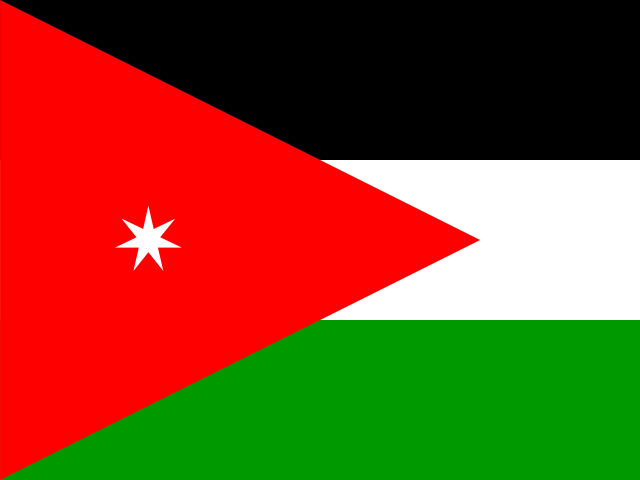
meaning: black stands for the Abbassid Caliphate, white for the Ummayyad Caliphate, and green for the Fatimid Caliphate; the triangle stands for the Great Arab Revolt of 1916, and the star's points for the seven verses of the opening Sura (Al-Fatiha) of the Quran, as well as faith in One God, humanity, national spirit, humility, social justice, virtue, and aspirations
history: the design is based on the Arab Revolt flag of World War I
National symbol(s)
eagle
National color(s)
black, white, green, red
National anthem(s)
lyrics/music: Abdul-Mone'm al-RIFAI'/Abdul-Qader al-TANEER
history: adopted 1946; the shortened version of the anthem is most commonly used; the full version is reserved for special occasions
National heritage
selected World Heritage Site locales: Petra (c); Quseir Amra (c); Um er-Rasas (Kastrom Mefa'a) (c); Wadi Rum Protected Area (m); Baptism Site “Bethany Beyond the Jordan” (Al-Maghtas) (c); As-Salt - The Place of Tolerance and Urban Hospitality (c); Umm Al-Jimāl (c)
Economy30
Economic overview
upper-middle-income Middle Eastern economy; high debt and unemployment, especially for youth and women; global events triggering trade slump and decreased revenue from tourism; growing manufacturing and agricultural sectors; key US foreign assistance recipient; natural-resource-poor and import-reliant
Real GDP (purchasing power parity)
Real GDP (purchasing power parity) 2023: $107.315 billion (2023 est.)
Real GDP (purchasing power parity) 2022: $104.307 billion (2022 est.)
Real GDP growth rate
Real GDP growth rate 2023: 2.9% (2023 est.)
Real GDP growth rate 2022: 2.6% (2022 est.)
Real GDP per capita
Real GDP per capita 2023: $9,400 (2023 est.)
Real GDP per capita 2022: $9,300 (2022 est.)
GDP (official exchange rate)
Inflation rate (consumer prices)
Inflation rate (consumer prices) 2023: 2.1% (2023 est.)
Inflation rate (consumer prices) 2022: 4.2% (2022 est.)
GDP - composition, by sector of origin
industry: 25.1% (2024 est.)
services: 60.4% (2024 est.)
GDP - composition, by end use
household consumption
government consumption
investment in fixed capital
investment in inventories
exports of goods and services
imports of goods and services
Agricultural products
Industries
tourism, information technology, clothing, fertilizer, potash, phosphate mining, pharmaceuticals, petroleum refining, cement, inorganic chemicals, light manufacturing
Industrial production growth rate
Labor force
Unemployment rate
Unemployment rate 2023: 18% (2023 est.)
Unemployment rate 2022: 18.2% (2022 est.)
Youth unemployment rate (ages 15-24)
male: 39.8% (2024 est.)
female: 49.2% (2024 est.)
Population below poverty line
Average household expenditures
on alcohol and tobacco: 4.5% of household expenditures (2023 est.)
Remittances
Remittances 2022: 10.1% of GDP (2022 est.)
Remittances 2021: 11% of GDP (2021 est.)
Budget
expenditures: $17.159 billion (2023 est.)
Public debt
Taxes and other revenues
Current account balance
Current account balance 2022: -$3.815 billion (2022 est.)
Current account balance 2021: -$3.718 billion (2021 est.)
Exports
Exports 2022: $20.743 billion (2022 est.)
Exports 2021: $13.87 billion (2021 est.)
Exports - partners
Exports - commodities
Imports
Imports 2022: $30.019 billion (2022 est.)
Imports 2021: $23.321 billion (2021 est.)
Imports - partners
Imports - commodities
Reserves of foreign exchange and gold
Reserves of foreign exchange and gold 2023: $19.069 billion (2023 est.)
Reserves of foreign exchange and gold 2022: $18.198 billion (2022 est.)
Debt - external
Exchange rates
Currency
Exchange rates 2024
Exchange rates 2023
Exchange rates 2022
Exchange rates 2021
Exchange rates 2020
Energy7
Electricity access
electrification - urban areas: 100%
electrification - rural areas: 98.9%
Electricity
consumption: 20.31 billion kWh (2023 est.)
exports: 162.93 million kWh (2023 est.)
imports: 383.073 million kWh (2023 est.)
transmission/distribution losses: 2.472 billion kWh (2023 est.)
Electricity generation sources
solar: 15.3% of total installed capacity (2023 est.)
wind: 7.7% of total installed capacity (2023 est.)
hydroelectricity: 0.1% of total installed capacity (2023 est.)
Coal
imports: 110,000 metric tons (2023 est.)
Petroleum
refined petroleum consumption: 97,000 bbl/day (2023 est.)
crude oil estimated reserves: 1 million barrels (2021 est.)
Natural gas
consumption: 5.441 billion cubic meters (2023 est.)
exports: 375.998 million cubic meters (2018 est.)
imports: 4.865 billion cubic meters (2023 est.)
proven reserves: 6.031 billion cubic meters (2021 est.)
Energy consumption per capita
Communications6
Telephones - fixed lines
subscriptions per 100 inhabitants: 4 (2023 est.)
Telephones - mobile cellular
subscriptions per 100 inhabitants: 70 (2024 est.)
Broadcast media
radio and TV dominated by the government-owned Jordan Radio and Television Corporation (JRTV) that operates a main network, a sports network, a film network, and a satellite channel; first independent TV broadcaster aired in 2007; international satellite TV and Israeli and Syrian TV broadcasts are available; roughly 30 radio stations; transmissions of multiple international radio broadcasters are available
Internet country code
.jo
Internet users
Broadband - fixed subscriptions
subscriptions per 100 inhabitants: 7 (2023 est.)
Transportation6
Civil aircraft registration country code prefix
JY
Airports
18 (2025)
Heliports
6 (2025)
Railways
narrow gauge: 509 km (2014) 1.050-m gauge
Merchant marine
by type: general cargo 5, other 29
Ports
total ports
large
medium
small
very small
ports with oil terminals
key ports
Military & Security7
Military and security forces
Ministry of Interior: Public Security Directorate (includes national police, the Gendarmerie, and the Civil Defense Directorate) (2025)
Military expenditures
Military Expenditures 2023: 4.5% of GDP (2023 est.)
Military Expenditures 2022: 4.8% of GDP (2022 est.)
Military Expenditures 2021: 5% of GDP (2021 est.)
Military Expenditures 2020: 5% of GDP (2020 est.)
Military and security service personnel strengths
approximately 100,000 active duty Armed Forces (2025)
Military equipment inventories and acquisitions
the JAF inventory is comprised of mostly older or secondhand equipment provided by China, some European countries, select Gulf States, Russia, and the US (2025)
Military service age and obligation
17 years of age for voluntary military service for men and women; initial service term is 24 months; selective compulsory military service (3 months) for men turning 18 will be reinstated in 2026; compulsory military service for jobless men aged 25-29 was reinstated in 2020 (12 months; 3 months of military training and 9 months of professional and technical training) (2025)
Military deployments
140 Democratic Republic of the Congo (MONUSCO) (2025)
Military - note
the US is a key security partner, and Jordan is one of the largest recipients of US military aid in the region; it cooperates with the US on a number of issues, including border security, arms transfers, cybersecurity, and counterterrorism; Jordan has Major Non-NATO Ally status with the US, a designation under US law that provides foreign partners with certain benefits in the areas of defense trade and security cooperation (2025)
Transnational Issues1
Refugees and internally displaced persons
stateless persons: 17 (2024 est.)