
Greenland
Population
57.8K
Area
2,166,086 km²
GDP
$3.33B
GDP Per Capita
$71,000
Quick Facts
Currency
kr.krone(DKK)
Calling Code
+299
Primary Timezone
UTC-03:00
Languages
Greenlandic+more
Driving Side
right
Demonym
Greenlandic
Background
Geography17
Location
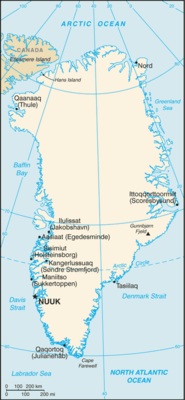
Northern North America, island between the Arctic Ocean and the North Atlantic Ocean, northeast of Canada
Geographic coordinates
72 00 N, 40 00 W
Map references
Arctic Region
Area
land: 2,166,086 sq km (approximately 1,710,000 sq km ice-covered)
Area - comparative
slightly more than three times the size of Texas
Land boundaries
Coastline
44,087 km
Maritime claims
continental shelf: 200 nm or agreed boundaries or median line
exclusive fishing zone: 200 nm or agreed boundaries or median line
Climate
arctic to subarctic; cool summers, cold winters
Terrain
flat to gradually sloping icecap covers all but a narrow, mountainous, barren, rocky coast
Elevation
lowest point: Atlantic Ocean 0 m
mean elevation: 1,792 m
Natural resources
coal, iron ore, lead, zinc, molybdenum, diamonds, gold, platinum, niobium, tantalite, uranium, fish, seals, whales, hydropower, possible oil and gas
Land use
agricultural land
agricultural land: arable land
agricultural land: permanent crops
agricultural land: permanent pasture
forest
other
Irrigated land
NA
Population distribution
settlement concentrated on the southwest shoreline, with limited settlements scattered along the remaining coast; interior is uninhabited
Natural hazards
continuous permafrost over northern two-thirds of the island
Geography - note
dominates North Atlantic Ocean between North America and Europe; sparse population confined to small settlements along coast; close to one-quarter of the population lives in the capital, Nuuk; world's second largest ice sheet after that of Antarctica, covering an area of 1.71 million sq km (660,000 sq mi), or about 79% of the island, and containing 2.85 million cu km (684 thousand cu mi) of ice (almost 7% of the world's fresh water)
People & Society25
Population
male: 29,843
female: 27,908
Nationality
adjective: Greenlandic
Ethnic groups
Languages
Religions
Evangelical Lutheran, traditional Inuit spiritual beliefs
Age structure
15-64 years: 67.1% (male 20,050/female 18,711)
65 years and over: 12.5% (2024 est.) (male 3,829/female 3,399)
Dependency ratios
youth dependency ratio: 30.3 (2024 est.)
elderly dependency ratio: 18.6 (2024 est.)
potential support ratio: 5.4 (2024 est.)
Median age
male: 35.9 years
female: 34.7 years
Population growth rate
-0.08% (2025 est.)
Birth rate
13.32 births/1,000 population (2025 est.)
Death rate
9.29 deaths/1,000 population (2025 est.)
Net migration rate
-4.82 migrant(s)/1,000 population (2025 est.)
Population distribution
settlement concentrated on the southwest shoreline, with limited settlements scattered along the remaining coast; interior is uninhabited
Urbanization
rate of urbanization: 0.41% annual rate of change (2020-25 est.)
Major urban areas - population
18,000 NUUK (capital) (2018)
Sex ratio
0-14 years: 1.03 male(s)/female
15-64 years: 1.07 male(s)/female
65 years and over: 1.13 male(s)/female
total population: 1.07 male(s)/female (2024 est.)
Infant mortality rate
male: 9.9 deaths/1,000 live births
female: 6.9 deaths/1,000 live births
Life expectancy at birth
male: 71.8 years
female: 77.3 years
Total fertility rate
1.87 children born/woman (2025 est.)
Gross reproduction rate
0.91 (2025 est.)
Drinking water source
unimproved: total: total: 0% of population (2022 est.)
Physician density
1.87 physicians/1,000 population (2016)
Sanitation facility access
unimproved: urban: urban: 0% of population
unimproved: rural: rural: 0% of population
unimproved: total: total: 37.5% of population (2022 est.)
Currently married women (ages 15-49)
38.8% (2022 est.)
Education expenditure
10.2% of GDP (2019 est.)
Government23
Country name
conventional short form: Greenland
local long form: none
local short form: Kalaallit Nunaat
etymology: named by Norse navigator Erik THORVALDSSON (Erik the Red) in A.D. 985 to attract settlers to the island; the original Greenlandic name, Kalaallit Nunaat, means "land of the people"
Government type
parliamentary democracy (Parliament of Greenland or Inatsisartut)
Dependency status
part of the Kingdom of Denmark; self-governing overseas administrative division of Denmark since 1979
Capital
name
geographic coordinates
time difference
daylight saving time
time zone note
etymology
Administrative divisions
Legal system
Denmark's laws apply in some areas, and Greenland's law for the remainder
Constitution
Citizenship
see Denmark
Suffrage
18 years of age; universal
Executive branch
head of government: Prime Minister Jens-Frederik NIELSEN (since 28 March 2025)
cabinet: Self-rule Government (Naalakkersuisut) elected by the Parliament (Inatsisartut)
election/appointment process: the monarchy is hereditary; high commissioner appointed by the monarch; premier indirectly elected by Parliament for a 4-year term
election results: 2025: Jens-Frederik NIELSEN (D) elected premier
2021: Mute B. EGEDE elected premier; Parliament vote - Mute B. EGEDE (Inuit Ataqatigiit) unanimous
2014: Kim KIELSEN elected premier; Parliament vote - Kim KIELSEN (S) 27.2%, Sara OLSVIG (IA) 25.5%, Randi Vestergaard EVALDSEN (D) 19.5%, other 27.8%
Legislative branch
legislature name
legislative structure
number of seats
electoral system
scope of elections
term in office
most recent election date
parties elected and seats per party
percentage of women in chamber
expected date of next election
Judicial branch
judge selection and term of office: judges appointed by the monarch on the recommendation of the Judicial Appointments Council, a 6-member independent body of judges and lawyers; judges appointed for life with retirement at age 70
subordinate courts: Court of Greenland; 18 district or magistrates' courts
Political parties
Fellowship Party (Atassut) or A
Forward Party (Siumut) or S
Inuit Community (Inuit Ataqatigiit) or IA
Signpost Party (Naleraq) or N (formerly Partii Naleraq)
Diplomatic representation in the US
chancery: 3200 Whitehaven Street, NW
Washington, DC 20008
telephone: [1] (202) 234-4300
FAX: [1] (202) 328-1470
email address and website:
[email protected]
All Greenlandic Representations | Grønlands Repræsentation (grl-rep.dk);
https://naalakkersuisut.gl/en/Naalakkersuisut/Groenlands-repraesentation-Washington
Diplomatic representation from the US
embassy: Aalisartut Aqqutaa 47
Nuuk 3900
Greenland
telephone: (+299) 384100
email address and website:
[email protected]
Homepage - U.S. Embassy & Consulate in the Kingdom of Denmark (usembassy.gov)
International organization participation
Arctic Council, ICC, NC, NIB, UPU
Independence
none (extensive self-rule as part of the Kingdom of Denmark)
National holiday
Flag
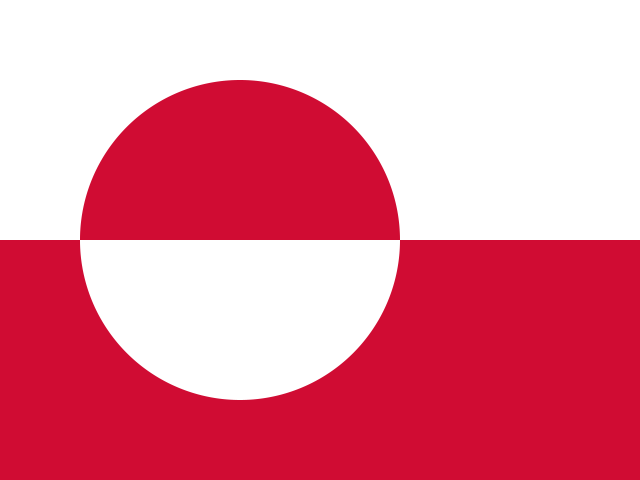
meaning: the design represents the sun reflecting off a field of ice; the colors are the same as the Danish flag and symbolize Greenland's links to the Kingdom of Denmark
National symbol(s)
polar bear
National color(s)
red, white
National anthem(s)
lyrics/music: unknown
history: adopted 1979, when home rule was granted; the Greenlandic government recognizes this local Kalaallit song as a secondary anthem
National heritage
selected World Heritage Site locales: Ilulissat Icefjord (n); Kujataa, Norse, and Inuit Farming (c); Aasivissuit–Nipisat, Inuit Hunting Ground (c)
Economy19
Economic overview
high-income, self-governing Danish territorial economy; non-EU member but preferential market access; dependent on Danish financial support; exports led by fishing industry; growing tourism and interest in untapped mineral deposits; relies on hydropower for fuel
Real GDP (purchasing power parity)
Real GDP (purchasing power parity) 2022: $4.005 billion (2022 est.)
Real GDP (purchasing power parity) 2021: $3.926 billion (2021 est.)
Real GDP growth rate
Real GDP growth rate 2022: 2% (2022 est.)
Real GDP growth rate 2021: 1.6% (2021 est.)
Real GDP per capita
Real GDP per capita 2022: $70,700 (2022 est.)
Real GDP per capita 2021: $69,300 (2021 est.)
GDP (official exchange rate)
Inflation rate (consumer prices)
Inflation rate (consumer prices) 2021: 0% (2021 est.)
Inflation rate (consumer prices) 2020: 2.1% (2020 est.)
GDP - composition, by sector of origin
industry: 18.4% (2023 est.)
services: 61% (2023 est.)
GDP - composition, by end use
household consumption
government consumption
investment in fixed capital
investment in inventories
exports of goods and services
imports of goods and services
Agricultural products
sheep, cattle, reindeer, fish, shellfish
Industries
fish processing (mainly shrimp and Greenland halibut), anorthosite and ruby mining, handicrafts, hides and skins, small shipyards
Industrial production growth rate
Budget
expenditures: $1.594 billion (2016 est.)
Exports
Exports 2022: $1.286 billion (2022 est.)
Exports 2021: $1.122 billion (2021 est.)
Exports - partners
Exports - commodities
Imports
Imports 2022: $1.657 billion (2022 est.)
Imports 2021: $1.635 billion (2021 est.)
Imports - partners
Imports - commodities
Exchange rates
Currency
Exchange rates 2024
Exchange rates 2023
Exchange rates 2022
Exchange rates 2021
Exchange rates 2020
Energy5
Electricity access
Electricity
consumption: 534.5 million kWh (2023 est.)
transmission/distribution losses: 10 million kWh (2023 est.)
Electricity generation sources
solar: 0.2% of total installed capacity (2023 est.)
hydroelectricity: 85.8% of total installed capacity (2023 est.)
biomass and waste: 0.5% of total installed capacity (2023 est.)
Coal
proven reserves: 383 million metric tons (2023 est.)
Petroleum
Communications6
Telephones - fixed lines
subscriptions per 100 inhabitants: 9 (2022 est.)
Telephones - mobile cellular
subscriptions per 100 inhabitants: 118 (2021 est.)
Broadcast media
Greenland Broadcasting Company provides public radio and TV, with a broadcast station and a series of repeaters; a few private local TV and radio stations; Danish public radio rebroadcasts are available (2019)
Internet country code
.gl
Internet users
Broadband - fixed subscriptions
subscriptions per 100 inhabitants: 32 (2022 est.)
Transportation5
Civil aircraft registration country code prefix
OY-H
Airports
25 (2025)
Heliports
54 (2025)
Merchant marine
by type: other 10
Ports
total ports
large
medium
small
very small
size unknown
ports with oil terminals
key ports
Military & Security2
Military and security forces
no regular military forces
Military - note
the US Space Force maintains a base on Greenland’s northwest coast, about 750 miles from the North Pole