
French Polynesia
Overseas Lands of French Polynesia
Population
305.5K
Area
4,167 km²
GDP
$6.56B
GDP Per Capita
$23,300
Pop. Density
73/km²
Quick Facts
Currency
₣CFP franc(XPF)
Calling Code
+689
Primary Timezone
UTC-10:00
Languages
French+more
Driving Side
right
Demonym
French Polynesian
Background
In 1880, King POMARE V ceded Tahiti and its possessions to France, changing its status into a colony. France then claimed the Gambier Islands and Tuamotu Archipelago and by 1901 had incorporated all five island groups into its establishments in Oceania. A Tahitian nationalist movement formed in 1940, leading France to grant French citizenship to the islanders in 1946 and change it to an overseas territory. In 1957, the islands’ name was changed to French Polynesia, and the following year, 64% of voters chose to stay part of France when they approved a new constitution. Uninhabited Mururoa Atoll was established as a French nuclear test site in 1962, and tests were conducted between 1966 and 1992 (underground beginning in 1975). France also conducted tests at Fangataufa Atoll, including its last nuclear test in 1996.
France granted French Polynesia partial internal autonomy in 1977 and expanded autonomy in 1984. French Polynesia was converted into an overseas collectivity in 2003 and renamed an overseas territory in 2004. Pro-independence politicians won a surprise majority in local elections that same year, but in subsequent elections, they have been relegated to a vocal minority. In 2013, French Polynesia was relisted on the UN List of Non-Self-Governing Territories.
Geography17
Location
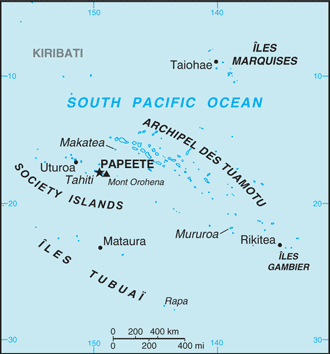
Oceania, five archipelagoes (Archipel des Tuamotu, Iles Gambier, Iles Marquises, Iles Tubuai, Society Islands) in the South Pacific Ocean about halfway between South America and Australia
Geographic coordinates
15 00 S, 140 00 W
Map references
Oceania
Area
land: 3,827 sq km
water: 340 sq km
Area - comparative
slightly less than one-third the size of Connecticut
Land boundaries
Coastline
2,525 km
Maritime claims
exclusive economic zone: 200 nm
Climate
tropical, but moderate
Terrain
mixture of rugged high islands and low islands with reefs
Elevation
lowest point: Pacific Ocean 0 m
Natural resources
timber, fish, cobalt, hydropower
Land use
agricultural land
agricultural land: arable land
agricultural land: permanent crops
agricultural land: permanent pasture
forest
other
Irrigated land
10 sq km (2012)
Population distribution
the majority of the population lives in the Society Islands, one of five archipelagos that includes the most populous island, Tahiti, with approximately 70% of the nation's population
Natural hazards
occasional cyclonic storms in January
Geography - note
includes five archipelagoes: four volcanic (Iles Gambier, Iles Marquises, Iles Tubuai, Society Islands) and one coral (Archipel des Tuamotu); the Tuamotu Archipelago forms the largest group of atolls in the world -- 78 in total, 48 inhabited; Makatea in the Tuamotu Archipelago is one of the three great phosphate rock islands in the Pacific Ocean -- the others are Banaba (Ocean Island) in Kiribati and Nauru
People & Society24
Population
male: 156,084
female: 149,423
Nationality
adjective: French Polynesian
Ethnic groups
Polynesian 78%, Chinese 12%, local French 6%, metropolitan French 4%
Languages
major-language sample(s):
The World Factbook, une source indispensable d'informations de base. (French)
The World Factbook, the indispensable source for basic information.
Religions
Protestant 54%, Roman Catholic 30%, other 10%, no religion 6%
Age structure
15-64 years: 68.7% (male 107,162/female 101,228)
65 years and over: 11% (2024 est.) (male 16,317/female 17,168)
Dependency ratios
youth dependency ratio: 29.3 (2025 est.)
elderly dependency ratio: 16.8 (2025 est.)
potential support ratio: 6 (2025 est.)
Median age
male: 35 years
female: 35.6 years
Population growth rate
0.63% (2025 est.)
Birth rate
12.7 births/1,000 population (2025 est.)
Death rate
5.84 deaths/1,000 population (2025 est.)
Net migration rate
-0.56 migrant(s)/1,000 population (2025 est.)
Population distribution
the majority of the population lives in the Society Islands, one of five archipelagos that includes the most populous island, Tahiti, with approximately 70% of the nation's population
Urbanization
rate of urbanization: 0.65% annual rate of change (2020-25 est.)
Major urban areas - population
136,000 PAPEETE (capital) (2018)
Sex ratio
0-14 years: 1.06 male(s)/female
15-64 years: 1.06 male(s)/female
65 years and over: 0.95 male(s)/female
total population: 1.05 male(s)/female (2024 est.)
Infant mortality rate
male: 5.2 deaths/1,000 live births
female: 3.4 deaths/1,000 live births
Life expectancy at birth
male: 76.6 years
female: 81.3 years
Total fertility rate
1.78 children born/woman (2025 est.)
Gross reproduction rate
0.87 (2025 est.)
Drinking water source
unimproved: total: total: 0% of population (2022 est.)
Physician density
0.02 physicians/1,000 population (2023)
Sanitation facility access
unimproved: total: total: 3% of population (2022 est.)
Currently married women (ages 15-49)
66.8% (2017 est.)
Government24
Country name
conventional long form
conventional short form
local long form
local short form
former
etymology
Government type
parliamentary democracy (Assembly of French Polynesia); an overseas collectivity of France
Dependency status
Capital
geographic coordinates: 17 32 S, 149 34 W
time difference: UTC-10 (5 hours behind Washington, DC, during Standard Time)
etymology: the name derives from the Tahitian words pape (water) and ete (basket), referring to a place where people came to get water
Administrative divisions
Legal system
the laws of France apply
Constitution
amendment process: French constitution amendment procedures apply
Citizenship
see France
Suffrage
18 years of age; universal
Executive branch
head of government: President of French Polynesia Moetai BROTHERSON (since 12 May 2023)
cabinet: Council of Ministers approved by the Assembly from a list of its members submitted by the president
election/appointment process: French president directly elected by absolute-majority popular vote in 2 rounds, if needed, for a 5-year term (eligible for a second term); high commissioner appointed by the French president on the advice of the French Ministry of Interior; French Polynesia president indirectly elected by Assembly of French Polynesia for a 5-year term (no term limits)
Legislative branch
legislature name
legislative structure
number of seats
electoral system
scope of elections
term in office
most recent election date
parties elected and seats per party
percentage of women in chamber
expected date of next election
Judicial branch
judge selection and term of office: judges assigned from France for 3 years
subordinate courts: Court of the First Instance or Tribunal de Première Instance; Court of Administrative Law or Tribunal Administratif
Political parties
List of the People (Tapura Huiraatira)
People's Servant Party (Tavini Huiraatira)
Rally of the Maohi People (Amuitahiraʻa o te Nunaʻa Maohi) (formerly known as Popular Rally (Tahoeraa Huiraatira))
Diplomatic representation in the US
none (overseas lands of France)
Diplomatic representation from the US
International organization participation
ITUC (NGOs), PIF, SPC, UPU, WMO
Independence
none (overseas land of France)
National holiday
note 2: often incorrectly referred to as Bastille Day, France's national celebration commemorates the storming of the Bastille prison on 14 July 1789 and the establishment of a constitutional monarchy; other names for the holiday are la Fête nationale (National Holiday) and le Quatorze Juillet (14th of July)
Flag
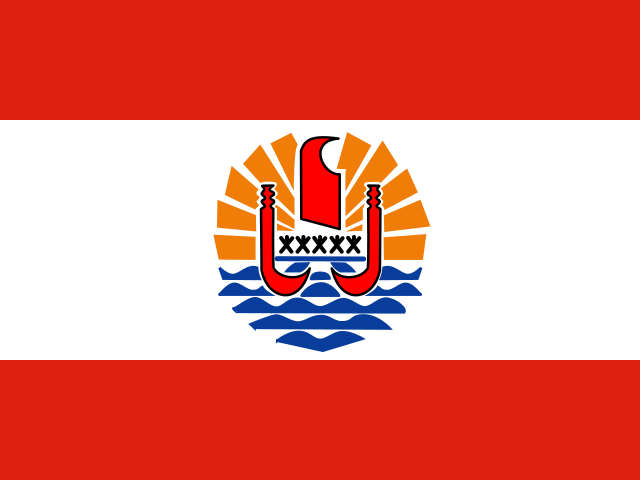
meaning: the stars symbolize the five island groups; red and white are traditional Polynesian colors
note 2: the flag of France is used for official occasions
National symbol(s)
National color(s)
red, white
National anthem(s)
lyrics/music: Claude-Joseph ROUGET de Lisle
history: official anthem, as a French territory
National heritage
selected World Heritage Site locales: Taputapuātea (c); Te Henua Enata – The Marquesas Islands (m)
Government - note
French Polynesia has acquired autonomy from France in all areas except those relating to police, monetary policy, tertiary education, immigration, and defense and foreign affairs; the duties of its president are similar to those of the French prime minister
Economy22
Economic overview
small, territorial-island tourism-based economy; large French financing; lower EU import duties; Pacific Islands Forum member; fairly resilient from COVID-19; oil-dependent infrastructure
Real GDP (purchasing power parity)
Real GDP (purchasing power parity) 2023: $5.935 billion (2023 est.)
Real GDP (purchasing power parity) 2022: $5.892 billion (2022 est.)
Real GDP growth rate
Real GDP growth rate 2022: 4.5% (2022 est.)
Real GDP growth rate 2021: 2.1% (2021 est.)
Real GDP per capita
Real GDP per capita 2023: $22,800 (2023 est.)
Real GDP per capita 2022: $20,700 (2022 est.)
GDP (official exchange rate)
Inflation rate (consumer prices)
Inflation rate (consumer prices) 2021: 0.5% (2021 est.)
Inflation rate (consumer prices) 2020: -0.1% (2020 est.)
GDP - composition, by sector of origin
industry: 10.6% (2020 est.)
services: 75.9% (2020 est.)
GDP - composition, by end use
household consumption
government consumption
investment in fixed capital
investment in inventories
exports of goods and services
imports of goods and services
Agricultural products
Industries
tourism, pearls, agricultural processing, handicrafts, phosphates
Labor force
Unemployment rate
Unemployment rate 2023: 11.8% (2023 est.)
Unemployment rate 2022: 11.9% (2022 est.)
Youth unemployment rate (ages 15-24)
male: 33.5% (2024 est.)
female: 41.5% (2024 est.)
Remittances
Remittances 2022: 10% of GDP (2022 est.)
Remittances 2021: 9.5% of GDP (2021 est.)
Current account balance
Current account balance 2015: $291.182 million (2015 est.)
Current account balance 2014: $264.32 million (2014 est.)
Exports
Exports 2020: $94.4 million (2020 est.)
Exports 2019: $184 million (2019 est.)
Exports - partners
Exports - commodities
Imports
Imports 2020: $1.75 billion (2020 est.)
Imports 2019: $2.24 billion (2019 est.)
Imports - partners
Imports - commodities
Exchange rates
Currency
Exchange rates 2024
Exchange rates 2023
Exchange rates 2022
Exchange rates 2021
Exchange rates 2020
Energy5
Electricity access
Electricity
consumption: 669.5 million kWh (2023 est.)
transmission/distribution losses: 42.663 million kWh (2023 est.)
Electricity generation sources
solar: 7% of total installed capacity (2023 est.)
hydroelectricity: 27% of total installed capacity (2023 est.)
Coal
Petroleum
Communications6
Telephones - fixed lines
subscriptions per 100 inhabitants: 24 (2023 est.)
Telephones - mobile cellular
subscriptions per 100 inhabitants: 119 (2023 est.)
Broadcast media
Internet country code
.pf
Internet users
Broadband - fixed subscriptions
subscriptions per 100 inhabitants: 28 (2022 est.)
Transportation4
Civil aircraft registration country code prefix
F-OH
Airports
54 (2025)
Merchant marine
by type: general cargo 14
Ports
total ports
large
medium
small
very small
ports with oil terminals
key ports
Military & Security2
Military and security forces
no regular military forces
Military - note
Compare French Polynesia
See how French Polynesia compares to other countries side by side.
Compare Countries