Finland
Republic of Finland
Population
5.55M
Area
338,145 km²
GDP
$299.84B
GDP Per Capita
$55,600
Pop. Density
16/km²
Quick Facts
Currency
€euro(EUR)
Calling Code
+358
Timezone
UTC+02:00
Languages
Finnish, Swedish+more
Driving Side
right
Demonym
Finnish
Background
Historical Trends
GDP (USD)
↑37.6% since 2006Population
↑6.7% since 2006Life Expectancy at Birth
Latest: 81.7 yearsData source: World Bank Open Data
Geography18
Location
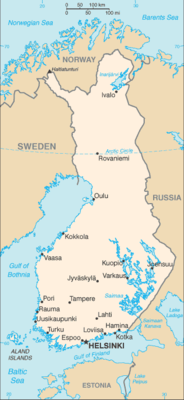
Northern Europe, bordering the Baltic Sea, Gulf of Bothnia, and Gulf of Finland, between Sweden and Russia
Geographic coordinates
64 00 N, 26 00 E
Map references
Europe
Area
land: 303,815 sq km
water: 34,330 sq km
Area - comparative
slightly more than two times the size of Georgia; slightly smaller than Montana
Land boundaries
border countries: Norway 709 km; Sweden 545 km; Russia 1,309 km
Coastline
1,250 km
Maritime claims
contiguous zone: 24 nm
continental shelf: 200 m depth or to the depth of exploitation
exclusive fishing zone: 12 nm; extends to continental shelf boundary with Sweden, Estonia, and Russia
Climate
cold temperate; potentially subarctic but comparatively mild because of moderating influence of the North Atlantic Current, Baltic Sea, and more than 60,000 lakes
Terrain
mostly low, flat to rolling plains interspersed with lakes and low hills
Elevation
lowest point: Baltic Sea 0 m
mean elevation: 164 m
Natural resources
timber, iron ore, copper, lead, zinc, chromite, nickel, gold, silver, limestone
Land use
agricultural land
agricultural land: arable land
agricultural land: permanent crops
agricultural land: permanent pasture
forest
other
Irrigated land
80 sq km (2016)
Major lakes (area sq km)
Population distribution
the vast majority of people are found in the south; the northern interior areas remain sparsely populated
Natural hazards
severe winters in the north
Geography - note
long boundary with Russia; Helsinki is northernmost national capital on European continent; population concentrated on small southwestern coastal plain
People & Society34
Population
male: 2,750,057
female: 2,800,392
Nationality
adjective: Finnish
Ethnic groups
Languages
major-language sample(s):
World Factbook, korvaamaton perustietolähde. (Finnish)
The World Factbook, the indispensable source for basic information.
Religions
Lutheran 66.6%, Greek Orthodox 1.1%, other 1.7%, none 30.6% (2022 est.)
Age structure
15-64 years: 60.3% (male 1,725,072/female 1,668,604)
65 years and over: 23.5% (2024 est.) (male 583,645/female 739,569)
Dependency ratios
youth dependency ratio: 23.3 (2025 est.)
elderly dependency ratio: 39 (2025 est.)
potential support ratio: 2.6 (2025 est.)
Median age
male: 41.8 years
female: 44.9 years
Population growth rate
0.02% (2025 est.)
Birth rate
7.75 births/1,000 population (2025 est.)
Death rate
11.01 deaths/1,000 population (2025 est.)
Net migration rate
3.44 migrant(s)/1,000 population (2025 est.)
Population distribution
the vast majority of people are found in the south; the northern interior areas remain sparsely populated
Urbanization
rate of urbanization: 0.42% annual rate of change (2020-25 est.)
Major urban areas - population
1.338 million HELSINKI (capital) (2023)
Sex ratio
0-14 years: 1.05 male(s)/female
15-64 years: 1.03 male(s)/female
65 years and over: 0.79 male(s)/female
total population: 0.97 male(s)/female (2024 est.)
Mother's mean age at first birth
29.5 years (2020 est.)
Maternal mortality ratio
8 deaths/100,000 live births (2023 est.)
Infant mortality rate
male: 2.3 deaths/1,000 live births
female: 1.9 deaths/1,000 live births
Life expectancy at birth
male: 79.3 years
female: 85.2 years
Total fertility rate
1.28 children born/woman (2025 est.)
Gross reproduction rate
0.63 (2025 est.)
Drinking water source
improved: urban
improved: rural
improved: total
unimproved: urban
unimproved: rural
unimproved: total
Health expenditure
Health expenditure (as % of national budget): 14.8% of national budget (2022 est.)
Physician density
3.61 physicians/1,000 population (2021)
Hospital bed density
2.8 beds/1,000 population (2020 est.)
Sanitation facility access
improved: urban
improved: rural
improved: total
unimproved: urban
unimproved: rural
unimproved: total
Obesity - adult prevalence rate
22.2% (2016)
Alcohol consumption per capita
beer: 3.76 liters of pure alcohol (2019 est.)
wine: 1.59 liters of pure alcohol (2019 est.)
spirits: 1.96 liters of pure alcohol (2019 est.)
other alcohols: 0.91 liters of pure alcohol (2019 est.)
Tobacco use
male: 21.7% (2025 est.)
female: 14.3% (2025 est.)
Currently married women (ages 15-49)
57.1% (2023 est.)
Child marriage
Education expenditure
Education expenditure (% national budget): 12.1% national budget (2022 est.)
School life expectancy (primary to tertiary education)
male: 18 years (2023 est.)
female: 21 years (2023 est.)
Government23
Country name
conventional short form: Finland
local long form: Suomen tasavalta (Finnish)/ Republiken Finland (Swedish)
local short form: Suomi (Finnish)/ Finland (Swedish)
etymology: name derives from the Finns, an ethnic group in northeastern Europe; their name comes from the Germanic word finna, meaning "fish scale;" the local name, Suomi, may come from two local words: suo, meaning "marsh," and maa, meaning "land"
Government type
parliamentary republic
Capital
geographic coordinates: 60 10 N, 24 56 E
time difference: UTC+2 (7 hours ahead of Washington, DC, during Standard Time)
daylight saving time: +1hr, begins last Sunday in March; ends last Sunday in October
etymology: the modern name is a Finnish derivation; King Gustav VASA of Sweden founded the city in 1550 as Helsingfors; the name came from Helsing, the Old Norwegian name for a local people, and the word fors, or "waterfall," referring to a waterfall at the city's original location on the Vantaa River
Administrative divisions
Legal system
civil law system based on the Swedish model
Constitution
amendment process: proposed by Parliament; passage normally requires simple majority vote in two readings in the first parliamentary session and at least two-thirds majority vote in a single reading by the newly elected Parliament; proposals declared "urgent" by five-sixths of Parliament members can be passed by at least two-thirds majority vote in the first parliamentary session only
International law organization participation
accepts compulsory ICJ jurisdiction with reservations; accepts ICCt jurisdiction
Citizenship
citizenship by descent only: at least one parent must be a citizen of Finland
dual citizenship recognized: yes
residency requirement for naturalization: 6 years
Suffrage
18 years of age; universal
Executive branch
chief of state
head of government
cabinet
election/appointment process
most recent election date
election results
2024: Alexander STUBB elected in the second round; percent of vote in the first round - Alexander STUBB (KoK) 27.2%, Pekka HAAVISTO (Vihr) 25.8%, Jussi HALLA-AHO (PS) 19.0%, Olli REHN (Kesk) 15.3%; percent of vote in second round - STUBB 51.6%, HAAVISTO 48.4%
2018: Sauli NIINISTO reelected president; percent of vote - Sauli NIINISTO (independent) 62.7%, Pekka HAAVISTO (Vihr) 12.4%, Laura HUHTASAARI (PS) 6.9%, Paavo VAYRYNEN (independent) 6.2%, Matti VANHANEN (Kesk) 4.1%, other 7.7%
expected date of next election
Legislative branch
legislature name
legislative structure
number of seats
electoral system
scope of elections
term in office
most recent election date
parties elected and seats per party
percentage of women in chamber
expected date of next election
Judicial branch
judge selection and term of office: Supreme Court and Supreme Administrative Court judges appointed by the president of the republic; judges serve until mandatory retirement at age 68
subordinate courts: 6 Courts of Appeal; 8 regional administrative courts; 27 district courts; special courts for issues relating to markets, labor, insurance, impeachment, land, tenancy, and water rights
Political parties
Center Party or Kesk
Christian Democrats or KD
Finns Party or PS
Green League or Vihr
Left Alliance or Vas
Movement Now or Liike Nyt
National Coalition Party or Kok
Social Democratic Party or SDP
Swedish People's Party or RKP or SFP
Diplomatic representation in the US
chief of mission
chancery
telephone
FAX
email address and website
consulate(s) general
Diplomatic representation from the US
chief of mission
embassy
mailing address
telephone
FAX
email address and website
International organization participation
ADB (nonregional member), AfDB (nonregional member), Arctic Council, Australia Group, BIS, CBSS, CD, CE, CERN, EAPC, EBRD, ECB, EIB, EITI (implementing country), EMU, ESA, EU, FAO, FATF, G-9, IADB, IAEA, IBRD, ICAO, ICC (national committees), ICCt, ICRM, IDA, IEA, IFAD, IFC, IFRCS, IHO, ILO, IMF, IMO, IMSO, Interpol, IOC, IOM, IPU, ISO, ITSO, ITU, ITUC (NGOs), MIGA, NATO, NC, NEA, NIB, NSG, OAS (observer), OECD, OPCW, OSCE, Pacific Alliance (observer), Paris Club, PCA, PFP, Schengen Convention, UN, UNCTAD, UNESCO, UNHCR, UNHRC, UNIDO, UNIFIL, UNMIL, UNMOGIP, UNOOSA, UNRWA, UNSOM, UNTSO, UPU, Wassenaar Arrangement, WCO, WFTU (NGOs), WHO, WIPO, WMO, WTO, ZC
Independence
6 December 1917 (from Russia)
National holiday
Independence Day, 6 December (1917)
Flag
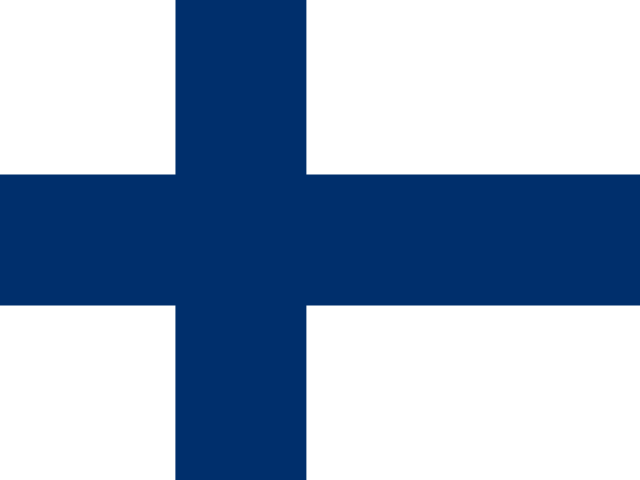
meaning: the blue stands for the country's thousands of lakes, and the white for snow
National symbol(s)
lion
National color(s)
blue, white
National anthem(s)
lyrics/music: Paavo Eemil KAJANDER, Johan Ludvig RUNEBERG/Fredrik PACIUS
history: in use since 1848; although never officially adopted, the anthem has been popular since a student group first sang it in 1848
National heritage
selected World Heritage Site locales: Fortress of Suomenlinna (c); Old Rauma (c); Petäjävesi Old Church (c); Verla Groundwood and Board Mill (c); Bronze Age Burial Site of Sammallahdenmäki (c); High Coast / Kvarken Archipelago (n); Struve Geodetic Arc (c)
Economy31
Economic overview
high-income, export-based EU and eurozone economy; major timber, metals, engineering, telecom, and electronics industries; emerging from recession triggered by inflation, weak consumer and export demand, and lower private investment; labor market reform plan to address structural rigidities
Real GDP (purchasing power parity)
Real GDP (purchasing power parity) 2023: $314.075 billion (2023 est.)
Real GDP (purchasing power parity) 2022: $317.078 billion (2022 est.)
Real GDP growth rate
Real GDP growth rate 2023: -0.9% (2023 est.)
Real GDP growth rate 2022: 0.8% (2022 est.)
Real GDP per capita
Real GDP per capita 2023: $56,200 (2023 est.)
Real GDP per capita 2022: $57,100 (2022 est.)
GDP (official exchange rate)
Inflation rate (consumer prices)
Inflation rate (consumer prices) 2023: 6.3% (2023 est.)
Inflation rate (consumer prices) 2022: 7.1% (2022 est.)
GDP - composition, by sector of origin
industry: 22.1% (2024 est.)
services: 62.9% (2024 est.)
GDP - composition, by end use
household consumption
government consumption
investment in fixed capital
investment in inventories
exports of goods and services
imports of goods and services
Agricultural products
Industries
metals and metal products, electronics, machinery and scientific instruments, shipbuilding, pulp and paper, foodstuffs, chemicals, textiles, clothing
Industrial production growth rate
Labor force
Unemployment rate
Unemployment rate 2023: 7.2% (2023 est.)
Unemployment rate 2022: 6.8% (2022 est.)
Youth unemployment rate (ages 15-24)
male: 20% (2024 est.)
female: 18.3% (2024 est.)
Population below poverty line
Gini Index coefficient - distribution of family income
Average household expenditures
on alcohol and tobacco: 4.4% of household expenditures (2023 est.)
Household income or consumption by percentage share
highest 10%: 23.1% (2022 est.)
Remittances
Remittances 2023: 0.3% of GDP (2023 est.)
Remittances 2022: 0.2% of GDP (2022 est.)
Budget
expenditures: $131.978 billion (2023 est.)
Public debt
Taxes and other revenues
Current account balance
Current account balance 2023: -$1.58 billion (2023 est.)
Current account balance 2022: -$7.026 billion (2022 est.)
Exports
Exports 2023: $127.098 billion (2023 est.)
Exports 2022: $129.389 billion (2022 est.)
Exports - partners
Exports - commodities
Imports
Imports 2023: $126.175 billion (2023 est.)
Imports 2022: $135.119 billion (2022 est.)
Imports - partners
Imports - commodities
Reserves of foreign exchange and gold
Reserves of foreign exchange and gold 2023: $16.929 billion (2023 est.)
Reserves of foreign exchange and gold 2022: $16.036 billion (2022 est.)
Exchange rates
Currency
Exchange rates 2024
Exchange rates 2023
Exchange rates 2022
Exchange rates 2021
Exchange rates 2020
Energy8
Electricity access
Electricity
consumption: 77.419 billion kWh (2023 est.)
exports: 7.883 billion kWh (2023 est.)
imports: 9.644 billion kWh (2023 est.)
transmission/distribution losses: 2.721 billion kWh (2023 est.)
Electricity generation sources
fossil fuels
nuclear
solar
wind
hydroelectricity
biomass and waste
Nuclear energy
Net capacity of operational nuclear reactors: 4.37GW (2025 est.)
Percent of total electricity production: 42% (2025 est.)
Coal
consumption: 3.933 million metric tons (2023 est.)
exports: 113,000 metric tons (2023 est.)
imports: 2.624 million metric tons (2023 est.)
Petroleum
refined petroleum consumption: 172,000 bbl/day (2024 est.)
Natural gas
exports: 479.457 million cubic meters (2023 est.)
imports: 2.112 billion cubic meters (2023 est.)
Energy consumption per capita
Communications6
Telephones - fixed lines
subscriptions per 100 inhabitants: 3 (2024 est.)
Telephones - mobile cellular
subscriptions per 100 inhabitants: 126 (2024 est.)
Broadcast media
Internet country code
Internet users
Broadband - fixed subscriptions
subscriptions per 100 inhabitants: 35 (2023 est.)
Transportation6
Civil aircraft registration country code prefix
OH
Airports
98 (2025)
Heliports
17 (2025)
Railways
Merchant marine
by type: bulk carrier 9, general cargo 75, oil tanker 4, other 194
Ports
total ports
large
medium
small
very small
ports with oil terminals
key ports
Military & Security7
Military and security forces
Military expenditures
Military Expenditures 2024: 2.4% of GDP (2024 est.)
Military Expenditures 2023: 2.1% of GDP (2023 est.)
Military Expenditures 2022: 1.7% of GDP (2022 est.)
Military Expenditures 2021: 1.4% of GDP (2021 est.)
Military and security service personnel strengths
Military equipment inventories and acquisitions
the military's inventory consists of a mix of modern European, Israeli, South Korean, US, and domestically produced weapons systems; the Finnish defense industry produces a variety of military equipment, including wheeled armored vehicles and naval vessels; Finland also cooperates with other European countries and the US in the joint production of armaments (2025)
Military service age and obligation
Military deployments
165 Lebanon (UNIFIL); Finland also contributes to several ongoing EU and NATO missions (2025)
Military - note
the FDF is also focused on fulfilling its commitment to NATO; following Russia’s full-scale invasion of Ukraine in 2022, Finland applied for NATO membership, gaining entry in April 2023; Finland had been part of NATO’s Partnership for Peace program since 1994 and participated in NATO-led military missions in the Balkans, Afghanistan, and Iraq; in 2024, it joined NATO's Air Policing mission in Eastern Europe
Finland is a signatory of the EU’s Common Security and Defense Policy and actively participates in EU crisis management missions and operations; the FDF also cooperates closely with the militaries of other Nordic countries through the Nordic Defense Cooperation structure (NORDEFCO; established 2009), which consists of Denmark, Finland, Iceland, Norway, and Sweden and involves cooperation in such areas as armaments, education, human resources, training and exercises, and operations; Sweden, the UK, and the US are close bi-lateral defense partners; in 2022, Finland signed a mutual security agreement with the UK, and since 2014 has been part of the UK-led Joint Expeditionary Force, a pool of high-readiness military forces from 10 Baltic and Scandinavian countries designed to respond to a wide range of contingencies in the North Atlantic, Baltic Sea, and High North regions (2025)
Transnational Issues1
Refugees and internally displaced persons
stateless persons: 1,326 (2024 est.)