

Estonia
Republic of Estonia
Population
1.34M
Area
45,228 km²
GDP
$42.77B
GDP Per Capita
$41,500
Pop. Density
30/km²
Quick Facts
Currency
€euro(EUR)
Calling Code
+372
Timezone
UTC+02:00
Languages
Estonian+more
Driving Side
right
Demonym
Estonian
Background
Historical Trends
GDP (USD)
↑153.3% since 2006Population
↑1.9% since 2006Life Expectancy at Birth
Latest: 78.5 yearsData source: World Bank Open Data
Geography18
Location
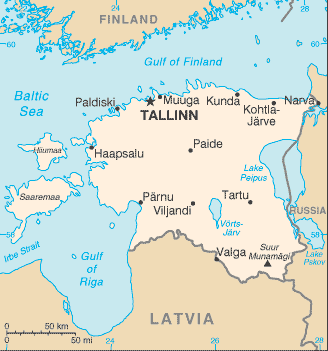
Eastern Europe, bordering the Baltic Sea and Gulf of Finland, between Latvia and Russia
Geographic coordinates
59 00 N, 26 00 E
Map references
Europe
Area
land: 42,388 sq km
water: 2,840 sq km
Area - comparative
about twice the size of New Jersey
Land boundaries
border countries: Latvia 333 km; Russia 324 km
Coastline
3,794 km
Maritime claims
exclusive economic zone: limits as agreed to by Estonia, Finland, Latvia, Sweden, and Russia
Climate
maritime; wet, moderate winters, cool summers
Terrain
marshy, lowlands; flat in the north, hilly in the south
Elevation
lowest point: Baltic Sea 0 m
mean elevation: 61 m
Natural resources
oil shale, peat, rare earth elements, phosphorite, clay, limestone, sand, dolomite, arable land, sea mud
Land use
agricultural land
agricultural land: arable land
agricultural land: permanent crops
agricultural land: permanent pasture
forest
other
Irrigated land
20 sq km (2016)
Major lakes (area sq km)
Population distribution
a fairly even distribution throughout most of the country, with urban areas attracting larger and denser populations
Natural hazards
sometimes flooding occurs in the spring
Geography - note
the mainland terrain is flat, boggy, and partly wooded; over 1,500 islands lie offshore
People & Society33
Population
male: 634,988
female: 705,490
Nationality
adjective: Estonian
Ethnic groups
Estonian 69.1%, Russian 23.7%, Ukrainian 2.1%, other 4.6%, unspecified 0.5% (2021 est.)
Languages
Estonian (official) 67.2%, Russian 28.5%, other 3.7%, unspecified 0.6% (2021est.)
Religions
Orthodox 16.5%, Protestant 9.2% (Lutheran 7.7%, other Protestant 1.5%), other 3% (includes Roman Catholic, Muslim, Jehovah's Witness, Pentecostal, Buddhist, and Taara Believer), none 58.4%, unspecified 12.9% (2021 est.)
Age structure
15-64 years: 62.2% (male 373,989/female 368,113)
65 years and over: 22.6% (2024 est.) (male 96,110/female 173,846)
Dependency ratios
youth dependency ratio: 24.8 (2025 est.)
elderly dependency ratio: 32.7 (2025 est.)
potential support ratio: 3.1 (2025 est.)
Median age
male: 41.9 years
female: 48.2 years
Population growth rate
-0.47% (2025 est.)
Birth rate
7.86 births/1,000 population (2025 est.)
Death rate
12.57 deaths/1,000 population (2025 est.)
Net migration rate
0 migrant(s)/1,000 population (2025 est.)
Population distribution
a fairly even distribution throughout most of the country, with urban areas attracting larger and denser populations
Urbanization
rate of urbanization: -0.03% annual rate of change (2020-25 est.)
Major urban areas - population
454,000 TALLINN (capital) (2023)
Sex ratio
0-14 years: 1.05 male(s)/female
15-64 years: 1.02 male(s)/female
65 years and over: 0.55 male(s)/female
total population: 0.89 male(s)/female (2024 est.)
Mother's mean age at first birth
28.2 years (2020 est.)
Maternal mortality ratio
5 deaths/100,000 live births (2023 est.)
Infant mortality rate
male: 3.2 deaths/1,000 live births
female: 3.4 deaths/1,000 live births
Life expectancy at birth
male: 73.8 years
female: 83.2 years
Total fertility rate
1.36 children born/woman (2025 est.)
Gross reproduction rate
0.66 (2025 est.)
Drinking water source
improved: urban
improved: rural
improved: total
unimproved: urban
unimproved: rural
unimproved: total
Health expenditure
Health expenditure (as % of national budget): 13.2% of national budget (2022 est.)
Physician density
3.47 physicians/1,000 population (2022)
Hospital bed density
4.5 beds/1,000 population (2020 est.)
Sanitation facility access
improved: urban
improved: rural
improved: total
unimproved: urban
unimproved: rural
unimproved: total
Obesity - adult prevalence rate
21.2% (2016)
Alcohol consumption per capita
beer: 4 liters of pure alcohol (2019 est.)
wine: 1.92 liters of pure alcohol (2019 est.)
spirits: 4.6 liters of pure alcohol (2019 est.)
other alcohols: 1.13 liters of pure alcohol (2019 est.)
Tobacco use
male: 29.9% (2025 est.)
female: 18.3% (2025 est.)
Currently married women (ages 15-49)
54.1% (2021 est.)
Education expenditure
Education expenditure (% national budget): 13% national budget (2022 est.)
School life expectancy (primary to tertiary education)
male: 15 years (2023 est.)
female: 16 years (2023 est.)
Government23
Country name
conventional long form
conventional short form
local long form
local short form
former
etymology
Government type
parliamentary republic
Capital
geographic coordinates: 59 26 N, 24 43 E
time difference: UTC+2 (7 hours ahead of Washington, DC, during Standard Time)
daylight saving time: +1hr, begins last Sunday in March; ends last Sunday in October
etymology: the name derives from the Old Estonian term tan-linn, meaning "Danish fort," a reference to Danish King VALDEMAR II founding the city in 1219
Administrative divisions
urban municipalities: Haapsalu, Keila, Kohtla-Jarve, Loksa, Maardu, Narva, Narva-Joesuu, Paide, Parnu, Rakvere, Sillamae, Tallinn, Tartu, Viljandi, Voru
rural municipalities: Alutaguse, Anija, Antsla, Elva, Haademeeste, Haljala, Harku, Hiiumaa, Jarva, Joelahtme, Jogeva, Johvi, Kadrina, Kambja, Kanepi, Kastre, Kehtna, Kihnu, Kiili, Kohila, Kose, Kuusalu, Laane-Harju, Laane-Nigula, Laaneranna, Luganuse, Luunja, Marjamaa, Muhu, Mulgi, Mustvee, Noo, Otepaa, Peipsiaare, Pohja-Parnumaa, Pohja-Sakala, Poltsamaa, Polva, Raasiku, Rae, Rakvere, Räpina, Rapla, Rouge, Ruhnu, Saarde, Saaremaa, Saku, Saue, Setomaa, Tapa, Tartu, Toila, Tori, Torva, Turi, Vaike-Maarja, Valga, Viimsi, Viljandi, Vinni, Viru-Nigula, Vormsi, Voru
Legal system
civil law system
Constitution
amendment process: proposed by at least one-fifth of Parliament members or by the president of the republic; passage requires three readings of the proposed amendment and a simple majority vote in two successive memberships of Parliament; passage of amendments to the "General Provisions" and "Amendment of the Constitution" chapters requires at least three-fifths majority vote by Parliament to conduct a referendum and majority vote in a referendum
International law organization participation
accepts compulsory ICJ jurisdiction with reservations; accepts ICCt jurisdiction
Citizenship
citizenship by descent only: at least one parent must be a citizen of Estonia
dual citizenship recognized: no
residency requirement for naturalization: 5 years
Suffrage
18 years of age; universal; age 16 for local elections
Executive branch
chief of state
head of government
cabinet
election/appointment process
most recent election date
election results
2021: Alar KARIS (independent) elected president; won second round of voting in parliament with 72 of 101 votes
2016: Kersti KALJULAID elected president; won sixth round of voting in parliament with 81 of 98 votes (17 ballots blank); KALJULAID sworn in on 10 October 2016 - first female head of state of Estonia
expected date of next election
Legislative branch
legislature name
legislative structure
number of seats
electoral system
scope of elections
term in office
most recent election date
parties elected and seats per party
percentage of women in chamber
expected date of next election
Judicial branch
judge selection and term of office: the chief justice is proposed by the president of the republic and appointed by the Riigikogu; other justices proposed by the chief justice and appointed by the Riigikogu; justices appointed for life
subordinate courts: circuit (appellate) courts; administrative, county, city, and specialized courts
Political parties
Estonia 200 or E200
Estonia Centre Party of (Keskerakond) or EK
Estonian Free Party or VAP
Estonian Freedom Party - Farmers' Assembly or V-PK
Estonian Greens or EER
Estonian Nationalists and Conservatives or ERK
Estonian Reform Party (Reformierakond) or RE
Fatherland or I
Left Alliance or VL
Social Democratic Party or SDE
The Right or PP
TOGETHER organization points to sovereignty or KOOS
Diplomatic representation in the US
chief of mission
chancery
Washington, DC, 20008
telephone
FAX
email address and website
consulate(s) general
Diplomatic representation from the US
chief of mission
embassy
mailing address
telephone
FAX
email address and website
International organization participation
Australia Group, BA, BIS, CBSS, CD, CE, EAPC, EBRD, ECB, EIB, EMU, ESA (cooperating state), EU, FAO, IAEA, IBRD, ICAO, ICC (national committees), ICCt, ICRM, IDA, IEA, IFAD, IFC, IFRCS, IHO, ILO, IMF, IMO, Interpol, IOC, IOM, IPU, ISO, ITSO, ITU, ITUC (NGOs), MIGA, NATO, NIB, NSG, OAS (observer), OECD, OIF (observer), OPCW, OSCE, PCA, Schengen Convention, UN, UNCTAD, UNESCO, UNHCR, UNTSO, UPU, Wassenaar Arrangement, WCO, WHO, WIPO, WMO, WTO
Independence
24 February 1918 (from Soviet Russia); 20 August 1991 (declared from the Soviet Union); 6 September 1991 (recognized by the Soviet Union)
National holiday
Flag
meaning: blue stands for faith, loyalty, and devotion, and also the sky, sea, and lakes; black for the country's soil and the Estonian people's past suffering; white for striving for enlightenment and virtue and also for birch bark, snow, and summer nights illuminated by the midnight sun
National symbol(s)
barn swallow, cornflower
National color(s)
blue, black, white
National anthem(s)
lyrics/music: Johann Voldemar JANNSEN/Fredrik PACIUS
history: adopted 1920, but banned between 1940 and 1990 under Soviet occupation; unofficially in use since 1869, it has the same melody as Finland's anthem, but with different lyrics
National heritage
selected World Heritage Site locales: Historic Center (Old Town) of Tallinn; Struve Geodetic Arc
Economy31
Economic overview
high-income, service-based EU and eurozone economy; rebound in exports playing a role in economic recovery; rising food prices contributing to inflation; decrease in labor force participation and rising unemployment rate; recovery depends on boosting private investment and productivity rates
Real GDP (purchasing power parity)
Real GDP (purchasing power parity) 2023: $57.15 billion (2023 est.)
Real GDP (purchasing power parity) 2022: $58.931 billion (2022 est.)
Real GDP growth rate
Real GDP growth rate 2023: -3% (2023 est.)
Real GDP growth rate 2022: 0.1% (2022 est.)
Real GDP per capita
Real GDP per capita 2023: $41,700 (2023 est.)
Real GDP per capita 2022: $43,700 (2022 est.)
GDP (official exchange rate)
Inflation rate (consumer prices)
Inflation rate (consumer prices) 2023: 9.2% (2023 est.)
Inflation rate (consumer prices) 2022: 19.4% (2022 est.)
GDP - composition, by sector of origin
industry: 20.5% (2024 est.)
services: 65.1% (2024 est.)
GDP - composition, by end use
household consumption
government consumption
investment in fixed capital
investment in inventories
exports of goods and services
imports of goods and services
Agricultural products
Industries
food, engineering, electronics, wood and wood products, textiles; information technology, telecommunications
Industrial production growth rate
Labor force
Unemployment rate
Unemployment rate 2023: 6.4% (2023 est.)
Unemployment rate 2022: 5.6% (2022 est.)
Youth unemployment rate (ages 15-24)
male: 21.9% (2024 est.)
female: 20% (2024 est.)
Population below poverty line
Gini Index coefficient - distribution of family income
Average household expenditures
on alcohol and tobacco: 6.7% of household expenditures (2023 est.)
Household income or consumption by percentage share
highest 10%: 24.4% (2022 est.)
Remittances
Remittances 2023: 1.2% of GDP (2023 est.)
Remittances 2022: 1.2% of GDP (2022 est.)
Budget
expenditures: $16.721 billion (2023 est.)
Public debt
Taxes and other revenues
Current account balance
Current account balance 2023: -$722.668 million (2023 est.)
Current account balance 2022: -$1.496 billion (2022 est.)
Exports
Exports 2023: $32.147 billion (2023 est.)
Exports 2022: $33.178 billion (2022 est.)
Exports - partners
Exports - commodities
Imports
Imports 2023: $31.796 billion (2023 est.)
Imports 2022: $33.655 billion (2022 est.)
Imports - partners
Imports - commodities
Reserves of foreign exchange and gold
Reserves of foreign exchange and gold 2023: $2.593 billion (2023 est.)
Reserves of foreign exchange and gold 2022: $2.217 billion (2022 est.)
Exchange rates
Currency
Exchange rates 2024
Exchange rates 2023
Exchange rates 2022
Exchange rates 2021
Exchange rates 2020
Energy7
Electricity access
Electricity
consumption: 8.636 billion kWh (2023 est.)
exports: 4.355 billion kWh (2023 est.)
imports: 7.66 billion kWh (2023 est.)
transmission/distribution losses: 1.164 billion kWh (2023 est.)
Electricity generation sources
solar: 9.7% of total installed capacity (2023 est.)
wind: 10.5% of total installed capacity (2023 est.)
hydroelectricity: 0.4% of total installed capacity (2023 est.)
biomass and waste: 27.2% of total installed capacity (2023 est.)
Coal
exports: 7,000 metric tons (2023 est.)
imports: 800 metric tons (2023 est.)
Petroleum
refined petroleum consumption: 27,000 bbl/day (2024 est.)
Natural gas
exports: 675.708 million cubic meters (2023 est.)
imports: 1.01 billion cubic meters (2023 est.)
Energy consumption per capita
Communications6
Telephones - fixed lines
subscriptions per 100 inhabitants: 17 (2024 est.)
Telephones - mobile cellular
subscriptions per 100 inhabitants: 151 (2024 est.)
Broadcast media
the publicly owned broadcaster, Eesti Rahvusringhaaling (ERR), operates 3 TV channels and 5 radio networks; growing number of private commercial radio stations broadcasting nationally, regionally, and locally; fully transitioned to digital television in 2010; national private TV channels expanding service, with a range of channels aimed at Russian-speaking viewers; in 2016, there were 42 on-demand services available in Estonia, including 19 pay TVOD and SVOD services; roughly 85% of households accessed digital television services
Internet country code
.ee
Internet users
Broadband - fixed subscriptions
subscriptions per 100 inhabitants: 38 (2023 est.)
Transportation6
Civil aircraft registration country code prefix
ES
Airports
34 (2025)
Heliports
10 (2025)
Railways
Merchant marine
by type: general cargo 3, oil tanker 3, other 66
Ports
total ports
large
medium
small
very small
ports with oil terminals
key ports
Military & Security6
Military and security forces
Ministry of Interior: Police and Border Guard Board, Internal Security Service (2025)
Military expenditures
Military Expenditures 2024: 3.4% of GDP (2024 est.)
Military Expenditures 2023: 3% of GDP (2023 est.)
Military Expenditures 2022: 2.2% of GDP (2022 est.)
Military Expenditures 2021: 2% of GDP (2021 est.)
Military and security service personnel strengths
Military equipment inventories and acquisitions
Military service age and obligation
note 2: in 2024, women comprised about 8% of the full-time professional military force; the Defense League includes a Women's Voluntary Defense Organization
Military - note
Estonia has been a member of NATO since 2004, is fully integrated within the NATO structure, and relies on its NATO partners for defense; since 2017, Estonia has hosted a UK-led multinational NATO ground force battlegroup as part of the Alliance’s Enhanced Forward Presence initiative; as the EDF Air Force does not have any combat aircraft, NATO has provided airspace protection for Estonia since 2004 through its Baltic Air Policing mission; NATO member countries that possess air combat capabilities voluntarily contribute to the mission on four-month rotations; NATO fighter aircraft have been hosted at Estonia’s Ämari Air Base since 2014; Estonia also hosts a NATO cyber security center; it cooperates closely with the EU on defense issues through the EU Common Security and Defense Policy and is a member of the UK-led Joint Expeditionary Force, a pool of high-readiness military forces from 10 Baltic and Scandinavian countries designed to respond to a wide range of contingencies in the North Atlantic, Baltic Sea, and High North regions; Estonia also has close defense ties with its Baltic neighbors and has bilateral military agreements with a number of European countries, as well as Canada and the US (2025)
Transnational Issues1
Refugees and internally displaced persons
stateless persons: 63,944 (2024 est.)