
Equatorial Guinea
Republic of Equatorial Guinea
Population
1.80M
Area
28,051 km²
GDP
$12.77B
GDP Per Capita
$15,500
Pop. Density
64/km²
Quick Facts
Currency
FrCentral African CFA franc(XAF)
Calling Code
+240
Timezone
UTC+01:00
Languages
French, Portuguese, Spanish+more
Driving Side
right
Demonym
Equatorial Guinean
Background
In 1968, Equatorial Guinea was granted independence from Spain and elected Francisco MACIAS NGUEMA as its first president. MACIAS consolidated power soon after his election and ruled brutally for over a decade. Under his regime, Equatorial Guinea experienced mass suppression, purges, and killings. Some estimates indicate that a third of the population either went into exile or was killed under MACIAS’ rule. In 1979, present-day President OBIANG Nguema Mbasogo, then a senior military officer, deposed MACIAS in a violent coup. OBIANG has ruled since and has been elected in non-competitive contests several times, most recently in 2022. The president exerts near-total control over the political system.
Equatorial Guinea experienced rapid economic growth in the early years of the 21st century due to the discovery of large offshore oil reserves in 1996. Production peaked in 2004 and has declined since. The country's economic windfall from oil production resulted in massive increases in government revenue, a significant portion of which was earmarked for infrastructure development. Systemic corruption, however, has hindered socio-economic development, and the population has seen only limited improvements to living standards. Equatorial Guinea continues to seek to diversify its economy, increase foreign investment, and assume a greater role in regional and international affairs. 
Historical Trends
GDP (USD)
↑26.6% since 2006Population
↑91.1% since 2006Life Expectancy at Birth
Latest: 63.7 yearsData source: World Bank Open Data
Geography17
Location
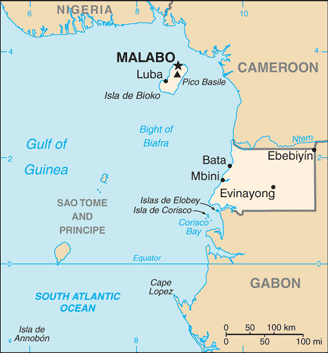
Central Africa, bordering the Bight of Biafra, between Cameroon and Gabon
Geographic coordinates
2 00 N, 10 00 E
Map references
Africa
Area
land: 28,051 sq km
water: 0 sq km
Area - comparative
slightly smaller than Maryland
Land boundaries
border countries: Cameroon 183 km; Gabon 345 km
Coastline
296 km
Maritime claims
exclusive economic zone: 200 nm
Climate
tropical; always hot, humid
Terrain
coastal plains rise to interior hills; islands are volcanic
Elevation
lowest point: Atlantic Ocean 0 m
mean elevation: 577 m
Natural resources
petroleum, natural gas, timber, gold, bauxite, diamonds, tantalum, sand and gravel, clay
Land use
agricultural land
agricultural land: arable land
agricultural land: permanent crops
agricultural land: permanent pasture
forest
other
Irrigated land
NA
Population distribution
the two large cities are Bata on the mainland and the capital Malabo on the island of Bioko; small communities are scattered throughout the mainland and the five inhabited islands, as shown in this population distribution map
Natural hazards
volcanism: Santa Isabel (3,007 m), which last erupted in 1923, is the country's only historically active volcano; Santa Isabel and two dormant volcanoes form Bioko Island in the Gulf of Guinea
Geography - note
insular and continental regions widely separated; despite its name, no part of the equator passes through Equatorial Guinea -- the mainland part of the country is located just north of the equator
People & Society25
Population
male: 962,385
female: 833,449
Nationality
adjective: Equatorial Guinean or Equatoguinean
Ethnic groups
Fang 78.1%, Bubi 9.4%, Ndowe 2.8%, Nanguedambo 2.7%, Bisio 0.9%, foreigner 5.3%, other 0.7%, unspecified 0.2% (2011 est.)
Languages
major-language sample(s):
La Libreta Informativa del Mundo, la fuente indispensable de información básica. (Spanish)
The World Factbook, the indispensable source for basic information.
Religions
Roman Catholic 88%, Protestant 5%, Muslim 2%, other 5% (animist, Baha'i, Jewish) (2015 est.)
Age structure
15-64 years: 59.4% (male 585,139/female 481,121)
65 years and over: 5% (2024 est.) (male 46,610/female 42,800)
Dependency ratios
youth dependency ratio: 60 (2024 est.)
elderly dependency ratio: 8.4 (2024 est.)
potential support ratio: 11.9 (2024 est.)
Median age
male: 22.7 years
female: 21.5 years
Population growth rate
3.1% (2025 est.)
Birth rate
28.55 births/1,000 population (2025 est.)
Death rate
8.81 deaths/1,000 population (2025 est.)
Net migration rate
11.29 migrant(s)/1,000 population (2025 est.)
Population distribution
the two large cities are Bata on the mainland and the capital Malabo on the island of Bioko; small communities are scattered throughout the mainland and the five inhabited islands, as shown in this population distribution map
Urbanization
rate of urbanization: 3.62% annual rate of change (2020-25 est.)
Major urban areas - population
297,000 MALABO (capital) (2018)
Sex ratio
0-14 years: 1.07 male(s)/female
15-64 years: 1.22 male(s)/female
65 years and over: 1.09 male(s)/female
total population: 1.16 male(s)/female (2024 est.)
Maternal mortality ratio
174 deaths/100,000 live births (2023 est.)
Infant mortality rate
male: 83.3 deaths/1,000 live births
female: 71.3 deaths/1,000 live births
Life expectancy at birth
male: 61.6 years
female: 66.2 years
Total fertility rate
4.05 children born/woman (2025 est.)
Gross reproduction rate
1.99 (2025 est.)
Health expenditure
Health expenditure (as % of national budget): 4.4% of national budget (2022 est.)
Physician density
0.15 physicians/1,000 population (2022)
Obesity - adult prevalence rate
8% (2016)
Alcohol consumption per capita
beer: 3.83 liters of pure alcohol (2019 est.)
wine: 1.24 liters of pure alcohol (2019 est.)
spirits: 0.99 liters of pure alcohol (2019 est.)
other alcohols: 0.05 liters of pure alcohol (2019 est.)
Government25
Country name
conventional long form
conventional short form
local long form
local short form
former
etymology
Government type
presidential republic
Capital
geographic coordinates: 3 45 N, 8 47 E
time difference: UTC+1 (6 hours ahead of Washington, DC, during Standard Time)
etymology: English settlers who founded the city in 1827 named it Port Clarence after the Duke of CLARENCE; the Spanish renamed it Santa Isabel in 1843, for Queen ISABELLA II of Spain; it was renamed again in 1973 after King MALABO (1837–1937), the last king of the Bubi (local ethnic group)
Administrative divisions
Legal system
mixed system of civil and customary law
Constitution
amendment process: proposed by the president of the republic or supported by three fourths of the membership in either house of the National Assembly; passage requires three-fourths majority vote by both houses of the Assembly and approval in a referendum if requested by the president
International law organization participation
accepts compulsory ICJ jurisdiction; accepts ICCt jurisdiction
Citizenship
citizenship by descent only: at least one parent must be a citizen of Equatorial Guinea
dual citizenship recognized: no
residency requirement for naturalization: 10 years
Suffrage
18 years of age; universal
Executive branch
chief of state
head of government
cabinet
election/appointment process
most recent election date
election results
2022: OBIANG Nguema Mbasogo reelected president; percent of vote - OBIANG Nguema Mbasogo (PDGE) 95%, other 6.1%
2016: OBIANG Nguema Mbasogo reelected president; percent of vote - OBIANG Nguema Mbasogo (PDGE) 93.5%, other 6.5%
expected date of next election
Legislative branch
legislative structure: bicameral
Legislative branch - lower chamber
chamber name
number of seats
electoral system
scope of elections
term in office
most recent election date
parties elected and seats per party
percentage of women in chamber
expected date of next election
Legislative branch - upper chamber
chamber name
number of seats
electoral system
scope of elections
term in office
most recent election date
parties elected and seats per party
percentage of women in chamber
expected date of next election
Judicial branch
judge selection and term of office: Supreme Court judges appointed by the president for five-year terms; Constitutional Court members appointed by the president, 2 of whom are nominated by the Chamber of Deputies
subordinate courts: Court of Guarantees; military courts; Courts of Appeal; first instance tribunals; district and county tribunals
Political parties
Convergence Party for Social Democracy or CPDS
Democratic Party for Equatorial Guinea or PDGE
Liberal Democratic Convention or CLD
Liberal Party or PL
National Congress of Equatorial Guinea (CNGE)
National Democratic Party (PNDGE)
National Democratic Union or UDENA
National Union for Democracy PUNDGE
Popular Action of Equatorial Guinea or APGE
Popular Union or UP
Progressive Democratic Alliance or ADP
Social and Popular Convergence Party or CSDP
Social Democratic Coalition Party (PCSD)
Social Democratic Party of Equatorial Guinea or PSDGE
Social Democratic Union or UDS
Socialist Party of Equatorial Guinea
Diplomatic representation in the US
chief of mission
chancery
telephone
FAX
email address and website
consulate(s) general
Diplomatic representation from the US
embassy: Malabo II Highway (between the Headquarters of Sonagas and the offices of the United Nations), Malabo
mailing address: 2320 Malabo Place, Washington, DC 20521-2520
telephone: [240] 333 09-57-41
email address and website:
[email protected]
https://gq.usembassy.gov/
International organization participation
ACP, AfDB, AU, BDEAC, CEMAC, CPLP, FAO, Francophonie, FZ, G-77, IBRD, ICAO, ICRM, IDA, IFAD, IFC, IFRCS, ILO, IMF, IMO, Interpol, IOC, IPU, ITSO, ITU, MIGA, NAM, OAS (observer), OIF, OPCW, UN, UNCTAD, UNESCO, UNIDO, UNWTO, UPU, WHO, WIPO, WTO (observer)
Independence
12 October 1968 (from Spain)
National holiday
Independence Day, 12 October (1968)
Flag
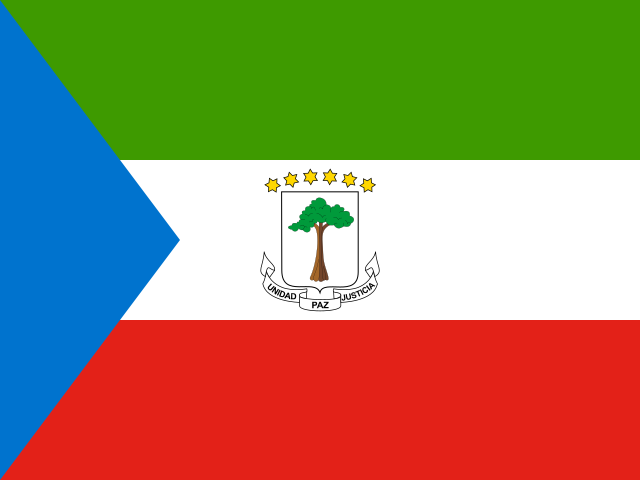
meaning: green stands for the jungle and natural resources, blue for the sea, white for peace, and red for the fight for independence
National symbol(s)
silk cotton tree
National color(s)
green, white, red, blue
National coat of arms
National anthem(s)
lyrics/music: Atanasio Ndongo MIYONO/Atanasio Ndongo MIYONO or Ramiro Sanchez LOPEZ (disputed)
history: adopted 1968
Economy28
Economic overview
growing CEMAC economy and new OPEC member; large oil and gas reserves; targeting economic diversification and poverty reduction; still recovering from CEMAC crisis; improving public financial management; persistent poverty; hard-hit by COVID-19
Real GDP (purchasing power parity)
Real GDP (purchasing power parity) 2023: $28.985 billion (2023 est.)
Real GDP (purchasing power parity) 2022: $30.539 billion (2022 est.)
Real GDP growth rate
Real GDP growth rate 2023: -5.1% (2023 est.)
Real GDP growth rate 2022: 3.2% (2022 est.)
Real GDP per capita
Real GDP per capita 2023: $15,700 (2023 est.)
Real GDP per capita 2022: $16,900 (2022 est.)
GDP (official exchange rate)
Inflation rate (consumer prices)
Inflation rate (consumer prices) 2021: -0.1% (2021 est.)
Inflation rate (consumer prices) 2020: 4.8% (2020 est.)
GDP - composition, by sector of origin
industry: 45.8% (2024 est.)
services: 51.1% (2024 est.)
GDP - composition, by end use
household consumption
government consumption
investment in fixed capital
investment in inventories
exports of goods and services
imports of goods and services
Agricultural products
Industries
petroleum, natural gas, sawmilling
Industrial production growth rate
Labor force
Unemployment rate
Unemployment rate 2023: 8.4% (2023 est.)
Unemployment rate 2022: 8.5% (2022 est.)
Youth unemployment rate (ages 15-24)
male: 13.9% (2024 est.)
female: 15.7% (2024 est.)
Gini Index coefficient - distribution of family income
Household income or consumption by percentage share
highest 10%: 29.1% (2022 est.)
Remittances
Remittances 2022: 0% of GDP (2022 est.)
Remittances 2021: 0% of GDP (2021 est.)
Budget
expenditures: $2.051 billion (2022 est.)
Public debt
Taxes and other revenues
Exports
Exports 2023: $4.516 billion (2023 est.)
Exports 2022: $7.25 billion (2022 est.)
Exports - partners
Exports - commodities
Imports
Imports 2023: $3.065 billion (2023 est.)
Imports 2022: $3.948 billion (2022 est.)
Imports - partners
Imports - commodities
Reserves of foreign exchange and gold
Reserves of foreign exchange and gold 2022: $1.458 billion (2022 est.)
Reserves of foreign exchange and gold 2021: $44.271 million (2021 est.)
Exchange rates
Currency
Exchange rates 2024
Exchange rates 2023
Exchange rates 2022
Exchange rates 2021
Exchange rates 2020
Energy7
Electricity access
electrification - urban areas: 89.8%
electrification - rural areas: 1.4%
Electricity
consumption: 1.402 billion kWh (2023 est.)
transmission/distribution losses: 170.527 million kWh (2023 est.)
Electricity generation sources
hydroelectricity: 31.4% of total installed capacity (2023 est.)
Coal
Petroleum
refined petroleum consumption: 6,000 bbl/day (2023 est.)
crude oil estimated reserves: 1.1 billion barrels (2021 est.)
Natural gas
consumption: 2.332 billion cubic meters (2023 est.)
exports: 3.63 billion cubic meters (2023 est.)
proven reserves: 139.007 billion cubic meters (2021 est.)
Energy consumption per capita
Communications6
Telephones - fixed lines
subscriptions per 100 inhabitants: 1 (2022 est.) less than 1
Telephones - mobile cellular
subscriptions per 100 inhabitants: 50 (2022 est.)
Broadcast media
the state maintains control of broadcast media; 1 state-owned TV station, 1 private TV station owned by the president's eldest son, 1 state-owned radio station, and 1 private radio station owned by the president's eldest son; satellite TV service is available; transmissions of multiple international broadcasters are generally accessible (2019)
Internet country code
.gq
Internet users
Broadband - fixed subscriptions
subscriptions per 100 inhabitants: (2022 est.) less than 1
Transportation4
Civil aircraft registration country code prefix
3C
Airports
7 (2025)
Merchant marine
by type: bulk carrier 1, general cargo 16, oil tanker 7, other 29
Ports
total ports
large
medium
small
very small
ports with oil terminals
key ports
Military & Security6
Military and security forces
Military expenditures
Military Expenditures 2023: 1.6% of GDP (2023 est.)
Military Expenditures 2022: 1.3% of GDP (2022 est.)
Military Expenditures 2021: 1.3% of GDP (2021 est.)
Military Expenditures 2020: 1.6% of GDP (2020 est.)
Military and security service personnel strengths
estimated 2,000 active Armed Forces, including Gendarmerie (2025)
Military equipment inventories and acquisitions
the FAGE is armed with mostly older (typically Soviet-era) and secondhand weapons systems; in recent years, it has sought to modernize its naval inventory with purchases of vessels from several countries, including Bulgaria and Israel; China and Russia have also supplied some equipment to the FAGE (2025)
Military service age and obligation
18-25 for voluntary military service; selective compulsory military service for men; 24-month service obligation (2025)
Military - note
the Armed Forces of Equatorial Guinea (FAGE) are responsible for defending the territory and sovereignty of the country; the FAGE also has some internal security duties, including fulfilling some police functions in border areas, sensitive sites, and high-traffic areas; maritime security, particularly protecting offshore oil installations and combating piracy and crime in the Gulf of Guinea, is a key priority (2025)
Transnational Issues1
Refugees and internally displaced persons
Compare Equatorial Guinea
See how Equatorial Guinea compares to other countries side by side.
Compare Countries