
El Salvador
Republic of El Salvador
Population
6.33M
Area
21,041 km²
GDP
$35.37B
GDP Per Capita
$11,700
Pop. Density
301/km²
Quick Facts
Currency
$United States dollar(USD)
Calling Code
+503
Timezone
UTC-06:00
Languages
Spanish+more
Driving Side
right
Demonym
Salvadoran
Background
Historical Trends
GDP (USD)
↑121.0% since 2006Population
↑5.6% since 2006Life Expectancy at Birth
Latest: 72.1 yearsData source: World Bank Open Data
Geography17
Location
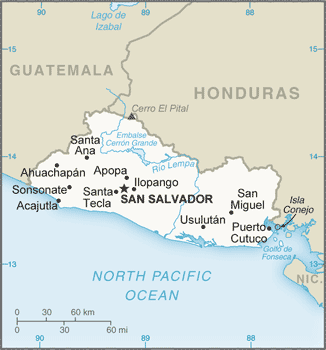
Central America, bordering the North Pacific Ocean, between Guatemala and Honduras
Geographic coordinates
13 50 N, 88 55 W
Map references
Central America and the Caribbean
Area
land: 20,721 sq km
water: 320 sq km
Area - comparative
about the same size as New Jersey
Land boundaries
border countries: Guatemala 199 km; Honduras 391 km
Coastline
307 km
Maritime claims
contiguous zone: 24 nm
exclusive economic zone: 200 nm
Climate
tropical; rainy season (May to October); dry season (November to April); tropical on coast; temperate in uplands
Terrain
mostly mountains with narrow coastal belt and central plateau
Elevation
lowest point: Pacific Ocean 0 m
mean elevation: 442 m
Natural resources
hydropower, geothermal power, petroleum, arable land
Land use
agricultural land
agricultural land: arable land
agricultural land: permanent crops
agricultural land: permanent pasture
forest
other
Irrigated land
240 sq km (2022)
Population distribution
high population density country-wide, with particular concentration around the capital of San Salvador
Natural hazards
volcanism: significant volcanic activity; San Salvador (1,893 m), which last erupted in 1917, has the potential to cause major harm to the country's capital, which lies just below the volcano's slopes; San Miguel (2,130 m) is one of the most active volcanoes in the country; other historically active volcanoes include Conchaguita, Ilopango, Izalco, and Santa Ana
Geography - note
smallest Central American country and only one without a coastline on the Caribbean Sea
People & Society36
Population
male: 3,026,645
female: 3,308,078
Nationality
adjective: Salvadoran
Ethnic groups
Mestizo 86.3%, White 12.7%, Indigenous 0.2% (includes Lenca, Kakawira, Nahua-Pipil), Black 0.1%, other 0.6% (2007 est.)
Languages
major-language sample(s):
La Libreta Informativa del Mundo, la fuente indispensable de información básica. (Spanish)
The World Factbook, the indispensable source for basic information.
Religions
Roman Catholic 43.9%, Protestant 39.6% (Evangelical - unspecified 38.2%, Evangelical - Methodist 1.3%, Evangelical - Baptist 0.1%), none 16.3%, unspecified 0.2% (2023 est.)
Age structure
15-64 years: 66.3% (male 2,077,745/female 2,317,416)
65 years and over: 8.4% (2024 est.) (male 238,658/female 320,400)
Dependency ratios
youth dependency ratio: 29.9 (2025 est.)
elderly dependency ratio: 13.1 (2025 est.)
potential support ratio: 7.6 (2025 est.)
Median age
male: 28.2 years
female: 31.2 years
Population growth rate
0.34% (2025 est.)
Birth rate
12.46 births/1,000 population (2025 est.)
Death rate
5.93 deaths/1,000 population (2025 est.)
Net migration rate
-3.16 migrant(s)/1,000 population (2025 est.)
Population distribution
high population density country-wide, with particular concentration around the capital of San Salvador
Urbanization
rate of urbanization: 1.33% annual rate of change (2020-25 est.)
Major urban areas - population
1.116 million SAN SALVADOR (capital) (2023)
Sex ratio
0-14 years: 1.05 male(s)/female
15-64 years: 0.9 male(s)/female
65 years and over: 0.74 male(s)/female
total population: 0.92 male(s)/female (2024 est.)
Mother's mean age at first birth
Maternal mortality ratio
39 deaths/100,000 live births (2023 est.)
Infant mortality rate
male: 13.3 deaths/1,000 live births
female: 10 deaths/1,000 live births
Life expectancy at birth
male: 72.4 years
female: 79.5 years
Total fertility rate
1.4 children born/woman (2025 est.)
Gross reproduction rate
0.68 (2025 est.)
Drinking water source
improved: urban
improved: rural
improved: total
unimproved: urban
unimproved: rural
unimproved: total
Health expenditure
Health expenditure (as % of national budget): 21.2% of national budget (2022 est.)
Physician density
1.62 physicians/1,000 population (2023)
Hospital bed density
1.2 beds/1,000 population (2021 est.)
Sanitation facility access
improved: urban
improved: rural
improved: total
unimproved: urban
unimproved: rural
unimproved: total
Obesity - adult prevalence rate
24.6% (2016)
Alcohol consumption per capita
beer: 1.5 liters of pure alcohol (2019 est.)
wine: 0.06 liters of pure alcohol (2019 est.)
spirits: 1.37 liters of pure alcohol (2019 est.)
other alcohols: 0 liters of pure alcohol (2019 est.)
Tobacco use
male: 14.7% (2025 est.)
female: 1.7% (2025 est.)
Children under the age of 5 years underweight
5% (2021 est.)
Currently married women (ages 15-49)
50.7% (2021 est.)
Child marriage
women married by age 18: 19.7% (2021)
Education expenditure
Education expenditure (% national budget): 15.9% national budget (2025 est.)
Literacy
male: 91.6% (2024 est.)
female: 88.2% (2024 est.)
School life expectancy (primary to tertiary education)
male: 11 years (2023 est.)
female: 12 years (2023 est.)
Government23
Country name
conventional short form: El Salvador
local long form: República de El Salvador
local short form: El Salvador
etymology: means "the Savior" in Spanish and is a shortened form of "the Divine Savior of the World" (el Divino Salvador del Mundo), referring to Jesus Christ; 16th-century Spanish colonists gave the name "San Salvador" to the fort located where the country's capital of San Salvador now stands, and the name was later used for the city and the surrounding region; the country was officially named El Salvador in 1824
Government type
presidential republic
Capital
geographic coordinates: 13 42 N, 89 12 W
time difference: UTC-6 (1 hour behind Washington, DC, during Standard Time)
etymology: Spanish colonists founded the city in 1526 on the feast day of the Transfiguration of the Savior (Jesus Christ), and the name means "Holy Savior" in Spanish
Administrative divisions
Legal system
civil law system with minor common law influence; Supreme Court reviews legislative acts
Constitution
amendment process: proposals require agreement by absolute majority of the Legislative Assembly membership; passage requires at least two-thirds majority vote of the Assembly; constitutional articles on basic principles, and citizen rights and freedoms cannot be amended
International law organization participation
has not submitted an ICJ jurisdiction declaration; non-party state to the ICCt
Citizenship
citizenship by descent only: yes
dual citizenship recognized: yes
residency requirement for naturalization: 5 years
Suffrage
18 years of age; universal
Executive branch
chief of state
head of government
cabinet
election/appointment process
most recent election date
election results
2024: Nayib Armando BUKELE Ortez reelected president - Nayib Armando BUKELE Ortez (Nuevas Ideas) 84.7%, Manuel FLORES (FMLN) 6.4%, Joel SANCHEZ (ARENA) 5.6%, Luis PARADA (NT) 2%, other 1.3%
2019: Nayib Armando BUKELE Ortez elected president - Nayib Armando BUKELE Ortez (GANA) 53.1%, Carlos CALLEJA Hakker (ARENA) 31.7%, Hugo MARTINEZ (FMLN) 14.4%, other 0.8%
expected date of next election
Legislative branch
legislature name
legislative structure
number of seats
electoral system
scope of elections
term in office
most recent election date
parties elected and seats per party
percentage of women in chamber
expected date of next election
Judicial branch
judge selection and term of office: judges elected by the Legislative Assembly on the recommendation of both the National Council of the Judicature, an independent body elected by the Legislative Assembly, and the Bar Association; judges elected for 9-year terms, with renewal of one third of membership every 3 years; consecutive reelection is allowed
subordinate courts: Appellate Courts; Courts of First Instance; Courts of Peace
Political parties
Farabundo Marti National Liberation Front or FMLN
Great Alliance for National Unity or GANA
National Coalition Party or PCN
Nationalist Republican Alliance or ARENA
New Ideas (Nuevas Ideas) or NI
Our Time (Nuestro Tiempo) or NT
Vamos or V
Diplomatic representation in the US
chief of mission
chancery
telephone
FAX
email address and website
[email protected]
https://rree.gob.sv/embajadas-consulados-y-misiones-permanentes-de-la-republica-de-el-salvador/
consulate(s) general
Diplomatic representation from the US
chief of mission
embassy
mailing address
telephone
FAX
email address and website
International organization participation
ACS, BCIE, CACM, CD, CELAC, FAO, G-11, G-77, IADB, IAEA, IBRD, ICAO, ICC (national committees), ICRM, IDA, IFAD, IFC, IFRCS, ILO, IMF, IMO, Interpol, IOC, IOM, IPU, ISO (correspondent), ITSO, ITU, ITUC (NGOs), LAES, LAIA (observer), MIGA, MINURSO, MINUSTAH, NAM (observer), OAS, OPANAL, OPCW, Pacific Alliance (observer), PCA, Petrocaribe, SICA, UN, UNCTAD, UNESCO, UNIDO, UNIFIL, Union Latina, UNISFA, UNMISS, UNOCI, UNOOSA, UNWTO, UPU, WCO, WFTU (NGOs), WHO, WIPO, WMO, WTO
Independence
15 September 1821 (from Spain)
National holiday
Independence Day, 15 September (1821)
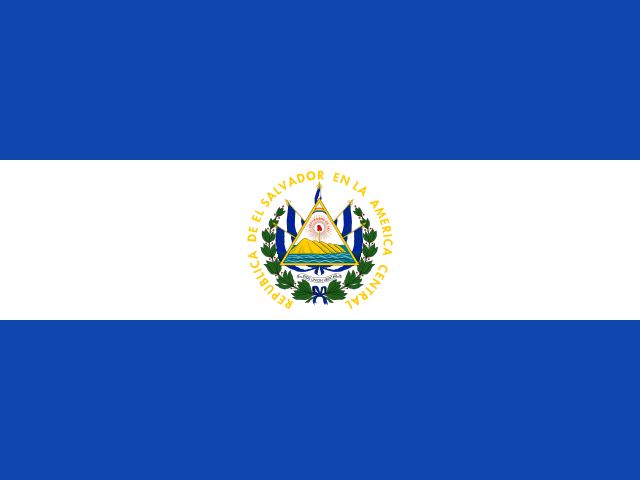
Flag
meaning: the blue bands stand for the Pacific Ocean and the Caribbean Sea, and the white for the land, as well as peace and prosperity
history: the banner is based on the former blue-white-blue flag of the Federal Republic of Central America
National symbol(s)
turquoise-browed motmot (bird)
National color(s)
blue, white
National anthem(s)
lyrics/music: Juan Jose CANAS/Juan ABERLE
history: officially adopted 1953, in use since 1879; at four minutes and 20 seconds, the anthem is one of the world's longest
National heritage
selected World Heritage Site locales: Joya de Cerén Archaeological Site
Economy32
Economic overview
upper-middle-income, dollarized Central American economy; reliant on remittances from US; recent growth linked to infrastructure investment, consumption, and crime reduction; $1.3 billion IMF loan to address fiscal imbalances; Bitcoin adopted as legal tender; persistent poverty and large informal sector
Real GDP (purchasing power parity)
Real GDP (purchasing power parity) 2023: $72.085 billion (2023 est.)
Real GDP (purchasing power parity) 2022: $69.621 billion (2022 est.)
Real GDP growth rate
Real GDP growth rate 2023: 3.5% (2023 est.)
Real GDP growth rate 2022: 3% (2022 est.)
Real GDP per capita
Real GDP per capita 2023: $11,400 (2023 est.)
Real GDP per capita 2022: $11,100 (2022 est.)
GDP (official exchange rate)
Inflation rate (consumer prices)
Inflation rate (consumer prices) 2023: 4% (2023 est.)
Inflation rate (consumer prices) 2022: 7.2% (2022 est.)
GDP - composition, by sector of origin
industry: 22.4% (2024 est.)
services: 61% (2024 est.)
GDP - composition, by end use
household consumption
government consumption
investment in fixed capital
investment in inventories
exports of goods and services
imports of goods and services
Agricultural products
Industries
food processing, beverages, petroleum, chemicals, fertilizer, textiles, furniture, light metals
Industrial production growth rate
Labor force
Unemployment rate
Unemployment rate 2023: 3% (2023 est.)
Unemployment rate 2022: 3% (2022 est.)
Youth unemployment rate (ages 15-24)
male: 5.2% (2024 est.)
female: 9.5% (2024 est.)
Population below poverty line
Gini Index coefficient - distribution of family income
Average household expenditures
on alcohol and tobacco: 0.5% of household expenditures (2023 est.)
Household income or consumption by percentage share
highest 10%: 29.7% (2023 est.)
Remittances
Remittances 2023: 24.5% of GDP (2023 est.)
Remittances 2022: 24.6% of GDP (2022 est.)
Budget
expenditures: $10.313 billion (2023 est.)
Public debt
Taxes and other revenues
Current account balance
Current account balance 2023: -$367.831 million (2023 est.)
Current account balance 2022: -$2.144 billion (2022 est.)
Exports
Exports 2023: $10.629 billion (2023 est.)
Exports 2022: $10.164 billion (2022 est.)
Exports - partners
Exports - commodities
Imports
Imports 2023: $17.034 billion (2023 est.)
Imports 2022: $18.181 billion (2022 est.)
Imports - partners
Imports - commodities
Reserves of foreign exchange and gold
Reserves of foreign exchange and gold 2023: $3.079 billion (2023 est.)
Reserves of foreign exchange and gold 2022: $2.695 billion (2022 est.)
Debt - external
Exchange rates
the US dollar is used as a medium of exchange and circulates freely in the economy
Energy7
Electricity access
Electricity
consumption: 6.335 billion kWh (2023 est.)
exports: 140 million kWh (2023 est.)
imports: 750.096 million kWh (2023 est.)
transmission/distribution losses: 770.613 million kWh (2023 est.)
Electricity generation sources
fossil fuels
solar
wind
hydroelectricity
geothermal
biomass and waste
Coal
imports: 2,000 metric tons (2023 est.)
Petroleum
refined petroleum consumption: 56,000 bbl/day (2023 est.)
Natural gas
imports: 486.291 million cubic meters (2023 est.)
Energy consumption per capita
Communications6
Telephones - fixed lines
subscriptions per 100 inhabitants: 14 (2024 est.)
Telephones - mobile cellular
subscriptions per 100 inhabitants: 177 (2024 est.)
Broadcast media
multiple privately owned national terrestrial TV networks, supplemented by cable TV networks that carry international channels; hundreds of commercial radio stations and 2 government-owned radio stations; transition to digital transmission was set to begin in 2018, along with adoption of the Japanese-Brazilian Digital Standard (ISDB-T) (2022)
Internet country code
.sv
Internet users
Broadband - fixed subscriptions
subscriptions per 100 inhabitants: 11 (2022 est.)
Transportation5
Civil aircraft registration country code prefix
YS
Airports
27 (2025)
Railways
narrow gauge: 12.5 km (2014) 0.914-mm gauge
Merchant marine
by type: other 5
Ports
total ports
large
medium
small
very small
ports with oil terminals
key ports
Military & Security6
Military and security forces
Ministry of Justice and Public Safety: National Civil Police (Policia Nacional Civil, PNC) (2025)
Military expenditures
Military Expenditures 2023: 1.2% of GDP (2023 est.)
Military Expenditures 2022: 1.3% of GDP (2022 est.)
Military Expenditures 2021: 1.2% of GDP (2021 est.)
Military Expenditures 2020: 1.4% of GDP (2020 est.)
Military and security service personnel strengths
Military equipment inventories and acquisitions
the FAES is lightly armed with an inventory of mostly older or secondhand arms and equipment, largely provided by the US (2025)
Military service age and obligation
Military - note
the military led the country for much of the 20th century; from 1980 to 1992, it fought a bloody civil war against guerrillas from the Farabundo Martí National Liberation Front or FMLN, the paramilitary arm of the Democratic Revolutionary Front (Frente Democrático Revolucionario), a coalition of left-wing dissident political groups backed by Cuba and the Soviet Union; the FAES received considerable US support during the conflict; significant human rights violations occurred during the war and approximately 75,000 Salvadorans, mostly civilians, were killed (2025)
Transnational Issues2
Refugees and internally displaced persons
IDPs: 35,391 (2024 est.)
Illicit drugs
major illicit drug-producing and/or drug-transit country
major precursor-chemical producer (2025)