
Djibouti
Republic of Djibouti
Population
1.01M
Area
23,200 km²
GDP
$4.09B
GDP Per Capita
$6,800
Pop. Density
44/km²
Quick Facts
Currency
FrDjiboutian franc(DJF)
Calling Code
+253
Timezone
UTC+03:00
Languages
Arabic, French+more
Driving Side
right
Demonym
Djibouti
Background
Tension between the ethnic Afar and Somali populations increased over time, as the ethnic Somalis perceived that the French unfairly favored the Afar and gave them disproportionate influence in local governance. In 1958, the French held a referendum that provided residents of French Somaliland the option to either continue their association with France or to join neighboring Somalia as it established its independence. Ethnic Somali protested the vote, because French colonial leaders did not recognize many Somali as residents, which gave the Afar outsized influence in the decision to uphold ties with France. After a second referendum in 1967, the French changed the territory’s name to the French Territory of the Afars and the Issas, in part to underscore their relationship with the ethnic Afar and downplay the significance of the ethnic Somalis. A final referendum in 1977 established Djibouti as an independent nation and granted ethnic Somalis Djiboutian nationality, formally resetting the balance of power between the majority ethnic Somalis and minority ethnic Afar residents. Upon independence, the country was named after its capital city of Djibouti. Hassan Gouled APTIDON, an ethnic Somali leader, installed an authoritarian one-party state and served as president until 1999. Unrest between the Afar minority and Somali majority culminated in a civil war during the 1990s that ended in 2001 with a peace accord between Afar rebels and the Somali Issa-dominated government. In 1999, Djibouti's first multiparty presidential election resulted in the election of Ismail Omar GUELLEH as president; he was reelected to a second term in 2005 and extended his tenure in office via a constitutional amendment, which allowed him to serve his third and fourth terms, and to begin a fifth term in 2021.
Djibouti occupies a strategic geographic location at the intersection of the Red Sea and the Gulf of Aden. Its ports handle 95% of Ethiopia’s trade. Djibouti’s ports also service transshipments between Europe, the Middle East, and Asia. The government has longstanding ties to France, which maintains a military presence in the country, as do the US, Japan, Italy, Germany, Spain, and China.
Historical Trends
GDP (USD)
↑440.0% since 2006Population
↑36.6% since 2006Life Expectancy at Birth
Latest: 66.0 yearsData source: World Bank Open Data
Geography18
Location
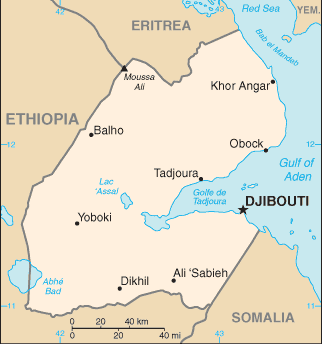
Eastern Africa, bordering the Gulf of Aden and the Red Sea, between Eritrea and Somalia
Geographic coordinates
11 30 N, 43 00 E
Map references
Africa
Area
land: 23,180 sq km
water: 20 sq km
Area - comparative
slightly smaller than New Jersey
Land boundaries
border countries: Eritrea 125 km; Ethiopia 342 km; Somalia 61 km
Coastline
314 km
Maritime claims
contiguous zone: 24 nm
exclusive economic zone: 200 nm
Climate
desert; torrid, dry
Terrain
coastal plain and plateau separated by central mountains
Elevation
lowest point: Lac Assal -155 m
mean elevation: 430 m
Natural resources
potential geothermal power, gold, clay, granite, limestone, marble, salt, diatomite, gypsum, pumice, petroleum
Land use
agricultural land
agricultural land: arable land
agricultural land: permanent crops
agricultural land: permanent pasture
forest
other
Irrigated land
10 sq km (2012)
Major lakes (area sq km)
Population distribution
most densely populated areas are in the east; the largest city is Djibouti, and the other cities in the country are a fraction of its size, as shown in this population distribution map
Natural hazards
volcanism: experiences limited volcanic activity; Ardoukoba (298 m) last erupted in 1978; Manda-Inakir, located along the Ethiopian border, is also historically active
Geography - note
strategic location near world's busiest shipping lanes and close to Arabian oilfields; Lac Assal (Lake Assal) is the lowest point in Africa and the saltiest lake in the world
People & Society32
Population
male: 458,988
female: 554,715
Nationality
adjective: Djiboutian
Ethnic groups
Somali 60%, Afar 35%, other 5% (mostly Yemeni Arab, also French, Ethiopian, and Italian)
Languages
French (official), Arabic (official), Somali, Afar
Religions
Sunni Muslim 94% (nearly all Djiboutians), other 6% (mainly foreign-born residents - Shia Muslim, Christian, Hindu, Jewish, Baha'i, and atheist)
Age structure
15-64 years: 67.4% (male 290,654/female 379,778)
65 years and over: 4.2% (2024 est.) (male 18,313/female 23,704)
Dependency ratios
youth dependency ratio: 41.7 (2025 est.)
elderly dependency ratio: 6.4 (2025 est.)
potential support ratio: 15.7 (2025 est.)
Median age
male: 24.4 years
female: 27.9 years
Population growth rate
1.84% (2025 est.)
Birth rate
21.46 births/1,000 population (2025 est.)
Death rate
7 deaths/1,000 population (2025 est.)
Net migration rate
3.94 migrant(s)/1,000 population (2025 est.)
Population distribution
most densely populated areas are in the east; the largest city is Djibouti, and the other cities in the country are a fraction of its size, as shown in this population distribution map
Urbanization
rate of urbanization: 1.56% annual rate of change (2020-25 est.)
Major urban areas - population
600,000 DJIBOUTI (capital) (2023)
Sex ratio
0-14 years: 1.01 male(s)/female
15-64 years: 0.77 male(s)/female
65 years and over: 0.77 male(s)/female
total population: 0.83 male(s)/female (2024 est.)
Maternal mortality ratio
162 deaths/100,000 live births (2023 est.)
Infant mortality rate
male: 52.1 deaths/1,000 live births
female: 38 deaths/1,000 live births
Life expectancy at birth
male: 63.4 years
female: 68.5 years
Total fertility rate
2.09 children born/woman (2025 est.)
Gross reproduction rate
1.03 (2025 est.)
Drinking water source
improved: urban
improved: rural
improved: total
unimproved: urban
unimproved: rural
unimproved: total
Health expenditure
Health expenditure (as % of national budget): 5.2% of national budget (2022 est.)
Physician density
0.21 physicians/1,000 population (2022)
Hospital bed density
1.4 beds/1,000 population (2018 est.)
Sanitation facility access
improved: urban
improved: rural
improved: total
unimproved: urban
unimproved: rural
unimproved: total
Obesity - adult prevalence rate
13.5% (2016)
Alcohol consumption per capita
beer: 0.05 liters of pure alcohol (2019 est.)
wine: 0.02 liters of pure alcohol (2019 est.)
spirits: 0.14 liters of pure alcohol (2019 est.)
other alcohols: 0 liters of pure alcohol (2019 est.)
Children under the age of 5 years underweight
17.7% (2023 est.)
Currently married women (ages 15-49)
46.5% (2017 est.)
Child marriage
women married by age 18: 6.5% (2019)
Education expenditure
Education expenditure (% national budget): 14.5% national budget (2018 est.)
Government22
Country name
conventional long form
conventional short form
local long form
local short form
former
etymology
Government type
presidential republic
Capital
geographic coordinates: 11 35 N, 43 09 E
time difference: UTC+3 (8 hours ahead of Washington, DC, during Standard Time)
etymology: the name is said to derive from the Afar word gabouri, meaning "plate," in reference to a palm-fiber plate used for ceremonial purposes
Administrative divisions
Legal system
mixed system based primarily on the French civil code (as it existed in 1997), Islamic religious law (in matters of family law and successions), and customary law
Constitution
amendment process: proposed by the president of the republic or by the National Assembly; Assembly consideration of proposals requires assent of at least one third of the membership; passage requires a simple majority vote by the Assembly and approval by simple majority vote in a referendum; the president can opt to bypass a referendum if adopted by at least two-thirds majority vote of the Assembly; constitutional articles on the sovereignty of Djibouti, its republican form of government, and its pluralist form of democracy cannot be amended
International law organization participation
accepts compulsory ICJ jurisdiction with reservations; accepts ICCt jurisdiction
Citizenship
citizenship by descent only: the mother must be a citizen of Djibouti
dual citizenship recognized: no
residency requirement for naturalization: 10 years
Suffrage
18 years of age; universal
Executive branch
chief of state
head of government
cabinet
election/appointment process
most recent election date
election results
2021: Ismail Omar GUELLEH reelected president for a fifth term; percent of vote - Ismail Omar GUELLEH (RPP) 97.4%, Zakaria Ismael FARAH (MDEND) 2.7%
expected date of next election
Legislative branch
legislature name
legislative structure
number of seats
electoral system
scope of elections
term in office
most recent election date
parties elected and seats per party
percentage of women in chamber
expected date of next election
Judicial branch
judge selection and term of office: Supreme Court magistrates appointed by the president with the advice of the Superior Council of the Magistracy (CSM), a 10-member body consisting of 4 judges, 3 members (non-parliamentarians and judges) appointed by the president, and 3 appointed by the National Assembly president or speaker; magistrates appointed for life with retirement at age 65; Constitutional Council magistrate appointments - 2 by the president of the republic, 2 by the president of the National Assembly, and 2 by the CSM; magistrates appointed for 8-year, non-renewable terms
subordinate courts: High Court of Appeal; Courts of First Instance; customary courts; State Court (replaced sharia courts in 2003)
Political parties
National Democratic Party or PND
People's Rally for Progress or RPP
Peoples Social Democratic Party or PPSD
Union for Democracy and Justice or UDJ
Union for the Presidential Majority coalition or UMP
Union of Reform Partisans or UPR
Diplomatic representation in the US
chancery: 1156 15th Street NW, Suite 515, Washington, DC 20005
telephone: [1] (202) 331-0270
FAX: [1] (202) 331-0302
email address and website:
[email protected]
https://www.djiboutiembassyus.org/
Diplomatic representation from the US
chief of mission
embassy
mailing address
telephone
FAX
email address and website
International organization participation
ACP, AfDB, AFESD, AMF, ATMIS, AU, CAEU (candidates), COMESA, FAO, G-77, IBRD, ICAO, ICCt, ICRM, IDA, IDB, IFAD, IFC, IFRCS, IGAD, ILO, IMF, IMO, Interpol, IOC, IOM, IPU, ITU, ITUC (NGOs), LAS, MIGA, MINURSO, NAM, OIC, OIF, OPCW, UN, UNCTAD, UNESCO, UNHCR, UNIDO, UNWTO, UPU, WCO, WFTU (NGOs), WHO, WIPO, WMO, WTO
Independence
27 June 1977 (from France)
National holiday
Independence Day, 27 June (1977)
Flag
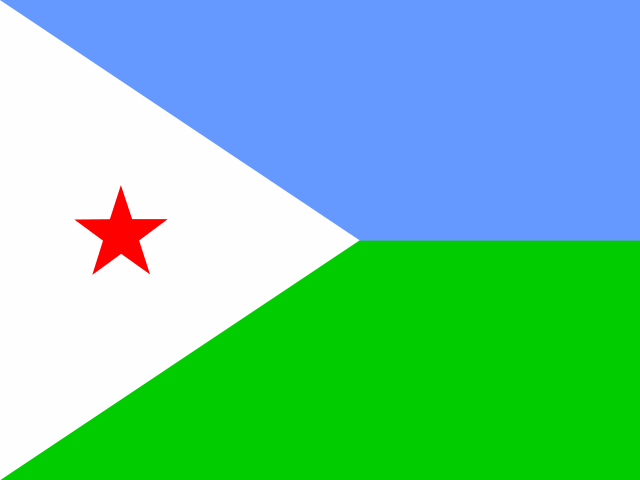
meaning: blue stands for sea, sky, and the Issa Somali people, green for earth and the Afar people, and white for peace; the red star stands for the struggle for independence and unity
National symbol(s)
red star
National color(s)
light blue, green, white, red
National anthem(s)
lyrics/music: Aden ELMI/Abdi ROBLEH
history: adopted 1977
Economy30
Economic overview
food import-dependent Horn of Africa economy driven by various national military bases and port-based trade; fairly resilient from COVID-19 disruptions; major re-exporter; increasing Ethiopian and Chinese trade relations; investing in infrastructure
Real GDP (purchasing power parity)
Real GDP (purchasing power parity) 2023: $7.546 billion (2023 est.)
Real GDP (purchasing power parity) 2022: $7.028 billion (2022 est.)
Real GDP growth rate
Real GDP growth rate 2023: 7.4% (2023 est.)
Real GDP growth rate 2022: 5.2% (2022 est.)
Real GDP per capita
Real GDP per capita 2023: $6,500 (2023 est.)
Real GDP per capita 2022: $6,200 (2022 est.)
GDP (official exchange rate)
Inflation rate (consumer prices)
Inflation rate (consumer prices) 2023: 1.5% (2023 est.)
Inflation rate (consumer prices) 2022: 5.2% (2022 est.)
GDP - composition, by sector of origin
industry: 15.4% (2024 est.)
services: 75.5% (2024 est.)
GDP - composition, by end use
household consumption
government consumption
investment in fixed capital
investment in inventories
exports of goods and services
imports of goods and services
Agricultural products
Industries
construction, agricultural processing, shipping
Industrial production growth rate
Labor force
Unemployment rate
Unemployment rate 2023: 26.2% (2023 est.)
Unemployment rate 2022: 26.4% (2022 est.)
Youth unemployment rate (ages 15-24)
male: 75.3% (2024 est.)
female: 77.9% (2024 est.)
Population below poverty line
Gini Index coefficient - distribution of family income
Household income or consumption by percentage share
highest 10%: 32.3% (2017 est.)
Remittances
Remittances 2023: 1.5% of GDP (2023 est.)
Remittances 2022: 1.6% of GDP (2022 est.)
Budget
expenditures: $754 million (2019 est.)
Public debt
Current account balance
Current account balance 2023: $721.349 million (2023 est.)
Current account balance 2022: $656.207 million (2022 est.)
Exports
Exports 2023: $5.877 billion (2023 est.)
Exports 2022: $5.674 billion (2022 est.)
Exports - partners
Exports - commodities
Imports
Imports 2023: $5.269 billion (2023 est.)
Imports 2022: $5.096 billion (2022 est.)
Imports - partners
Imports - commodities
Reserves of foreign exchange and gold
Reserves of foreign exchange and gold 2023: $502.034 million (2023 est.)
Reserves of foreign exchange and gold 2022: $589.437 million (2022 est.)
Debt - external
Exchange rates
Currency
Exchange rates 2024
Exchange rates 2023
Exchange rates 2022
Exchange rates 2021
Exchange rates 2020
Energy6
Electricity access
electrification - urban areas: 72.8%
electrification - rural areas: 36.6%
Electricity
consumption: 584.997 million kWh (2023 est.)
imports: 512 million kWh (2023 est.)
transmission/distribution losses: 128.74 million kWh (2023 est.)
Electricity generation sources
solar: 0.5% of total installed capacity (2023 est.)
wind: 34.2% of total installed capacity (2023 est.)
Coal
imports: 19,000 metric tons (2023 est.)
Petroleum
Energy consumption per capita
Communications6
Telephones - fixed lines
subscriptions per 100 inhabitants: 3 (2023 est.)
Telephones - mobile cellular
subscriptions per 100 inhabitants: 49 (2023 est.)
Broadcast media
Internet country code
.dj
Internet users
Broadband - fixed subscriptions
subscriptions per 100 inhabitants: 1 (2023 est.)
Transportation6
Civil aircraft registration country code prefix
J2
Airports
10 (2025)
Heliports
6 (2025)
Railways
standard gauge: 97 km (2017) 1.435-m gauge
Merchant marine
by type: bulk carrier 1, container ship 1, general cargo 4, oil tanker 13, other 21
Ports
total ports
large
medium
small
very small
ports with oil terminals
key ports
Military & Security7
Military and security forces
Ministry of Interior: National Police (Police Nationale) (2025)
note 2: the National Police are responsible for security within Djibouti City and have primary control over immigration and customs procedures for all land border-crossing points
Military expenditures
Military Expenditures 2018: 3.5% of GDP (2018 est.)
Military Expenditures 2017: 3.3% of GDP (2017 est.)
Military Expenditures 2016: 2.7% of GDP (2016 est.)
Military Expenditures 2015: 2.5% of GDP (2015 est.)
Military and security service personnel strengths
estimated 10-12,000 active Armed Forces, including Gendarmerie (2025)
Military equipment inventories and acquisitions
Military service age and obligation
18-26 years of age for voluntary military service (2025)
Military deployments
approximately 1,500 Somalia (AUSSOM) (2025)
Military - note
China, France, Italy, Japan, and the US maintain bases in Djibouti for regional military missions, including counterterrorism, counter-piracy, crisis response, and security assistance; other countries, such as Germany and Spain, have smaller military contingents; the EU and NATO also maintain a presence in Djibouti to support multinational naval counter-piracy operations and maritime training efforts (2025)