
Croatia
Republic of Croatia
Population
4.07M
Area
56,594 km²
GDP
$92.53B
GDP Per Capita
$42,600
Pop. Density
72/km²
Quick Facts
Currency
€euro(EUR)
Calling Code
+385
Timezone
UTC+01:00
Languages
Croatian+more
Driving Side
right
Demonym
Croatian
Background
Historical Trends
GDP (USD)
↑87.5% since 2006Population
↓10.3% since 2006Life Expectancy at Birth
Latest: 78.5 yearsData source: World Bank Open Data
Geography19
Location
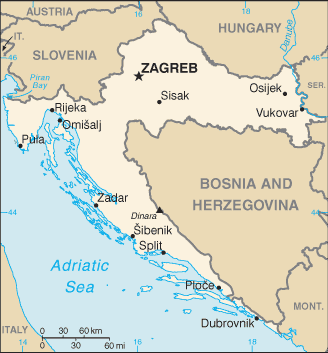
Southeastern Europe, bordering the Adriatic Sea, between Bosnia and Herzegovina and Slovenia
Geographic coordinates
45 10 N, 15 30 E
Map references
Europe
Area
land: 55,974 sq km
water: 620 sq km
Area - comparative
slightly smaller than West Virginia
Land boundaries
border countries: Bosnia and Herzegovina 956 km; Hungary 348 km; Montenegro 19 km; Serbia 314 km; Slovenia 600 km
Coastline
5,835 km (mainland 1,777 km; islands 4,058 km)
Maritime claims
continental shelf: 200-m depth or to the depth of exploitation
Climate
Mediterranean and continental; continental climate predominant with hot summers and cold winters; mild winters, dry summers along coast
Terrain
geographically diverse; flat plains along Hungarian border, low mountains and highlands near Adriatic coastline and islands
Elevation
lowest point: Adriatic Sea 0 m
mean elevation: 331 m
Natural resources
oil, some coal, bauxite, low-grade iron ore, calcium, gypsum, natural asphalt, silica, mica, clays, salt, hydropower
Land use
agricultural land
agricultural land: arable land
agricultural land: permanent crops
agricultural land: permanent pasture
forest
other
Irrigated land
170 sq km (2022)
Major rivers (by length in km)
note: [s] after country name indicates river source; [m] after country name indicates river mouth
Major watersheds (area sq km)
Population distribution
more of the population lives in the northern half of the country, with approximately a quarter of the populace residing in and around the capital of Zagreb; many of the islands are sparsely populated
Natural hazards
destructive earthquakes
Geography - note
controls most land routes from Western Europe to the Aegean Sea and Turkish Straits; most Adriatic Sea islands lie off the coast of Croatia -- some 1,200 islands, islets, ridges, and rocks
People & Society32
Population
male: 1,968,334
female: 2,102,874
Nationality
adjective: Croatian
Ethnic groups
Croat 91.6%, Serb 3.2%, other 3.9% (including Bosniak, Romani, Albanian, Italian, and Hungarian), unspecified 1.3% (2021 est.)
Languages
major-language sample(s):
Knjiga svjetskih činjenica, nužan izvor osnovnih informacija. (Croatian)
The World Factbook, the indispensable source for basic information.
Religions
Roman Catholic 79%, Orthodox 3.3%, Protestant 0.3%, other Christian 4.8%, Muslim 1.3%, other 1.1%, agnostic 1.7%, none or atheist 4.7%, unspecified 3.9% (2021 est.)
Age structure
15-64 years: 63.1% (male 1,307,814/female 1,309,394)
65 years and over: 23.1% (2024 est.) (male 399,090/female 559,055)
Dependency ratios
youth dependency ratio: 21.5 (2025 est.)
elderly dependency ratio: 34.4 (2025 est.)
potential support ratio: 2.9 (2025 est.)
Median age
male: 43.2 years
female: 47 years
Population growth rate
-0.53% (2025 est.)
Birth rate
8.49 births/1,000 population (2025 est.)
Death rate
12.87 deaths/1,000 population (2025 est.)
Net migration rate
-0.87 migrant(s)/1,000 population (2025 est.)
Population distribution
more of the population lives in the northern half of the country, with approximately a quarter of the populace residing in and around the capital of Zagreb; many of the islands are sparsely populated
Urbanization
rate of urbanization: 0.05% annual rate of change (2020-25 est.)
Major urban areas - population
684,000 ZAGREB (capital) (2023)
Sex ratio
0-14 years: 1.07 male(s)/female
15-64 years: 1 male(s)/female
65 years and over: 0.71 male(s)/female
total population: 0.93 male(s)/female (2024 est.)
Mother's mean age at first birth
29 years (2020 est.)
Maternal mortality ratio
3 deaths/100,000 live births (2023 est.)
Infant mortality rate
male: 8.2 deaths/1,000 live births
female: 8.7 deaths/1,000 live births
Life expectancy at birth
male: 74.6 years
female: 81 years
Total fertility rate
1.43 children born/woman (2025 est.)
Gross reproduction rate
0.69 (2025 est.)
Drinking water source
unimproved: urban: urban: 0% of population (2022 est.)
Health expenditure
Health expenditure (as % of national budget): 13.7% of national budget (2022 est.)
Physician density
3.91 physicians/1,000 population (2022)
Hospital bed density
5.6 beds/1,000 population (2020 est.)
Obesity - adult prevalence rate
24.4% (2016)
Alcohol consumption per capita
beer: 4.75 liters of pure alcohol (2019 est.)
wine: 3.52 liters of pure alcohol (2019 est.)
spirits: 1.37 liters of pure alcohol (2019 est.)
other alcohols: 0.36 liters of pure alcohol (2019 est.)
Tobacco use
male: 33.6% (2025 est.)
female: 32.1% (2025 est.)
Currently married women (ages 15-49)
50.1% (2021 est.)
Education expenditure
Education expenditure (% national budget): 8.5% national budget (2021 est.)
School life expectancy (primary to tertiary education)
male: 15 years (2022 est.)
female: 17 years (2022 est.)
Government23
Country name
conventional long form
conventional short form
local long form
local short form
former
etymology
Government type
parliamentary republic
Capital
geographic coordinates: 45 48 N, 16 00 E
time difference: UTC+1 (6 hours ahead of Washington, DC, during Standard Time)
daylight saving time: +1hr, begins last Sunday in March; ends last Sunday in October
etymology: the city's name means "beyond the bank (or ditch)"; za in Old Croat means "beyond," and greb means "bank" or "ditch," relating to the city's original site above the Sava River
Administrative divisions
Legal system
civil law system influenced by legal heritage of Austria-Hungary
Constitution
amendment process: proposed by at least one fifth of the Assembly membership, by the president of the republic, by the Government of Croatia, or through petition by at least 10% of the total electorate; proceedings to amend require majority vote by the Assembly; passage requires two-thirds majority vote by the Assembly; passage by petition requires a majority vote in a referendum and promulgation by the Assembly
International law organization participation
has not submitted an ICJ jurisdiction declaration; accepts ICCt jurisdiction
Citizenship
citizenship by descent only: at least one parent must be a citizen of Croatia
dual citizenship recognized: yes
residency requirement for naturalization: 5 years
Suffrage
18 years of age; universal
Executive branch
chief of state
head of government
cabinet
election/appointment process
most recent election date
election results
2025: Zoran MILANOVIC elected president in second round; percent of vote in second round - Zoran MILANOVIC (SDP) 74.6%, Dragan PRIMORAC (independent) 25.3%
2019: Zoran MILANOVIC elected president in second round; percent of vote in second round - Zoran MILANOVIC (SDP) 52.7%, Kolinda GRABAR-KITAROVIC (HDZ) 47.3%
expected date of next election
Legislative branch
legislature name
legislative structure
number of seats
electoral system
scope of elections
term in office
most recent election date
parties elected and seats per party
percentage of women in chamber
expected date of next election
Judicial branch
judge selection and term of office: president of Supreme Court nominated by the president of Croatia and elected by the Sabor for a 4-year term; other Supreme Court justices appointed by the National Judicial Council; all judges serve until age 70
subordinate courts: Administrative Court; county, municipal, and specialized courts
Political parties
The Bridge or MOST (formerly the Bridge of Independent Lists)
Croatia Romani Union Kali Sara (SRRH)
Croatian Democratic Union or HDZ
Democratic Union of Hungarians in Croatia (DZMH)
Focus or Fokus
Homeland Movement or DP (also known as Miroslav Škoro Homeland Movement or DPMS)
Independent Democratic Serb Party or SDSS
Independent Platform of the North (NPS)
Istrian Democratic Assembly or IDS
Social Democratic Party of Croatia or SDP
We Can! or Mozemo!
Diplomatic representation in the US
chief of mission
chancery
telephone
FAX
email address and website
consulate(s) general
consulate(s)
Diplomatic representation from the US
chief of mission
embassy
mailing address
telephone
FAX
email address and website
International organization participation
AIIB, Australia Group, BIS, BSEC (observer), CD, CE, CEI, EAPC, EBRD, ECB, EMU, EU, FAO, G-11, IADB, IAEA, IBRD, ICAO, ICC (national committees), ICCt, ICRM, IDA, IFAD, IFC, IFRCS, IHO, ILO, IMF, IMO, IMSO, Interpol, IOC, IOM, IPU, ISO, ITSO, ITU, ITUC (NGOs), MIGA, MINURSO, NAM (observer), NATO, NSG, OAS (observer), OIF (observer), OPCW, OSCE, PCA, Schengen Convention, SELEC, UN, UNCTAD, UNESCO, UNFICYP, UNHCR, UNIDO, UNIFIL, UNMIL, UNMOGIP, UNWTO, UPU, Wassenaar Arrangement, WCO, WHO, WIPO, WMO, WTO, ZC
Independence
National holiday
Flag
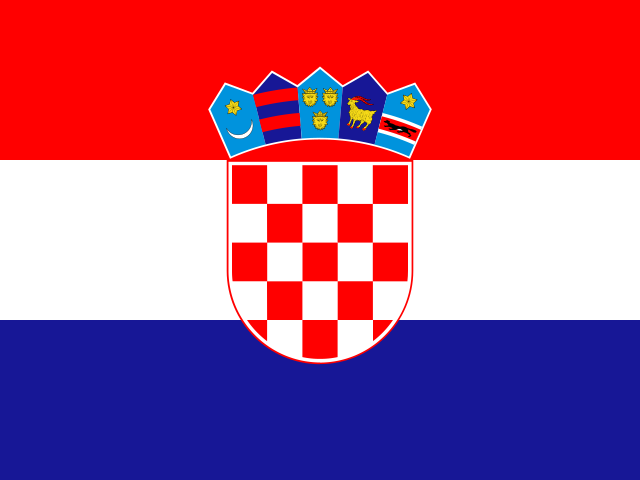
meaning: the small shields represent the five historic regions (from left to right): Croatia, Dubrovnik, Dalmatia, Istria, and Slavonia
history: Russia's 19th-century flag inspired the pan-Slav colors
National symbol(s)
red-and-white checkerboard
National color(s)
red, white, blue
National anthem(s)
lyrics/music: Antun MIHANOVIC/Josip RUNJANIN
history: adopted in 1972 while still part of Yugoslavia; the lyrics were written in 1835, and it served as an unofficial anthem beginning in 1891
National heritage
selected World Heritage Site locales: Plitvice Lakes National Park (n); Historic Split (c); Old City of Dubrovnik (c); Euphrasian Basilica; Historic Trogir (c); Šibenik Cathedral (c); Stari Grad Plain (c); Zadar and Fort St. Nikola Venetian Defense Works (c); Primeval Beech Forests (n); Stećci Medieval Tombstones Graveyards (c)
Economy31
Economic overview
upper-middle-income Balkan economy; newest euro user (introduced in 2023); increased investments from EU structural funds and tourism sector contributing to strong but moderating economic growth; declining energy prices and restrictive monetary policy easing inflation; historically low unemployment rate with labor shortages within services and manufacturing sectors
Real GDP (purchasing power parity)
Real GDP (purchasing power parity) 2023: $158.769 billion (2023 est.)
Real GDP (purchasing power parity) 2022: $153.693 billion (2022 est.)
Real GDP growth rate
Real GDP growth rate 2023: 3.3% (2023 est.)
Real GDP growth rate 2022: 7.3% (2022 est.)
Real GDP per capita
Real GDP per capita 2023: $41,100 (2023 est.)
Real GDP per capita 2022: $39,900 (2022 est.)
GDP (official exchange rate)
Inflation rate (consumer prices)
Inflation rate (consumer prices) 2023: 7.9% (2023 est.)
Inflation rate (consumer prices) 2022: 10.8% (2022 est.)
GDP - composition, by sector of origin
industry: 19.8% (2024 est.)
services: 59.7% (2024 est.)
GDP - composition, by end use
household consumption
government consumption
investment in fixed capital
investment in inventories
exports of goods and services
imports of goods and services
Agricultural products
Industries
chemicals and plastics, machine tools, fabricated metal, electronics, pig iron and rolled steel products, aluminum, paper, wood products, construction materials, textiles, shipbuilding, petroleum and petroleum refining, food and beverages, tourism
Industrial production growth rate
Labor force
Unemployment rate
Unemployment rate 2023: 6.1% (2023 est.)
Unemployment rate 2022: 7% (2022 est.)
Youth unemployment rate (ages 15-24)
male: 15.5% (2024 est.)
female: 18.2% (2024 est.)
Population below poverty line
Gini Index coefficient - distribution of family income
Average household expenditures
on alcohol and tobacco: 7.9% of household expenditures (2023 est.)
Household income or consumption by percentage share
highest 10%: 23% (2022 est.)
Remittances
Remittances 2023: 7.2% of GDP (2023 est.)
Remittances 2022: 7.5% of GDP (2022 est.)
Budget
expenditures: $33.715 billion (2023 est.)
Public debt
Taxes and other revenues
Current account balance
Current account balance 2023: $635.97 million (2023 est.)
Current account balance 2022: -$2.621 billion (2022 est.)
Exports
Exports 2023: $45.064 billion (2023 est.)
Exports 2022: $41.907 billion (2022 est.)
Exports - partners
Exports - commodities
Imports
Imports 2023: $46.811 billion (2023 est.)
Imports 2022: $46.769 billion (2022 est.)
Imports - partners
Imports - commodities
Reserves of foreign exchange and gold
Reserves of foreign exchange and gold 2023: $3.176 billion (2023 est.)
Reserves of foreign exchange and gold 2022: $29.726 billion (2022 est.)
Exchange rates
Currency
Exchange rates 2024
Exchange rates 2023
Exchange rates 2022
Exchange rates 2021
Exchange rates 2020
Energy7
Electricity access
Electricity
consumption: 16.408 billion kWh (2023 est.)
exports: 8.461 billion kWh (2023 est.)
imports: 10.038 billion kWh (2023 est.)
transmission/distribution losses: 2.053 billion kWh (2023 est.)
Electricity generation sources
fossil fuels
solar
wind
hydroelectricity
geothermal
biomass and waste
Coal
exports: 1,000 metric tons (2022 est.)
imports: 663,000 metric tons (2023 est.)
Petroleum
refined petroleum consumption: 70,000 bbl/day (2023 est.)
crude oil estimated reserves: 71 million barrels (2021 est.)
Natural gas
consumption: 2.689 billion cubic meters (2023 est.)
exports: 1.119 billion cubic meters (2023 est.)
imports: 2.995 billion cubic meters (2023 est.)
proven reserves: 24.919 billion cubic meters (2021 est.)
Energy consumption per capita
Communications6
Telephones - fixed lines
subscriptions per 100 inhabitants: 29 (2024 est.)
Telephones - mobile cellular
subscriptions per 100 inhabitants: 122 (2024 est.)
Broadcast media
the national state-owned public broadcaster, Croatian Radiotelevision, operates 4 terrestrial TV networks, a satellite channel that rebroadcasts programs for Croatians overseas, and 6 regional TV centers; 2 private broadcasters with national terrestrial networks; 29 privately owned regional TV stations; multi-channel cable and satellite TV subscription services are available; state-owned public broadcaster operates 4 national radio networks and 23 regional radio stations; 2 privately owned national radio networks and 117 local radio stations (2019)
Internet country code
.hr
Internet users
Broadband - fixed subscriptions
subscriptions per 100 inhabitants: 28 (2023 est.)
Transportation6
Civil aircraft registration country code prefix
9A
Airports
45 (2025)
Heliports
7 (2025)
Railways
Merchant marine
by type: bulk carrier 10, general cargo 32, oil tanker 14, other 328
Ports
total ports
large
medium
small
very small
ports with oil terminals
key ports
Military & Security7
Military and security forces
Military expenditures
Military Expenditures 2024: 1.9% of GDP (2024 est.)
Military Expenditures 2023: 1.7% of GDP (2023 est.)
Military Expenditures 2022: 1.8% of GDP (2022 est.)
Military Expenditures 2021: 2% of GDP (2021 est.)
Military and security service personnel strengths
approximately 15,000 active-duty military personnel (2025)
Military equipment inventories and acquisitions
Military service age and obligation
Military deployments
150 Kosovo (KFOR/NATO); also has a few hundred personnel participating in several other EU, NATO, and UN missions (2025)
Military - note
the OSRH was established in 1991 from the Croatian National Guard during the Croatian War of Independence (1991-95); during the war, the ground forces grew to as many as 60 brigades and dozens of independent battalions, and a single military offensive against Serbian forces in 1995 included some 100,000 Croatian troops; in 2000, Croatia initiated an effort to modernize and reform the OSRH into a small, professional military capable of meeting the challenges of NATO membership (2025)
Transnational Issues1
Refugees and internally displaced persons
stateless persons: 758 (2024 est.)