
Comoros
Union of the Comoros
Population
911.7K
Area
2,235 km²
GDP
$1.55B
GDP Per Capita
$3,600
Pop. Density
408/km²
Quick Facts
Currency
FrComorian franc(KMF)
Calling Code
+269
Timezone
UTC+03:00
Languages
Arabic, French, Comorian+more
Driving Side
right
Demonym
Comoran
Background
Since independence, Comoros has weathered approximately 20 successful and attempted coups, mostly between 1975 and 2000, resulting in prolonged political instability and stunted economic development. In 2002, President AZALI Assoumani became the first elected president following the completion of the Fomboni Accords, in which the islands of Grande Comore, Anjouan, and Moheli agreed to rotate the presidency among the islands every five years. This power-sharing agreement also included provisions allowing each island to maintain its local government. In 2007, Mohamed BACAR effected Anjouan's de-facto secession from the Union of the Comoros, refusing to step down when Comoros' other islands held legitimate elections. The African Union (AU) initially attempted to resolve the political crisis with sanctions and a naval blockade of Anjouan, but in 2008, the AU and Comoran soldiers seized the island. The island's inhabitants generally welcomed the move. In 2011, Ikililou DHOININE won the presidency in peaceful elections widely deemed to be free and fair. In closely contested elections in 2016, AZALI won a second term, when the rotating presidency returned to Grande Comore. In 2018, a referendum -- which the opposition parties boycotted -- approved a new constitution that extended presidential term limits and abolished the requirement for the presidency to rotate between the three main islands. AZALI formed a new government later that year, and he subsequently ran and was reelected in 2019. AZALI was reelected again in January 2024 in an election that the opposition disputed but the Supreme Court validated.
Historical Trends
GDP (USD)
↑109.3% since 2006Population
↑43.3% since 2006Life Expectancy at Birth
Latest: 66.8 yearsData source: World Bank Open Data
Geography17
Location
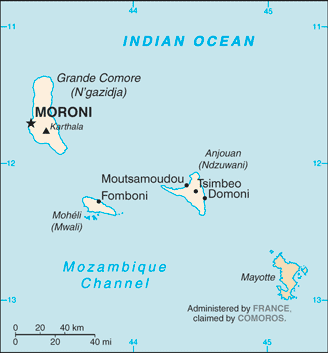
Southern Africa, group of islands at the northern mouth of the Mozambique Channel, about two-thirds of the way between northern Madagascar and northern Mozambique
Geographic coordinates
12 10 S, 44 15 E
Map references
Africa
Area
land: 2,235 sq km
water: 0 sq km
Area - comparative
slightly more than 12 times the size of Washington, D.C.
Land boundaries
Coastline
340 km
Maritime claims
exclusive economic zone: 200 nm
Climate
tropical marine; rainy season (November to May)
Terrain
volcanic islands, interiors vary from steep mountains to low hills
Elevation
lowest point: Indian Ocean 0 m
Natural resources
fish
Land use
agricultural land
agricultural land: arable land
agricultural land: permanent crops
agricultural land: permanent pasture
forest
other
Irrigated land
1.3 sq km (2012)
Population distribution
the capital city of Maroni, on the western side of the island of Grande Comore, is the country's largest city; however, Anjouan is the most densely populated of the three islands that comprise Comoros, as shown in this population distribution map
Natural hazards
volcanism: Karthala (2,361 m) on Grand Comore Island last erupted in 2007; a 2005 eruption forced thousands of people to be evacuated and produced a large ash cloud
Geography - note
important location at northern end of Mozambique Channel; the only Arab League country that lies entirely in the Southern Hemisphere
People & Society33
Population
male: 441,215
female: 470,492
Nationality
adjective: Comoran
Ethnic groups
Antalote, Cafre, Makoa, Oimatsaha, Sakalava
Languages
Arabic (official), French (official), Shikomoro (official; similar to Swahili), Comorian
Religions
Age structure
15-64 years: 62.8% (male 271,139/female 294,231)
65 years and over: 4.6% (2024 est.) (male 18,139/female 23,526)
Dependency ratios
youth dependency ratio: 49.9 (2025 est.)
elderly dependency ratio: 7.4 (2025 est.)
potential support ratio: 13.5 (2025 est.)
Median age
male: 22.1 years
female: 23.3 years
Population growth rate
1.26% (2025 est.)
Birth rate
21.12 births/1,000 population (2025 est.)
Death rate
6.38 deaths/1,000 population (2025 est.)
Net migration rate
-2.17 migrant(s)/1,000 population (2025 est.)
Population distribution
the capital city of Maroni, on the western side of the island of Grande Comore, is the country's largest city; however, Anjouan is the most densely populated of the three islands that comprise Comoros, as shown in this population distribution map
Urbanization
rate of urbanization: 2.97% annual rate of change (2020-25 est.)
Major urban areas - population
62,000 MORONI (capital) (2018)
Sex ratio
0-14 years: 1 male(s)/female
15-64 years: 0.92 male(s)/female
65 years and over: 0.77 male(s)/female
total population: 0.94 male(s)/female (2024 est.)
Mother's mean age at first birth
Maternal mortality ratio
179 deaths/100,000 live births (2023 est.)
Infant mortality rate
male: 64.9 deaths/1,000 live births
female: 44.7 deaths/1,000 live births
Life expectancy at birth
male: 65.5 years
female: 70.2 years
Total fertility rate
2.52 children born/woman (2025 est.)
Gross reproduction rate
1.24 (2025 est.)
Drinking water source
improved: urban
improved: rural
improved: total
unimproved: urban
unimproved: rural
unimproved: total
Health expenditure
Health expenditure (as % of national budget): 4.7% of national budget (2022 est.)
Physician density
0.42 physicians/1,000 population (2022)
Obesity - adult prevalence rate
7.8% (2016)
Alcohol consumption per capita
beer: 0.04 liters of pure alcohol (2019 est.)
wine: 0.07 liters of pure alcohol (2019 est.)
spirits: 0.07 liters of pure alcohol (2019 est.)
other alcohols: 0 liters of pure alcohol (2019 est.)
Tobacco use
male: 24.8% (2025 est.)
female: 4.7% (2025 est.)
Children under the age of 5 years underweight
9.1% (2022 est.)
Currently married women (ages 15-49)
63.1% (2022 est.)
Child marriage
women married by age 18: 20.7% (2022)
men married by age 18: 6.9% (2022)
Education expenditure
Education expenditure (% national budget): 11.5% national budget (2025 est.)
Literacy
male: 79.9% (2021 est.)
female: 72.2% (2021 est.)
Government23
Country name
conventional long form
conventional short form
local long form
local short form
former
etymology
Government type
federal presidential republic
Capital
geographic coordinates: 11 42 S, 43 14 E
time difference: UTC+3 (8 hours ahead of Washington, DC, during Standard Time)
etymology: the name means "at the place of fire," referring to the capital's location below the active volcano Mt. Karthala
Administrative divisions
3 islands; Anjouan (Ndzuwani), Grande Comore (N'gazidja), Moheli (Mwali)
Legal system
mixed legal system of Islamic religious law, the French civil code of 1975, and customary law
Constitution
amendment process: proposed by the president of the union or supported by at least one third of the Assembly of the Union membership; adoption requires approval by at least three-quarters majority of the total Assembly membership or approval in a referendum
International law organization participation
has not submitted an ICJ jurisdiction declaration; accepts ICCt jurisdiction
Citizenship
citizenship by descent only: at least one parent must be a citizen of the Comoros
dual citizenship recognized: no
residency requirement for naturalization: 10 years
Suffrage
18 years of age; universal
Executive branch
chief of state
head of government
cabinet
election/appointment process
most recent election date
election results
2024: AZALI Assoumani reelected president in first round - AZALI Assoumani (CRC) 63%, SALIM ISSA Abdallah (PJ) 20.3%, DAOUDOU Abdallah Mohamed (Orange Party) 5.9%, Bourhane HAMIDOU (independent) 5.1%
expected date of next election
Legislative branch
legislature name
legislative structure
number of seats
electoral system
scope of elections
term in office
most recent election date
parties elected and seats per party
percentage of women in chamber
expected date of next election
Judicial branch
judge selection and term of office: Supreme Court judges - selection and term of office NA
subordinate courts: Court of Appeals (in Moroni); Tribunal de première instance; island village (community) courts; religious courts
Political parties
Juwa Party (Parti Juwa) or PJ
Orange Party (2020)
Diplomatic representation in the US
chancery: Permanent Mission to the UN, 866 United Nations Plaza, Suite 495, New York, NY 10017
telephone: [1] (212) 750-1637
FAX: [1] (212) 750-1657
email address and website:
[email protected]
https://www.un.int/comoros/
Diplomatic representation from the US
International organization participation
ACP, AfDB, AMF, AOSIS, AU, CAEU (candidates), COMESA, FAO, FZ, G-77, IBRD, ICAO, ICCt, ICRM, IDA, IDB, IFAD, IFC, IFRCS, ILO, IMF, IMO, IMSO, InOC, Interpol, IOC, IOM, ITSO, ITU, ITUC (NGOs), LAS, MIGA, NAM, OIC, OIF, OPCW, UN, UNCTAD, UNESCO, UNIDO, UPU, WCO, WHO, WIPO, WMO, WTO (observer)
Independence
6 July 1975 (from France)
National holiday
Independence Day, 6 July (1975)
Flag
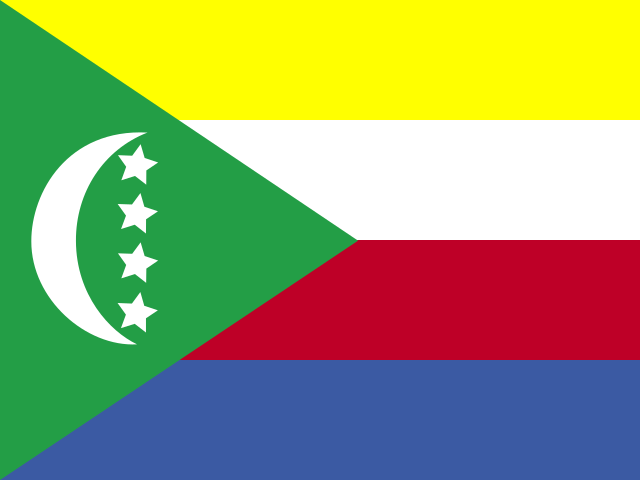
meaning: the horizontal bands and the stars represent the four main islands of the archipelago -- Mwali, N'gazidja, Ndzuwani, and Mahore (Mayotte is a department of France, but claimed by Comoros)
National symbol(s)
four five-pointed stars and crescent moon
National color(s)
green, white
National coat of arms
National anthem(s)
lyrics/music: Said Hachim SIDI ABDEREMANE/Said Hachim SIDI ABDEREMANE and Kamildine ABDALLAH
history: adopted 1978
Economy28
Economic overview
small trade-based island economy; declining remittances; new structural and fiscal reforms; adverse cyclone and COVID-19 impacts; manageable debts; fragile liquidity environment; large foreign direct investment; state-owned enterprises suffering
Real GDP (purchasing power parity)
Real GDP (purchasing power parity) 2023: $2.99 billion (2023 est.)
Real GDP (purchasing power parity) 2022: $2.901 billion (2022 est.)
Real GDP growth rate
Real GDP growth rate 2023: 3.1% (2023 est.)
Real GDP growth rate 2022: 2.8% (2022 est.)
Real GDP per capita
Real GDP per capita 2023: $3,500 (2023 est.)
Real GDP per capita 2022: $3,500 (2022 est.)
GDP (official exchange rate)
Inflation rate (consumer prices)
Inflation rate (consumer prices) 2016: 1.8% (2016 est.)
GDP - composition, by sector of origin
industry: 9.6% (2024 est.)
services: 50.1% (2024 est.)
GDP - composition, by end use
household consumption
government consumption
investment in fixed capital
investment in inventories
exports of goods and services
imports of goods and services
Agricultural products
Industries
fishing, tourism, perfume distillation
Industrial production growth rate
Labor force
Unemployment rate
Unemployment rate 2023: 3.8% (2023 est.)
Unemployment rate 2022: 3.9% (2022 est.)
Youth unemployment rate (ages 15-24)
male: 8.3% (2024 est.)
female: 9.6% (2024 est.)
Population below poverty line
Remittances
Remittances 2022: 22% of GDP (2022 est.)
Remittances 2021: 22.2% of GDP (2021 est.)
Budget
expenditures: $230.338 million (2023 est.)
Public debt
Current account balance
Current account balance 2022: -$5.248 million (2022 est.)
Current account balance 2021: -$4.076 million (2021 est.)
Exports
Exports 2022: $166.032 million (2022 est.)
Exports 2021: $128.331 million (2021 est.)
Exports - partners
Exports - commodities
Imports
Imports 2022: $480.268 million (2022 est.)
Imports 2021: $415.965 million (2021 est.)
Imports - partners
Imports - commodities
Reserves of foreign exchange and gold
Reserves of foreign exchange and gold 2023: $324.561 million (2023 est.)
Reserves of foreign exchange and gold 2022: $283.746 million (2022 est.)
Debt - external
Exchange rates
Currency
Exchange rates 2024
Exchange rates 2023
Exchange rates 2022
Exchange rates 2021
Exchange rates 2020
Energy6
Electricity access
electrification - urban areas: 100%
electrification - rural areas: 82.9%
Electricity
consumption: 113.052 million kWh (2023 est.)
transmission/distribution losses: 22.1 million kWh (2023 est.)
Electricity generation sources
Coal
Petroleum
Energy consumption per capita
Communications6
Telephones - fixed lines
subscriptions per 100 inhabitants: 1 (2023 est.) less than 1
Telephones - mobile cellular
subscriptions per 100 inhabitants: 110 (2023 est.)
Broadcast media
national state-owned TV station and a TV station run by Anjouan regional government; national state-owned radio; regional governments on the islands of Grande Comore and Anjouan each operate a radio station; a few independent and small community radio stations operate on the islands of Grande Comore and Moheli, and these two islands have access to Mayotte Radio and French TV
Internet country code
.km
Internet users
Broadband - fixed subscriptions
subscriptions per 100 inhabitants: (2023 est.) less than 1
Transportation4
Civil aircraft registration country code prefix
D6
Airports
3 (2025)
Merchant marine
by type: bulk carrier 17, container ship 7, general cargo 125, oil tanker 36, other 88
Ports
total ports
large
medium
small
very small
ports with oil terminals
key ports
Military & Security5
Military and security forces
note 2: the FCD is also known as the Comoran Security Force
Military and security service personnel strengths
estimated 600 Defense Force; estimated 500 Federal Police (2023)
Military equipment inventories and acquisitions
the AND is lightly armed and equipped with small arms, a few light aircraft, and utility vehicles (2024)
Military service age and obligation
18-25 years of age for voluntary military service for men and women; no conscription (2023)
Military - note
the focus for the security forces is search and rescue operations and maintaining internal security; a defense treaty with France provides naval resources for the protection of territorial waters, training of Comoran military personnel, and air surveillance; France maintains a small maritime base and a Foreign Legion contingent on neighboring Mayotte (2024)
Transnational Issues1
Refugees and internally displaced persons
IDPs: 38 (2024 est.)