
Cameroon
Republic of Cameroon
Population
31.52M
Area
475,440 km²
GDP
$51.33B
GDP Per Capita
$4,900
Pop. Density
66/km²
Quick Facts
Currency
FrCentral African CFA franc(XAF)
Calling Code
+237
Timezone
UTC+01:00
Languages
English, French+more
Driving Side
right
Demonym
Cameroonian
Background
Historical Trends
GDP (USD)
↑154.9% since 2006Population
↑65.9% since 2006Life Expectancy at Birth
Latest: 63.7 yearsData source: World Bank Open Data
Geography20
Location
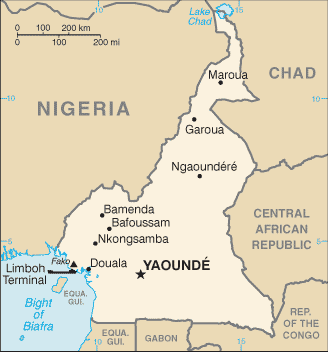
Central Africa, bordering the Bight of Biafra, between Equatorial Guinea and Nigeria
Geographic coordinates
6 00 N, 12 00 E
Map references
Africa
Area
land: 472,710 sq km
water: 2,730 sq km
Area - comparative
slightly larger than California; about four times the size of Pennsylvania
Land boundaries
border countries: Central African Republic 901 km; Chad 1,116 km; Republic of the Congo 494 km; Equatorial Guinea 183 km; Gabon 349 km; Nigeria 1975 km
Coastline
402 km
Maritime claims
contiguous zone: 24 nm
Climate
varies with terrain, from tropical along coast to semiarid and hot in north
Terrain
diverse, with coastal plain in southwest, dissected plateau in center, mountains in west, plains in north
Elevation
lowest point: Atlantic Ocean 0 m
mean elevation: 667 m
Natural resources
petroleum, bauxite, iron ore, timber, hydropower
Land use
agricultural land
agricultural land: arable land
agricultural land: permanent crops
agricultural land: permanent pasture
forest
other
Irrigated land
290 sq km (2012)
Major lakes (area sq km)
note - area varies by season and year to year
Major watersheds (area sq km)
Internal (endorheic basin) drainage: Lake Chad (2,497,738 sq km)
Major aquifers
Lake Chad Basin
Population distribution
population concentrated in the west and north, with the interior of the country sparsely populated, as shown in this population distribution map
Natural hazards
volcanism: Mt. Cameroon (4,095 m), which last erupted in 2000, is the most frequently active volcano in West Africa; lakes in the Oku volcanic field sometimes release fatal levels of gas, which killed about 1,700 people in 1986
Geography - note
sometimes referred to as the hinge of Africa because of its central location on the continent and its position at the west-south juncture of the Gulf of Guinea; areas of thermal springs and indications of current or prior volcanic activity; Mount Cameroon, the highest mountain in Sub-Saharan west Africa, is an active volcano
People & Society36
Population
male: 15,683,611
female: 15,835,343
Nationality
adjective: Cameroonian
Ethnic groups
Bamileke-Bamu 22.2%, Biu-Mandara 16.4%, Arab-Choa/Hausa/Kanuri 13.5%, Beti/Bassa, Mbam 13.1%, Grassfields 9.9%, Adamawa-Ubangi, 9.8%, Cotier/Ngoe/Oroko 4.6%, Southwestern Bantu 4.3%, Kako/Meka 2.3%, foreign/other ethnic group 3.8% (2022 est.)
Languages
major-language sample(s):
The World Factbook, the indispensable source for basic information. (English)
The World Factbook, une source indispensable d'informations de base. (French)
Religions
Roman Catholic 33.1%, Muslim 30.6%, Protestant 27.1% other Christian 6.1%, animist 1.3%, other 0.7%, none 1.2% (2022 est.)
Age structure
15-64 years: 55.3% (male 8,488,522/female 8,638,519)
65 years and over: 3.2% (2024 est.) (male 463,628/female 533,011)
Dependency ratios
youth dependency ratio: 71.8 (2025 est.)
elderly dependency ratio: 5.8 (2025 est.)
potential support ratio: 17.3 (2025 est.)
Median age
male: 18.6 years
female: 19.2 years
Population growth rate
2.37% (2025 est.)
Birth rate
30.79 births/1,000 population (2025 est.)
Death rate
6.73 deaths/1,000 population (2025 est.)
Net migration rate
-0.32 migrant(s)/1,000 population (2025 est.)
Population distribution
population concentrated in the west and north, with the interior of the country sparsely populated, as shown in this population distribution map
Urbanization
rate of urbanization: 3.43% annual rate of change (2020-25 est.)
Major urban areas - population
4.509 million YAOUNDE (capital), 4.063 million Douala (2023)
Sex ratio
0-14 years: 1.02 male(s)/female
15-64 years: 0.98 male(s)/female
65 years and over: 0.87 male(s)/female
total population: 0.99 male(s)/female (2024 est.)
Mother's mean age at first birth
Maternal mortality ratio
258 deaths/100,000 live births (2023 est.)
Infant mortality rate
male: 50.8 deaths/1,000 live births
female: 41.3 deaths/1,000 live births
Life expectancy at birth
male: 62.3 years
female: 66.1 years
Total fertility rate
3.87 children born/woman (2025 est.)
Gross reproduction rate
1.91 (2025 est.)
Drinking water source
improved: urban
improved: rural
improved: total
unimproved: urban
unimproved: rural
unimproved: total
Health expenditure
Health expenditure (as % of national budget): 3.9% of national budget (2022 est.)
Physician density
0.14 physicians/1,000 population (2022)
Hospital bed density
2.6 beds/1,000 population (2016 est.)
Sanitation facility access
improved: urban
improved: rural
improved: total
unimproved: urban
unimproved: rural
unimproved: total
Obesity - adult prevalence rate
11.4% (2016)
Alcohol consumption per capita
beer: 2.36 liters of pure alcohol (2019 est.)
wine: 0.16 liters of pure alcohol (2019 est.)
spirits: 0.01 liters of pure alcohol (2019 est.)
other alcohols: 1.56 liters of pure alcohol (2019 est.)
Tobacco use
male: 9.2% (2025 est.)
female: 0.9% (2025 est.)
Children under the age of 5 years underweight
11% (2018 est.)
Currently married women (ages 15-49)
58.1% (2018 est.)
Child marriage
women married by age 18: 29.8% (2018)
men married by age 18: 2.9% (2018)
Education expenditure
Education expenditure (% national budget): 13.8% national budget (2024 est.)
Literacy
male: 79.7% (2018 est.)
female: 66.2% (2018 est.)
School life expectancy (primary to tertiary education)
male: 12 years (2023 est.)
female: 10 years (2023 est.)
Government25
Country name
conventional long form
conventional short form
local long form
local short form
former
etymology
Government type
presidential republic
Capital
geographic coordinates: 3 52 N, 11 31 E
time difference: UTC+1 (6 hours ahead of Washington, DC, during Standard Time)
etymology: Germans founded the city in 1888, but the name comes from the native Ewondo people; the meaning of the name is unclear
Administrative divisions
Legal system
mixed system of English common law, French civil law, and customary law
Constitution
amendment process: proposed by the president of the republic or by Parliament; amendment drafts require approval of at least one third of the membership in either house of Parliament; passage requires absolute majority vote of the Parliament membership; passage of drafts requested by the president for a second reading in Parliament requires two-thirds majority vote of its membership; the president can opt to submit drafts to a referendum, in which case passage requires a simple majority; constitutional articles on Cameroon’s unity and territorial integrity and its democratic principles cannot be amended
International law organization participation
accepts compulsory ICJ jurisdiction; non-party state to the ICCt
Citizenship
citizenship by descent only: at least one parent must be a citizen of Cameroon
dual citizenship recognized: no
residency requirement for naturalization: 5 years
Suffrage
20 years of age; universal
Executive branch
chief of state
head of government
cabinet
election/appointment process
most recent election date
election results
2018: Paul BIYA reelected president; percent of vote - Paul BIYA (CPDM) 71.3%, Maurice KAMTO (MRC) 14.2%, Cabral LIBII (Univers) 6.3%, other 8.2%
(2018)
expected date of next election
Legislative branch
legislative structure: bicameral
Legislative branch - lower chamber
chamber name
number of seats
electoral system
scope of elections
term in office
most recent election date
parties elected and seats per party
percentage of women in chamber
expected date of next election
Legislative branch - upper chamber
chamber name
number of seats
scope of elections
term in office
most recent election date
percentage of women in chamber
expected date of next election
Judicial branch
judge selection and term of office: Supreme Court judges appointed by the president with the advice of the Higher Judicial Council of Cameroon, a body chaired by the president and includes the minister of justice, selected magistrates, and representatives of the National Assembly; judge term NA; Constitutional Council members appointed by the president for renewable 6-year terms
subordinate courts: Parliamentary Court of Justice (jurisdiction limited to cases involving the president and prime minister); appellate and first instance courts; circuit and magistrates' courts
Political parties
Cameroon People's Democratic Movement or CPDM
Cameroon People's Party or CPP
Cameroon Renaissance Movement or MRC
Cameroonian Democratic Union or UDC
Cameroonian Party for National Reconciliation or PCRN
Front for the National Salvation of Cameroon or FSNC
Movement for the Defense of the Republic or MDR
Movement for the Liberation and Development of Cameroon or MLDC
National Union for Democracy and Progress or UNDP
Progressive Movement or MP
Social Democratic Front or SDF
Union of Peoples of Cameroon or UPC
Union of Socialist Movements
Diplomatic representation in the US
chancery: 2349 Massachusetts Avenue NW, Washington, DC 20008
telephone: [1] (202) 265-8790
FAX: [1] (202) 387-3826
email address and website:
mail@cameroonembassyusa
Cameroon Embassy in Washington DC, USA (cameroonembassyusa.org)
Diplomatic representation from the US
chief of mission
embassy
mailing address
telephone
FAX
email address and website
branch office(s)
International organization participation
ACP, AfDB, AU, BDEAC, C, CEMAC, EITI (compliant country), FAO, FZ, G-77, IAEA, IBRD, ICAO, ICRM, IDA, IDB, IFAD, IFC, IFRCS, IHO, ILO, IMF, IMO, IMSO, Interpol, IOC, IOM, IPU, ISO, ITSO, ITU, ITUC (NGOs), LCBC, MIGA, MNJTF, MONUSCO, NAM, OIC, OIF, OPCW, PCA, UN, UNCTAD, UNESCO, UNHRC, UNIDO, UNMISS, UNOOSA, UNWTO, UPU, WCO, WFTU (NGOs), WHO, WIPO, WMO, WTO
Independence
1 January 1960 (from French-administered UN trusteeship)
National holiday
State Unification Day (National Day), 20 May (1972)
Flag
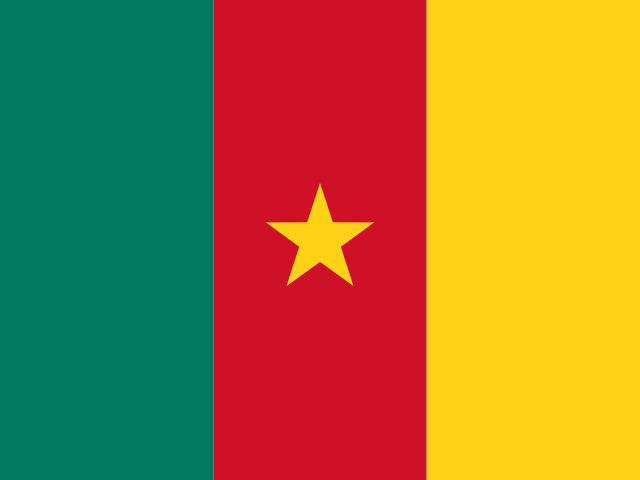
meaning: red stands for unity; yellow for the sun, happiness, and the northern savannahs; green for hope and the southern forests; the star is called the "star of unity;" the vertical tricolor design is similar to the French flag
history: uses the colors of the Pan-African movement
National symbol(s)
lion
National color(s)
green, red, yellow
National anthem(s)
lyrics/music: Rene Djam AFAME, Samuel Minkio BAMBA, Moise Nyatte NKO'O [French], Benard Nsokika FONLON [English]/Rene Djam AFAME
history: adopted 1957; lyrics were changed slightly to the current version in 1978
National heritage
selected World Heritage Site locales: Dja Faunal Reserve (n); Sangha Trinational Forest (n); Diy-Gid-Biy Cultural Landscape of the Mandara Mountains (c)
Economy31
Economic overview
largest CEMAC economy with many natural resources; recent political instability and terrorism reducing economic output; systemic corruption; poor property rights enforcement; increasing poverty in northern regions
Real GDP (purchasing power parity)
Real GDP (purchasing power parity) 2023: $138.191 billion (2023 est.)
Real GDP (purchasing power parity) 2022: $133.843 billion (2022 est.)
Real GDP growth rate
Real GDP growth rate 2023: 3.2% (2023 est.)
Real GDP growth rate 2022: 3.7% (2022 est.)
Real GDP per capita
Real GDP per capita 2023: $4,900 (2023 est.)
Real GDP per capita 2022: $4,800 (2022 est.)
GDP (official exchange rate)
Inflation rate (consumer prices)
Inflation rate (consumer prices) 2023: 7.4% (2023 est.)
Inflation rate (consumer prices) 2022: 6.2% (2022 est.)
GDP - composition, by sector of origin
industry: 25.6% (2024 est.)
services: 49.9% (2024 est.)
GDP - composition, by end use
household consumption
government consumption
investment in fixed capital
investment in inventories
exports of goods and services
imports of goods and services
Agricultural products
Industries
petroleum production and refining, aluminum production, food processing, light consumer goods, textiles, lumber, ship repair
Industrial production growth rate
Labor force
Unemployment rate
Unemployment rate 2023: 3.7% (2023 est.)
Unemployment rate 2022: 3.7% (2022 est.)
Youth unemployment rate (ages 15-24)
male: 5.9% (2024 est.)
female: 6.7% (2024 est.)
Gini Index coefficient - distribution of family income
Average household expenditures
on alcohol and tobacco: 2.9% of household expenditures (2023 est.)
Household income or consumption by percentage share
highest 10%: 31.1% (2021 est.)
Remittances
Remittances 2022: 1.3% of GDP (2022 est.)
Remittances 2021: 1% of GDP (2021 est.)
Budget
expenditures: $7.624 billion (2021 est.)
Public debt
Taxes and other revenues
Current account balance
Current account balance 2022: -$1.505 billion (2022 est.)
Current account balance 2021: -$1.794 billion (2021 est.)
Exports
Exports 2022: $8.641 billion (2022 est.)
Exports 2021: $7.447 billion (2021 est.)
Exports - partners
Exports - commodities
Imports
Imports 2022: $9.759 billion (2022 est.)
Imports 2021: $9.025 billion (2021 est.)
Imports - partners
Imports - commodities
Reserves of foreign exchange and gold
Reserves of foreign exchange and gold 2022: $5.133 billion (2022 est.)
Reserves of foreign exchange and gold 2021: $4.3 billion (2021 est.)
Debt - external
Exchange rates
Currency
Exchange rates 2024
Exchange rates 2023
Exchange rates 2022
Exchange rates 2021
Exchange rates 2020
Energy7
Electricity access
electrification - urban areas: 94%
electrification - rural areas: 25%
Electricity
consumption: 6.161 billion kWh (2023 est.)
imports: 60 million kWh (2023 est.)
transmission/distribution losses: 2.238 billion kWh (2023 est.)
Electricity generation sources
solar: 0.3% of total installed capacity (2023 est.)
hydroelectricity: 63.1% of total installed capacity (2023 est.)
biomass and waste: 0.5% of total installed capacity (2023 est.)
Coal
Petroleum
refined petroleum consumption: 41,000 bbl/day (2023 est.)
crude oil estimated reserves: 200 million barrels (2021 est.)
Natural gas
consumption: 534.691 million cubic meters (2023 est.)
exports: 1.821 billion cubic meters (2023 est.)
proven reserves: 135.071 billion cubic meters (2021 est.)
Energy consumption per capita
Communications6
Telephones - fixed lines
subscriptions per 100 inhabitants: (2024 est.) less than 1
Telephones - mobile cellular
subscriptions per 100 inhabitants: 108 (2024 est.)
Broadcast media
Internet country code
.cm
Internet users
Broadband - fixed subscriptions
subscriptions per 100 inhabitants: 2 (2022 est.)
Transportation6
Civil aircraft registration country code prefix
TJ
Airports
37 (2025)
Heliports
1 (2025)
Railways
narrow gauge: 987 km (2014) 1.000-m gauge
Merchant marine
by type: bulk carrier 2, general cargo 91, oil tanker 42, other 63
Ports
total ports
large
medium
small
very small
size unknown
ports with oil terminals
key ports
Military & Security7
Military and security forces
General Delegation for National Security (Délégation Générale à la Sûreté Nationale or DGSN): Cameroon Police (2025)
note 2: the Cameroon Police and the National Gendarmerie are responsible for internal security; the Gendarmerie conducts administrative, criminal, and military investigative functions; other missions include customs, air and maritime surveillance, and road traffic control; in times of conflict, it participates in internal defense
Military expenditures
Military Expenditures 2023: 1% of GDP (2023 est.)
Military Expenditures 2022: 1% of GDP (2022 est.)
Military Expenditures 2021: 1% of GDP (2021 est.)
Military Expenditures 2020: 1% of GDP (2020 est.)
Military and security service personnel strengths
estimated 40-50,000 active FAC, including the Gendarmerie (2025)
Military equipment inventories and acquisitions
the FAC inventory is comprised of armaments from a variety of countries, including China, Israel, Russia/former Soviet Union, South Africa, the US, and some Western European countries, particularly France (2025)
Military service age and obligation
18-23 years of age for voluntary military service for men and women (18-28 for medical services); no conscription; service obligation 4 years (2025)
Military deployments
Military - note
Transnational Issues1
Refugees and internally displaced persons
IDPs: 1,058,405 (2024 est.)