
Cabo Verde
Republic of Cabo Verde
Population
611.0K
Area
4,033 km²
GDP
$2.77B
GDP Per Capita
$9,900
Pop. Density
152/km²
Quick Facts
Currency
EscCape Verdean escudo(CVE)
Calling Code
+238
Timezone
UTC-01:00
Languages
Portuguese+more
Driving Side
right
Demonym
Cape Verdian
Background
Most Cabo Verdeans have both African and Portuguese antecedents. Cabo Verde’s population descends from its first permanent inhabitants in the late 15th-century -- a preponderance of West African slaves, a small share of Portuguese colonists, and even fewer Italians and Spaniards. Among the nine inhabited islands, population distribution is varied. The islands in the east are very dry and are home to the country's growing tourism industry. The more western islands receive more precipitation and support larger populations, but agriculture and livestock grazing have damaged their soil fertility and vegetation. For centuries, the country’s overall population size has fluctuated significantly, as recurring periods of famine and epidemics have caused high death tolls and emigration.
Historical Trends
GDP (USD)
↑146.1% since 2006Population
↑7.0% since 2006Life Expectancy at Birth
Latest: 76.1 yearsData source: World Bank Open Data
Geography17
Location
Western Africa, group of islands in the North Atlantic Ocean, west of Senegal
Geographic coordinates
16 00 N, 24 00 W
Map references
Africa
Area
land: 4,033 sq km
water: 0 sq km
Area - comparative
slightly larger than Rhode Island
Land boundaries
Coastline
965 km
Maritime claims
contiguous zone: 24 nm
exclusive economic zone: 200 nm
Climate
temperate; warm, dry summer; precipitation meager and erratic
Terrain
steep, rugged, rocky, volcanic
Elevation
lowest point: Atlantic Ocean 0 m
Natural resources
salt, basalt rock, limestone, kaolin, fish, clay, gypsum
Land use
agricultural land
agricultural land: arable land
agricultural land: permanent crops
agricultural land: permanent pasture
forest
other
Irrigated land
35 sq km (2012)
Population distribution
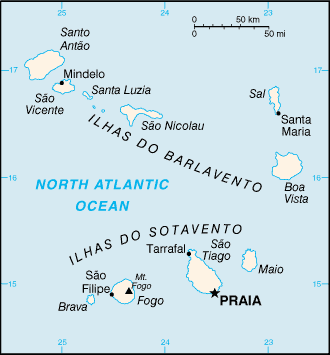
among the nine inhabited islands, population distribution is variable; islands in the east are very dry and are only sparsely settled; the more southerly islands receive more precipitation and support larger populations; approximately half of the population lives on Sao Tiago Island, which is the location of the capital of Praia; Mindelo, on the northern island of Sao Vicente, also has a large urban population, as shown in this population distribution map
Natural hazards
volcanism: Fogo (2,829 m), which last erupted in 1995, is Cabo Verde's only active volcano
Geography - note
strategic location 500 km from west coast of Africa near major north-south sea routes; one of four North Atlantic archipelagos that make up Macaronesia; the others are Azores (Portugal), Canary Islands (Spain), and Madeira (Portugal)
People & Society35
Population
male: 297,106
female: 313,908
Nationality
adjective: Cabo Verdean
Ethnic groups
Creole (Mulatto) 71%, African 28%, European 1%
Languages
Portuguese (official), Crioulo (a Portuguese-based creole language with two main dialects)
Religions
Roman Catholic 72.5%, Protestant 4% (includes Adventist 1.9%, Nazarene 1.8%, Assembly of God 0.2%, God is Love 0.1%), Christian Rationalism 1.7%, Muslim 1.3%, Jehovah's Witness 1.2%, Church of Jesus Christ 1%, other Christian 1.3%, other 1.2%, none 15.6%, no response 0.4% (2021 est.)
Age structure
15-64 years: 67.2% (male 201,084/female 209,676)
65 years and over: 6.4% (2024 est.) (male 15,049/female 24,103)
Dependency ratios
youth dependency ratio: 39.2 (2024 est.)
elderly dependency ratio: 9.5 (2024 est.)
potential support ratio: 10.5 (2024 est.)
Median age
male: 27.9 years
female: 29.6 years
Population growth rate
1.12% (2025 est.)
Birth rate
17.51 births/1,000 population (2025 est.)
Death rate
5.73 deaths/1,000 population (2025 est.)
Net migration rate
-0.56 migrant(s)/1,000 population (2025 est.)
Population distribution
among the nine inhabited islands, population distribution is variable; islands in the east are very dry and are only sparsely settled; the more southerly islands receive more precipitation and support larger populations; approximately half of the population lives on Sao Tiago Island, which is the location of the capital of Praia; Mindelo, on the northern island of Sao Vicente, also has a large urban population, as shown in this population distribution map
Urbanization
rate of urbanization: 1.83% annual rate of change (2020-25 est.)
Major urban areas - population
168,000 PRAIA (capital) (2018)
Sex ratio
0-14 years: 1.01 male(s)/female
15-64 years: 0.96 male(s)/female
65 years and over: 0.62 male(s)/female
total population: 0.95 male(s)/female (2024 est.)
Maternal mortality ratio
40 deaths/100,000 live births (2023 est.)
Infant mortality rate
male: 26.3 deaths/1,000 live births
female: 18.4 deaths/1,000 live births
Life expectancy at birth
male: 72 years
female: 76.7 years
Total fertility rate
2.08 children born/woman (2025 est.)
Gross reproduction rate
1.02 (2025 est.)
Drinking water source
improved: urban
improved: rural
improved: total
unimproved: urban
unimproved: rural
unimproved: total
Health expenditure
Health expenditure (as % of national budget): 16.1% of national budget (2022 est.)
Physician density
0.73 physicians/1,000 population (2023)
Hospital bed density
2 beds/1,000 population (2018 est.)
Sanitation facility access
improved: urban
improved: rural
improved: total
unimproved: urban
unimproved: rural
unimproved: total
Obesity - adult prevalence rate
11.8% (2016)
Alcohol consumption per capita
beer: 2.28 liters of pure alcohol (2019 est.)
wine: 1.82 liters of pure alcohol (2019 est.)
spirits: 0.6 liters of pure alcohol (2019 est.)
other alcohols: 0 liters of pure alcohol (2019 est.)
Tobacco use
male: 15.3% (2025 est.)
female: 4.5% (2025 est.)
Children under the age of 5 years underweight
2.2% (2018 est.)
Currently married women (ages 15-49)
45% (2021 est.)
Child marriage
women married by age 18: 8.4% (2018)
men married by age 18: 1.5% (2018)
Education expenditure
Education expenditure (% national budget): 13.4% national budget (2024 est.)
Literacy
male: 92.9% (2024 est.)
female: 84.1% (2024 est.)
School life expectancy (primary to tertiary education)
male: 13 years (2018 est.)
female: 14 years (2018 est.)
Government24
Country name
conventional short form: Cabo Verde
local long form: Republica de Cabo Verde
local short form: Cabo Verde
etymology: the name derives from the Cape Verde (Green Cape) peninsula on the Senegalese coast, the westernmost point of Africa and the nearest mainland to the islands
Government type
parliamentary republic
Capital
geographic coordinates: 14 55 N, 23 31 W
time difference: UTC-1 (4 hours ahead of Washington, DC, during Standard Time)
etymology: the earlier Portuguese name was Villa de Praia ("Village of the Beach"); it was shortened to Praia in 1974
Administrative divisions
Legal system
civil law system of Portugal
Constitution
amendment process: proposals require support of at least four fifths of the active National Assembly membership; amendment drafts require sponsorship of at least one third of the active Assembly membership; passage requires at least two-thirds majority vote by the Assembly membership; constitutional sections, including those on national independence, form of government, political pluralism, suffrage, and human rights and liberties, cannot be amended
International law organization participation
has not submitted an ICJ jurisdiction declaration; accepts ICCt jurisdiction
Citizenship
citizenship by descent only: at least one parent must be a citizen of Cabo Verde
dual citizenship recognized: yes
residency requirement for naturalization: 5 years
Suffrage
18 years of age; universal
Executive branch
chief of state
head of government
cabinet
election/appointment process
most recent election date
election results
2020: Jose Maria Pereira NEVES elected president; percent of vote - Jose Maria Pereira NEVES (PAICV) 51.7%, Carlos VEIGA (MPD) 42.4%, Casimiro DE PINA (independent) 1.8%, Fernando Rocha DELGADO (independent) 1.4%, Helio SANCHES (independent) 1.14%, Gilson ALVES (independent) 0.8%, Joaquim MONTEIRO (independent) 3.4%
2016: Jorge Carlos FONSECA reelected president; percent of vote - Jorge Carlos FONSECA (MPD) 74.1%, Albertino GRACA (independent) 22.5%, other 3.4%
expected date of next election
Legislative branch
legislature name
legislative structure
number of seats
electoral system
scope of elections
term in office
most recent election date
parties elected and seats per party
percentage of women in chamber
expected date of next election
Judicial branch
judge selection and term of office: judge appointments - 1 by the president of the republic, 1 elected by the National Assembly, and 3 by the Superior Judicial Council (SJC), a 16-member independent body chaired by the chief justice and includes the attorney general, 8 private citizens, 2 judges, 2 prosecutors, the senior legal inspector of the Attorney General's office, and a representative of the Ministry of Justice; chief justice appointed by the president of the republic from among peers of the Supreme Court of Justice and in consultation with the SJC; judges appointed for life
subordinate courts: appeals courts, first instance (municipal) courts; audit, military, and fiscal and customs courts
Political parties
Democratic and Independent Cabo Verdean Union or UCID
Democratic Christian Party or PDC
Democratic Renewal Party or PRD
Movement for Democracy or MPD
Party for Democratic Convergence or PCD
Party of Work and Solidarity or PTS
Social Democratic Party or PSD
Diplomatic representation in the US
chief of mission
chancery
telephone
FAX
email address and website
consulate(s) general
Diplomatic representation from the US
chief of mission
embassy
mailing address
telephone
FAX
email address and website
International organization participation
ACP, AfDB, AOSIS, AU, CD, CPLP, ECOWAS, FAO, G-77, IAEA, IBRD, ICAO, ICCt (signatory), ICRM, IDA, IFAD, IFC, IFRCS, ILO, IMF, IMO, Interpol, IOC, IOM, IPU, ITSO, ITU, ITUC (NGOs), MIGA, NAM, OIF, OPCW, UN, UNCTAD, UNESCO, UNIDO, Union Latina, UNWTO, UPU, WCO, WHO, WIPO, WMO, WTO
Independence
5 July 1975 (from Portugal)
National holiday
Independence Day, 5 July (1975)
Flag
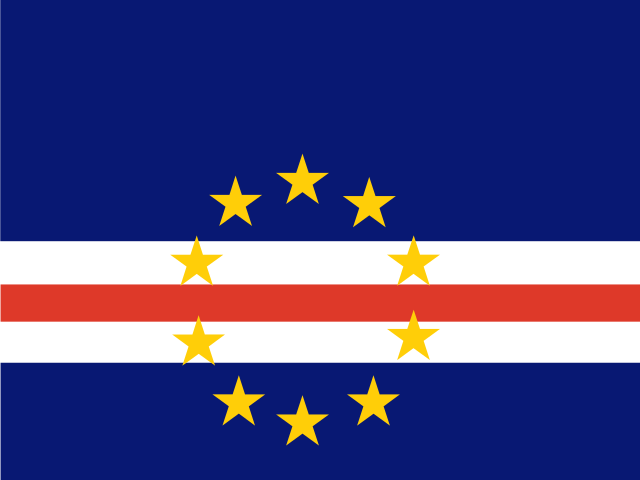
meaning: blue stands for the sea and sky; the stripes symbolize the country's formation through peace (white) and effort (red); the stars represent the 10 major islands
National symbol(s)
ten five-pointed yellow stars
National color(s)
blue, white, red, yellow
National coat of arms
National anthem(s)
lyrics/music: Amilcar Spencer LOPES/Adalberto Higino Tavares SILVA
history: adopted 1996
National heritage
selected World Heritage Site locales: Cidade Velha; Historic Center of Ribeira Grande
Economy31
Economic overview
stable, middle-income, developing island economy; strong GDP growth led by tourism sector recovery; sustained poverty reduction through PEDS II development plan; high reliance on foreign remittances and aid to finance external debt
Real GDP (purchasing power parity)
Real GDP (purchasing power parity) 2023: $4.848 billion (2023 est.)
Real GDP (purchasing power parity) 2022: $4.6 billion (2022 est.)
Real GDP growth rate
Real GDP growth rate 2023: 5.4% (2023 est.)
Real GDP growth rate 2022: 15.8% (2022 est.)
Real GDP per capita
Real GDP per capita 2023: $9,300 (2023 est.)
Real GDP per capita 2022: $8,900 (2022 est.)
GDP (official exchange rate)
Inflation rate (consumer prices)
Inflation rate (consumer prices) 2023: 3.7% (2023 est.)
Inflation rate (consumer prices) 2022: 7.9% (2022 est.)
GDP - composition, by sector of origin
industry: 10.5% (2024 est.)
services: 69.4% (2024 est.)
GDP - composition, by end use
household consumption
government consumption
investment in fixed capital
investment in inventories
exports of goods and services
imports of goods and services
Agricultural products
Industries
food and beverages, fish processing, shoes and garments, salt mining, ship repair
Industrial production growth rate
Labor force
Unemployment rate
Unemployment rate 2023: 12% (2023 est.)
Unemployment rate 2022: 12.3% (2022 est.)
Youth unemployment rate (ages 15-24)
male: 24.6% (2024 est.)
female: 33.8% (2024 est.)
Population below poverty line
Gini Index coefficient - distribution of family income
Household income or consumption by percentage share
highest 10%: 32.3% (2015 est.)
Remittances
Remittances 2023: 12.5% of GDP (2023 est.)
Remittances 2022: 14% of GDP (2022 est.)
Budget
expenditures: $623.816 million (2020 est.)
Public debt
Taxes and other revenues
Current account balance
Current account balance 2023: -$64.439 million (2023 est.)
Current account balance 2022: -$78.271 million (2022 est.)
Exports
Exports 2023: $972.636 million (2023 est.)
Exports 2022: $851.907 million (2022 est.)
Exports - partners
Exports - commodities
Imports
Imports 2023: $1.428 billion (2023 est.)
Imports 2022: $1.31 billion (2022 est.)
Imports - partners
Imports - commodities
Reserves of foreign exchange and gold
Reserves of foreign exchange and gold 2023: $837.881 million (2023 est.)
Reserves of foreign exchange and gold 2022: $729.566 million (2022 est.)
Debt - external
Exchange rates
Currency
Exchange rates 2024
Exchange rates 2023
Exchange rates 2022
Exchange rates 2021
Exchange rates 2020
Energy5
Electricity access
electrification - urban areas: 95.3%
electrification - rural areas: 96.9%
Electricity
consumption: 400 million kWh (2023 est.)
transmission/distribution losses: 106 million kWh (2023 est.)
Electricity generation sources
solar: 14.2% of total installed capacity (2023 est.)
wind: 14.6% of total installed capacity (2023 est.)
Petroleum
Energy consumption per capita
Communications6
Telephones - fixed lines
subscriptions per 100 inhabitants: 12 (2023 est.)
Telephones - mobile cellular
subscriptions per 100 inhabitants: 112 (2024 est.)
Broadcast media
state-run TV and radio network, plus a growing number of private broadcasters; Portuguese public TV and radio services for Africa are available; transmissions of a few international broadcasters are available (2019)
Internet country code
.cv
Internet users
Broadband - fixed subscriptions
subscriptions per 100 inhabitants: 7 (2023 est.)
Transportation4
Civil aircraft registration country code prefix
D4
Airports
10 (2025)
Merchant marine
by type: general cargo 14, oil tanker 2, other 28
Ports
total ports
large
medium
small
very small
ports with oil terminals
key ports
Military & Security6
Military and security forces
Military expenditures
Military Expenditures 2023: 0.6% of GDP (2023 est.)
Military Expenditures 2022: 0.5% of GDP (2022 est.)
Military Expenditures 2021: 0.5% of GDP (2021 est.)
Military Expenditures 2020: 0.5% of GDP (2020 est.)
Military and security service personnel strengths
the FACV has approximately 1,000-1,500 active personnel (2025)
Military equipment inventories and acquisitions
the FACV has a limited amount of mostly dated or secondhand equipment, largely from China, some European countries, and the former Soviet Union (2025)
Military service age and obligation
17 years of age for voluntary service (with parental consent); 18-35 years of age for selective compulsory service (14-month service obligation) (2025)
Military - note
the FACV is responsible for external defense; it also has an internal security role in collaboration with the police if required; its duties include monitoring and patrolling the country's air and maritime spaces, participating in training exercises, conducting search and rescue, countering narcotics and other forms of illicit trafficking, and supporting the police and civil society (2025)