
Burundi
Republic of Burundi
Population
13.59M
Area
27,830 km²
GDP
$2.16B
GDP Per Capita
$800
Pop. Density
488/km²
Quick Facts
Currency
FrBurundian franc(BIF)
Calling Code
+257
Timezone
UTC+02:00
Languages
French, Kirundi+more
Driving Side
right
Demonym
Burundian
Background
Burundi gained its independence from Belgium in 1962 as the Kingdom of Burundi. Revolution in neighboring Rwanda stoked ethnic polarization as the Tutsi increasingly feared violence and loss of political power. A failed Hutu-led coup in 1965 triggered a purge of Hutu officials and set the stage for Tutsi officers to overthrow the monarchy in 1966 and establish a Tutsi-dominated republic. A Hutu rebellion in 1972 resulted in the deaths of several thousand Tutsi civilians and sparked brutal Tutsi-led military reprisals against Hutu civilians which ultimately killed 100,000-200,000 people. International pressure led to a new constitution in 1992 and democratic elections in 1993. Tutsi military officers feared Hutu domination and assassinated Burundi's first democratically elected president, Hutu Melchior NDADAYE, in 1993 after only 100 days in office, sparking a civil war. In 1994, his successor, Cyprien NTARYAMIRA, died when the Rwandan president’s plane he was traveling on was shot down, which triggered the Rwandan genocide and further entrenched ethnic conflict in Burundi. The internationally brokered Arusha Agreement, signed in 2000, and subsequent cease-fire agreements with armed movements ended the 1993-2005 civil war. Burundi’s second democratic elections were held in 2005, resulting in the election of Pierre NKURUNZIZA as president. He was reelected in 2010 and again in 2015 after a controversial court decision allowed him to circumvent a term limit. President Evariste NDAYISHIMIYE -- from NKURUNZIZA’s ruling party -- was elected in 2020.
Historical Trends
GDP (USD)
↑142.1% since 2006Population
↑78.6% since 2006Life Expectancy at Birth
Latest: 63.7 yearsData source: World Bank Open Data
Geography19
Location
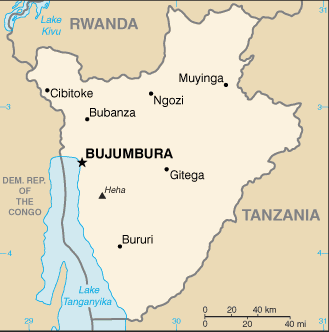
Central Africa, east of the Democratic Republic of the Congo, west of Tanzania
Geographic coordinates
3 30 S, 30 00 E
Map references
Africa
Area
land: 25,680 sq km
water: 2,150 sq km
Area - comparative
slightly smaller than Maryland
Land boundaries
border countries: Democratic Republic of the Congo 236 km; Rwanda 315 km; Tanzania 589 km
Coastline
0 km (landlocked)
Maritime claims
none (landlocked)
Climate
equatorial; high plateau with considerable altitude variation (772 m to 2,670 m above sea level); average annual temperature varies with altitude from 23 to 17 degrees Celsius but is generally moderate; average annual rainfall is about 150 cm with two wet seasons (February to May and September to November) and two dry seasons (June to August and December to January)
Terrain
hilly and mountainous, dropping to a plateau in east, some plains
Elevation
lowest point: Lake Tanganyika 772 m
mean elevation: 1,504 m
Natural resources
nickel, uranium, rare earth oxides, peat, cobalt, copper, platinum, vanadium, arable land, hydropower, niobium, tantalum, gold, tin, tungsten, kaolin, limestone
Land use
agricultural land
agricultural land: arable land
agricultural land: permanent crops
agricultural land: permanent pasture
forest
other
Irrigated land
230 sq km (2012)
Major lakes (area sq km)
Major watersheds (area sq km)
Population distribution
one of Africa's most densely populated countries; concentrations tend to be in the north and along the northern shore of Lake Tanganyika in the west; most people live on farms near areas of fertile volcanic soil, as shown in this population distribution map
Natural hazards
flooding; landslides; drought
Geography - note
landlocked; straddles crest of the Nile-Congo watershed; the Kagera, which drains into Lake Victoria, is the most remote headstream of the White Nile
People & Society35
Population
male: 6,755,456
female: 6,834,646
Nationality
adjective: Burundian
Ethnic groups
Hutu, Tutsi, Twa, South Asian
Languages
major-language sample(s):
Igitabo Mpuzamakungu c'ibimenyetso bifatika, isoko ntabanduka ku nkuru z'urufatiro. (Kirundi)
The World Factbook, the indispensable source for basic information.
Religions
Christian 93.9% (Roman Catholic 58.6%, Protestant 35.3% [includes Adventist 2.7% and other Protestant religions 32.6%]), Muslim 3.4%, other 1.3%, none 1.3% (2016-17 est.)
Age structure
15-64 years: 54.4% (male 3,662,688/female 3,727,022)
65 years and over: 3.4% (2024 est.) (male 197,493/female 259,338)
Dependency ratios
youth dependency ratio: 77.7 (2024 est.)
elderly dependency ratio: 6.2 (2024 est.)
potential support ratio: 16.2 (2024 est.)
Median age
male: 18 years
female: 18.7 years
Population growth rate
2.96% (2025 est.)
Birth rate
35.91 births/1,000 population (2025 est.)
Death rate
5.51 deaths/1,000 population (2025 est.)
Net migration rate
-0.81 migrant(s)/1,000 population (2025 est.)
Population distribution
one of Africa's most densely populated countries; concentrations tend to be in the north and along the northern shore of Lake Tanganyika in the west; most people live on farms near areas of fertile volcanic soil, as shown in this population distribution map
Urbanization
rate of urbanization: 5.43% annual rate of change (2020-25 est.)
Major urban areas - population
1.207 million BUJUMBURA (capital) (2023)
Sex ratio
0-14 years: 1.02 male(s)/female
15-64 years: 0.98 male(s)/female
65 years and over: 0.76 male(s)/female
total population: 0.99 male(s)/female (2024 est.)
Mother's mean age at first birth
Maternal mortality ratio
392 deaths/100,000 live births (2023 est.)
Infant mortality rate
male: 39.7 deaths/1,000 live births
female: 31.5 deaths/1,000 live births
Life expectancy at birth
male: 66 years
female: 70.3 years
Total fertility rate
4.94 children born/woman (2025 est.)
Gross reproduction rate
2.43 (2025 est.)
Drinking water source
improved: urban
improved: rural
improved: total
unimproved: urban
unimproved: rural
unimproved: total
Health expenditure
Health expenditure (as % of national budget): 4.7% of national budget (2022 est.)
Physician density
0.08 physicians/1,000 population (2022)
Sanitation facility access
improved: urban
improved: rural
improved: total
unimproved: urban
unimproved: rural
unimproved: total
Obesity - adult prevalence rate
5.4% (2016)
Alcohol consumption per capita
beer: 1.84 liters of pure alcohol (2019 est.)
wine: 0 liters of pure alcohol (2019 est.)
spirits: 0 liters of pure alcohol (2019 est.)
other alcohols: 2.23 liters of pure alcohol (2019 est.)
Tobacco use
male: 14% (2025 est.)
female: 4.3% (2025 est.)
Children under the age of 5 years underweight
28.3% (2024 est.)
Currently married women (ages 15-49)
58.2% (2017 est.)
Child marriage
women married by age 18: 19% (2017)
men married by age 18: 1.4% (2017)
Education expenditure
Education expenditure (% national budget): 14.4% national budget (2025 est.)
Literacy
male: 78.2% (2020 est.)
female: 66.2% (2020 est.)
School life expectancy (primary to tertiary education)
male: 10 years (2018 est.)
female: 10 years (2018 est.)
Government24
Country name
conventional long form
conventional short form
local long form
local short form
former
etymology
Government type
presidential republic
Capital
geographic coordinates: 3 25 S, 29 55 E
time difference: UTC+2 (7 hours ahead of Washington, DC, during Standard Time)
etymology: the origin of the name Bujumbura is unclear, but "bu-" is a Bantu prefix meaning "place"
Administrative divisions
5 provinces: Buhumuza, Bujumbura, Burunga, Butanyerera, Gitega
Legal system
mixed legal system of Belgian civil law and customary law
Constitution
amendment process: proposed by the president of the republic after consultation with the government or by absolute majority support of the membership in both houses of Parliament; passage requires at least two-thirds majority vote by the Senate membership and at least four-fifths majority vote by the National Assembly; the president can opt to submit amendment bills to a referendum; constitutional articles including those on national unity, the secularity of Burundi, its democratic form of government, and its sovereignty cannot be amended
International law organization participation
has not submitted an ICJ jurisdiction declaration; withdrew from ICCt in October 2017
Citizenship
citizenship by descent only: the father must be a citizen of Burundi
dual citizenship recognized: no
residency requirement for naturalization: 10 years
Suffrage
18 years of age; universal
Executive branch
chief of state
head of government
cabinet
election/appointment process
most recent election date
election results
2020: Evariste NDAYISHIMIYE elected president; percent of vote - Evariste NDAYISHIMIYE (CNDD-FDD) 71.5%, Agathon RWASA (CNL) 25.2%, Gaston SINDIMWO (UPRONA) 1.7%, other 1.6%
2015: Pierre NKURUNZIZA reelected president; percent of vote - Pierre NKURUNZIZA (CNDD-FDD) 69.4%, Agathon RWASA (Hope of Burundians - Amizerio y'ABARUNDI) 19%, other 11.6%
expected date of next election
Legislative branch
legislative structure: bicameral
Legislative branch - lower chamber
chamber name
number of seats
electoral system
scope of elections
term in office
most recent election date
parties elected and seats per party
percentage of women in chamber
expected date of next election
Legislative branch - upper chamber
chamber name
number of seats
scope of elections
term in office
most recent election date
parties elected and seats per party
percentage of women in chamber
expected date of next election
Judicial branch
judge selection and term of office: Supreme Court judges nominated by the Judicial Service Commission, a 15-member body of judicial and legal profession officials), appointed by the president and confirmed by the Senate; judge tenure NA; Constitutional Court judges appointed by the president and confirmed by the Senate and serve 6-year nonrenewable terms
subordinate courts: Courts of Appeal; County Courts; Courts of Residence; Martial Court; Commercial Court
Political parties
Front for Democracy in Burundi-Sahwanya or FRODEBU-Sahwanya
National Council for the Defense of Democracy - Front for the Defense of Democracy or CNDD-FDD
National Congress for Liberty or CNL
National Liberation Forces or FNL
Union for National Progress (Union pour le Progress Nationale) or UPRONA
Diplomatic representation in the US
chancery: 2233 Wisconsin Avenue NW, Washington, DC 20007
telephone: [1] (202) 342-2574
FAX: [1] (202) 342-2578
email address and website: [email protected]
Burundi Embassy Washington D.C. (burundiembassy-usa.com)
Diplomatic representation from the US
chief of mission
embassy
mailing address
telephone
FAX
email address and website
International organization participation
ACP, AfDB, ATMIS, AU, CEMAC, CEPGL, CICA, COMESA, EAC, FAO, G-77, IBRD, ICAO, ICGLR, ICRM, IDA, IFAD, IFC, IFRCS, ILO, IMF, Interpol, IOC, IOM, IPU, ISO (correspondent), ITU, ITUC (NGOs), MIGA, NAM, OIF, OPCW, UN, UNCTAD, UNESCO, UNHRC, UNIDO, UNISFA, UNMISS, UNWTO, UPU, WCO, WHO, WIPO, WMO, WTO
Independence
1 July 1962 (from UN trusteeship under Belgian administration)
National holiday
Independence Day, 1 July (1962)
Flag
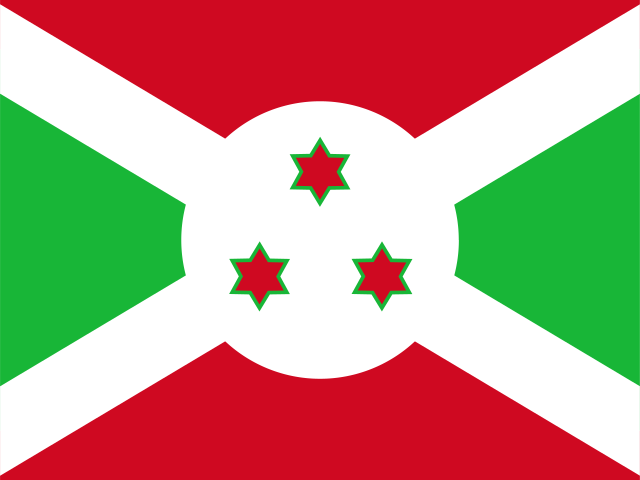
meaning: green stands for hope and optimism, white for purity and peace, and red for the blood shed in the struggle for independence; the three stars represent the major ethnic groups (Hutu, Twa, Tutsi), as well as unity, work, and progress
National symbol(s)
lion
National color(s)
red, white, green
National anthem(s)
lyrics/music: Jean-Baptiste NTAHOKAJA/Marc BARENGAYABO
history: adopted 1962
Economy31
Economic overview
highly agrarian, low-income Sub-Saharan economy; declining foreign assistance; increasing fiscal insolvencies; dense and still growing population; COVID-19 weakened economic recovery and flipped two years of deflation
Real GDP (purchasing power parity)
Real GDP (purchasing power parity) 2023: $11.343 billion (2023 est.)
Real GDP (purchasing power parity) 2022: $11.048 billion (2022 est.)
Real GDP growth rate
Real GDP growth rate 2023: 2.7% (2023 est.)
Real GDP growth rate 2022: 1.8% (2022 est.)
Real GDP per capita
Real GDP per capita 2023: $800 (2023 est.)
Real GDP per capita 2022: $800 (2022 est.)
GDP (official exchange rate)
Inflation rate (consumer prices)
Inflation rate (consumer prices) 2023: 26.9% (2023 est.)
Inflation rate (consumer prices) 2022: 18.8% (2022 est.)
GDP - composition, by sector of origin
industry: 9.6% (2023 est.)
services: 49% (2023 est.)
GDP - composition, by end use
household consumption
government consumption
investment in fixed capital
investment in inventories
exports of goods and services
imports of goods and services
Agricultural products
Industries
light consumer goods (sugar, shoes, soap, beer); cement, assembly of imported components; public works construction; food processing (fruits)
Industrial production growth rate
Labor force
Unemployment rate
Unemployment rate 2023: 1% (2023 est.)
Unemployment rate 2022: 1% (2022 est.)
Youth unemployment rate (ages 15-24)
male: 2.1% (2024 est.)
female: 1.2% (2024 est.)
Population below poverty line
Gini Index coefficient - distribution of family income
Household income or consumption by percentage share
highest 10%: 29.9% (2020 est.)
Remittances
Remittances 2022: 4.9% of GDP (2022 est.)
Remittances 2021: 6.1% of GDP (2021 est.)
Budget
expenditures: $737.898 million (2021 est.)
Public debt
Taxes and other revenues
Current account balance
Current account balance 2022: -$621.969 million (2022 est.)
Current account balance 2021: -$393.88 million (2021 est.)
Exports
Exports 2022: $333.637 million (2022 est.)
Exports 2021: $302.752 million (2021 est.)
Exports - partners
Exports - commodities
Imports
Imports 2022: $1.42 billion (2022 est.)
Imports 2021: $1.166 billion (2021 est.)
Imports - partners
Imports - commodities
Reserves of foreign exchange and gold
Reserves of foreign exchange and gold 2022: $158.53 million (2022 est.)
Reserves of foreign exchange and gold 2021: $266.164 million (2021 est.)
Debt - external
Exchange rates
Currency
Exchange rates 2023
Exchange rates 2022
Exchange rates 2021
Exchange rates 2020
Exchange rates 2019
Energy6
Electricity access
electrification - urban areas: 64%
electrification - rural areas: 1.7%
Electricity
consumption: 444.018 million kWh (2023 est.)
imports: 100 million kWh (2023 est.)
transmission/distribution losses: 39.994 million kWh (2023 est.)
Electricity generation sources
solar: 0.5% of total installed capacity (2023 est.)
hydroelectricity: 66.7% of total installed capacity (2023 est.)
biomass and waste: 1.6% of total installed capacity (2023 est.)
Coal
imports: 10,000 metric tons (2023 est.)
Petroleum
Energy consumption per capita
Communications6
Telephones - fixed lines
subscriptions per 100 inhabitants: (2023 est.) less than 1
Telephones - mobile cellular
subscriptions per 100 inhabitants: 63 (2023 est.)
Broadcast media
state-controlled Radio Television Nationale de Burundi (RTNB) operates a TV station and a national radio network; 3 private TV stations and about 10 privately owned radio stations; transmissions of several international broadcasters are available in Bujumbura (2019)
Internet country code
.bi
Internet users
Broadband - fixed subscriptions
subscriptions per 100 inhabitants: (2023 est.) less than 1
Transportation2
Civil aircraft registration country code prefix
9U
Airports
6 (2025)
Military & Security7
Military and security forces
Ministry of Interior, Community Development, and Public Security: Burundi National Police (Police Nationale du Burundi, PNB) (2024)
Military expenditures
Military Expenditures 2023: 3% of GDP (2023 est.)
Military Expenditures 2022: 2.6% of GDP (2022 est.)
Military Expenditures 2021: 2% of GDP (2021 est.)
Military Expenditures 2020: 2.1% of GDP (2020 est.)
Military and security service personnel strengths
limited available information; estimated 25-30,000 active-duty Defense Force troops (2025)
Military equipment inventories and acquisitions
the military has a mix of mostly older armaments typically of French, Russian, and Soviet origin, and a smaller selection of more modern equipment from such countries as China, Egypt, South Africa, and the US (2025)
Military service age and obligation
18 years of age for voluntary military service for men and women (2025)
Military deployments
770 Central African Republic (MINUSCA); up to 10,000 Democratic Republic of the Congo (2025)
Military - note
the Arusha Accords that ended the 1993-2005 civil war created a unified military by balancing the predominantly Tutsi ex-Burundi Armed Forces (ex-FAB) and the largely Hutu dominated armed movements and requiring the military to have a 50/50 ethnic mix of Tutsis and Hutus (2025)
Transnational Issues1
Refugees and internally displaced persons
IDPs: 92,174 (2024 est.)
stateless persons: 791 (2024 est.)