
Belarus
Republic of Belarus
Population
9.46M
Area
207,600 km²
GDP
$75.96B
GDP Per Capita
$29,000
Pop. Density
46/km²
Quick Facts
Currency
BrBelarusian ruble(BYN)
Calling Code
+375
Timezone
UTC+03:00
Languages
Belarusian, Russian+more
Driving Side
right
Demonym
Belarusian
Background
Historical Trends
GDP (USD)
↑105.5% since 2006Population
↓4.9% since 2006Life Expectancy at Birth
Latest: 74.2 yearsData source: World Bank Open Data
Geography19
Location
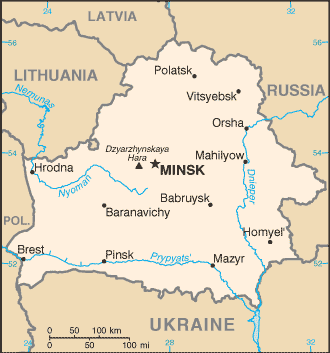
Eastern Europe, east of Poland
Geographic coordinates
53 00 N, 28 00 E
Map references
Europe
Area
land: 202,900 sq km
water: 4,700 sq km
Area - comparative
slightly less than twice the size of Kentucky; slightly smaller than Kansas
Land boundaries
border countries: Latvia 161 km; Lithuania 640 km; Poland 375 km; Russia 1,312 km; Ukraine 1,111 km
Coastline
0 km (landlocked)
Maritime claims
none (landlocked)
Climate
cold winters, cool and moist summers; transitional between continental and maritime
Terrain
generally flat with much marshland
Elevation
lowest point: Nyoman River 90 m
mean elevation: 160 m
Natural resources
timber, peat deposits, small quantities of oil and natural gas, granite, dolomitic limestone, marl, chalk, sand, gravel, clay
Land use
agricultural land
agricultural land: arable land
agricultural land: permanent crops
agricultural land: permanent pasture
forest
other
Irrigated land
260 sq km (2022)
Major rivers (by length in km)
note: [s] after country name indicates river source; [m] after country name indicates river mouth
Major watersheds (area sq km)
Population distribution
a fairly even distribution throughout most of the country, with urban areas attracting larger and denser populations
Natural hazards
large tracts of marshy land
Geography - note
landlocked; glacial scouring accounts for the flatness of Belarusian terrain and for its 11,000 lakes
People & Society35
Population
male: 4,414,771
female: 5,046,201
Nationality
adjective: Belarusian
Ethnic groups
Belarusian 83.7%, Russian 8.3%, Polish 3.1%, Ukrainian 1.7%, other 2.4%, unspecified 0.9% (2009 est.)
Languages
major-language sample(s):
Книга фактов о мире – незаменимый источник базовой информации. (Russian)
The World Factbook, the indispensable source for basic information.
Religions
Orthodox 48.3%, Catholic 7.1%, other 3.5%, non-believers 41.1% (2011 est.)
Age structure
15-64 years: 66.1% (male 3,073,507/female 3,204,088)
65 years and over: 17.8% (2024 est.) (male 572,483/female 1,122,231)
Dependency ratios
youth dependency ratio: 24.1 (2025 est.)
elderly dependency ratio: 27.9 (2025 est.)
potential support ratio: 3.6 (2025 est.)
Median age
male: 39.5 years
female: 45 years
Population growth rate
-0.44% (2025 est.)
Birth rate
8.16 births/1,000 population (2025 est.)
Death rate
13.21 deaths/1,000 population (2025 est.)
Net migration rate
0.67 migrant(s)/1,000 population (2025 est.)
Population distribution
a fairly even distribution throughout most of the country, with urban areas attracting larger and denser populations
Urbanization
rate of urbanization: 0.28% annual rate of change (2020-25 est.)
Major urban areas - population
2.057 million MINSK (capital) (2023)
Sex ratio
0-14 years: 1.06 male(s)/female
15-64 years: 0.96 male(s)/female
65 years and over: 0.51 male(s)/female
total population: 0.88 male(s)/female (2024 est.)
Mother's mean age at first birth
26.8 years (2019 est.)
Maternal mortality ratio
1 deaths/100,000 live births (2023 est.)
Infant mortality rate
male: 2.5 deaths/1,000 live births
female: 1.7 deaths/1,000 live births
Life expectancy at birth
male: 69.8 years
female: 80 years
Total fertility rate
1.45 children born/woman (2025 est.)
Gross reproduction rate
0.7 (2025 est.)
Drinking water source
improved: urban
improved: rural
improved: total
unimproved: urban
unimproved: rural
unimproved: total
Health expenditure
Health expenditure (as % of national budget): 12.3% of national budget (2022 est.)
Physician density
4.72 physicians/1,000 population (2023)
Hospital bed density
9.7 beds/1,000 population (2019 est.)
Sanitation facility access
improved: urban
improved: rural
improved: total
unimproved: urban
unimproved: rural
unimproved: total
Obesity - adult prevalence rate
24.5% (2016)
Alcohol consumption per capita
beer: 2.26 liters of pure alcohol (2019 est.)
wine: 0.98 liters of pure alcohol (2019 est.)
spirits: 4.67 liters of pure alcohol (2019 est.)
other alcohols: 2.66 liters of pure alcohol (2019 est.)
Tobacco use
male: 44.5% (2025 est.)
female: 11.6% (2025 est.)
Currently married women (ages 15-49)
62.4% (2019 est.)
Child marriage
women married by age 18: 4.7% (2019)
men married by age 18: 1.6% (2019)
Education expenditure
Education expenditure (% national budget): 13.2% national budget (2024 est.)
Literacy
male: 99.9% (2019 est.)
female: 99.9% (2019 est.)
School life expectancy (primary to tertiary education)
male: 14 years (2023 est.)
female: 15 years (2023 est.)
Government25
Country name
conventional long form
conventional short form
local long form
local short form
former
etymology
Government type
presidential republic in name, although in fact a dictatorship
Capital
geographic coordinates: 53 54 N, 27 34 E
time difference: UTC+3 (8 hours ahead of Washington, DC, during Standard Time)
etymology: the origin of the name is disputed; it may be derived from the Menka River
Administrative divisions
Legal system
Constitution
amendment process: proposed by the president of the republic through petition to the National Assembly or by petition of least 150,000 eligible voters; approval required by at least two-thirds majority vote in both chambers or by simple majority of votes cast in a referendum
International law organization participation
has not submitted an ICJ jurisdiction declaration; non-party state to the ICCt
Citizenship
citizenship by descent only: at least one parent must be a citizen of Belarus
dual citizenship recognized: no
residency requirement for naturalization: 7 years
Suffrage
18 years of age; universal
Executive branch
chief of state
head of government
cabinet
election/appointment process
most recent election date
election results
2025: Alyaksandr LUKASHENKA reelected president; percent of vote - Alyaksandr LUKASHENKA (independent) 86.8%, Sergey Syrankov (Communist Party) 3.2%, 3.6% voting against all
2020: Alyaksandr LUKASHENKA reelected president; percent of vote - Alyaksandr LUKASHENKA (independent) 80.1%, Svyatlana TSIKHANOWSKAYA (independent) 10.1%, other 9.8%; note - widespread street protests erupted following announcement of the election results amid allegations of voter fraud
2015: Alyaksandr LUKASHENKA elected president; percent of vote - Alyaksandr LUKASHENKA (independent) 84.1%, Tatsyana KARATKEVIC (BSDPH) 4.4%, Sergey GAYDUKEVICH (LDP) 3.3%, other 8.2%.
expected date of next election
Legislative branch
legislative structure: bicameral
Legislative branch - lower chamber
chamber name
number of seats
electoral system
scope of elections
term in office
most recent election date
parties elected and seats per party
percentage of women in chamber
expected date of next election
Legislative branch - upper chamber
chamber name
number of seats
scope of elections
term in office
most recent election date
percentage of women in chamber
expected date of next election
Judicial branch
judge selection and term of office: Supreme Court judges appointed by the president with the consent of the Council of the Republic; judges initially appointed for 5 years and evaluated for life appointment; Constitutional Court judges - 6 appointed by the president and 6 elected by the Council of the Republic; the presiding judge directly elected by the president and approved by the Council of the Republic; judges can serve for 11 years with an age limit of 70
subordinate courts: oblast courts; Minsk City Court; town courts; Minsk city and oblast economic courts
Political parties
Republican Party of Labour and Justice or RPTS
Communist Party of Belarus or CBP
Liberal Democratic Party of Belarus or LDPB
Diplomatic representation in the US
chancery: 1619 New Hampshire Avenue NW, Washington, DC 20009
telephone: [1] (202) 986-1606
FAX: [1] (202) 986-1805
email address and website:
[email protected]
Embassy of the Republic of Belarus in the United States of America (mfa.gov.by)
Diplomatic representation from the US
chief of mission
embassy
mailing address
telephone
FAX
email address and website
International organization participation
BSEC (observer), CBSS (observer), CEI, CIS, CSTO, EAEC, EAEU, EAPC, EBRD, FAO, GCTU, IAEA, IBRD, ICAO, ICC (NGOs), ICRM, IDA, IFC, IFRCS, ILO, IMF, IMSO, Interpol, IOC, IOM, IPU, ISO, ITU, ITUC (NGOs), MIGA, NAM, NSG, OPCW, OSCE, PCA, PFP, SCO (dialogue member), UN, UNCTAD, UNESCO, UNIDO, UNIFIL, UNOOSA, UNWTO, UPU, WCO, WFTU (NGOs), WHO, WIPO, WMO, WTO (observer), ZC
Independence
25 August 1991 (from the Soviet Union)
National holiday
Flag
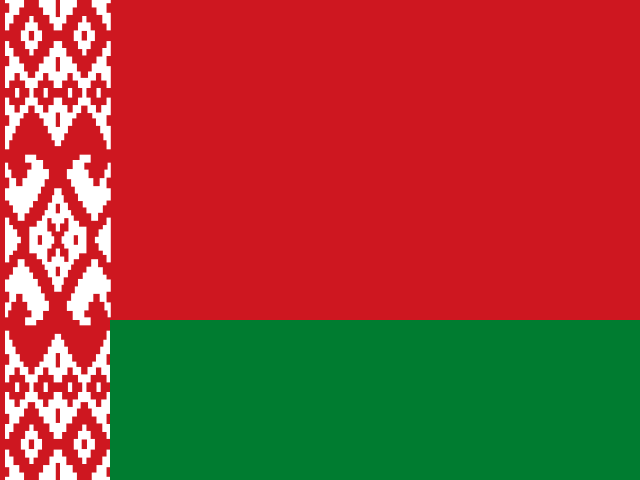
meaning: the red stands for past struggles to escape oppression, and the green for hope and the country's forests
National symbol(s)
no official symbol; the mounted knight known as Pahonia (the Chaser) is the traditional symbol
National color(s)
green, red, white
National anthem(s)
lyrics/music: Mikhas KLIMKOVICH and Uladzimir KARYZNA/Nester SAKALOUSKI
history: music adopted 1955, lyrics adopted 2002; after the fall of the Soviet Union, Belarus kept the music of its Soviet-era anthem but adopted new lyrics; also known as "Dziarzauny himn Respubliki Bielarus" (State Anthem of the Republic of Belarus)
National heritage
selected World Heritage Site locales: Białowieża Forest (n); Mir Castle Complex (c); Architectural, Residential, and Cultural Complex of the Radziwill Family at Nesvizh (c)
Economy32
Economic overview
declining Russian energy subsidies will end in 2024; growing public debt; strong currency pressures have led to higher inflation; recent price controls on basic food and drugs; public sector wage increases and fragile private sector threaten household income gains and economic growth
Real GDP (purchasing power parity)
Real GDP (purchasing power parity) 2023: $254.995 billion (2023 est.)
Real GDP (purchasing power parity) 2022: $244.89 billion (2022 est.)
Real GDP growth rate
Real GDP growth rate 2023: 4.1% (2023 est.)
Real GDP growth rate 2022: -4.7% (2022 est.)
Real GDP per capita
Real GDP per capita 2023: $27,800 (2023 est.)
Real GDP per capita 2022: $26,500 (2022 est.)
GDP (official exchange rate)
Inflation rate (consumer prices)
Inflation rate (consumer prices) 2023: 5% (2023 est.)
Inflation rate (consumer prices) 2022: 15.2% (2022 est.)
GDP - composition, by sector of origin
industry: 30.7% (2024 est.)
services: 49.7% (2024 est.)
GDP - composition, by end use
household consumption
government consumption
investment in fixed capital
investment in inventories
exports of goods and services
imports of goods and services
Agricultural products
Industries
metal-cutting machine tools, tractors, trucks, earthmovers, motorcycles, synthetic fibers, fertilizer, textiles, refrigerators, washing machines and other household appliances
Industrial production growth rate
Labor force
Unemployment rate
Unemployment rate 2023: 3.5% (2023 est.)
Unemployment rate 2022: 3.6% (2022 est.)
Youth unemployment rate (ages 15-24)
male: 11.7% (2024 est.)
female: 8.4% (2024 est.)
Population below poverty line
Gini Index coefficient - distribution of family income
Average household expenditures
on alcohol and tobacco: 7.6% of household expenditures (2023 est.)
Household income or consumption by percentage share
highest 10%: 20.7% (2020 est.)
Remittances
Remittances 2023: 1.7% of GDP (2023 est.)
Remittances 2022: 2% of GDP (2022 est.)
Budget
expenditures: $21.912 billion (2023 est.)
Public debt
Taxes and other revenues
Current account balance
Current account balance 2023: -$1.104 billion (2023 est.)
Current account balance 2022: $2.628 billion (2022 est.)
Exports
Exports 2023: $47.714 billion (2023 est.)
Exports 2022: $47.124 billion (2022 est.)
Exports - partners
Exports - commodities
Imports
Imports 2023: $47.459 billion (2023 est.)
Imports 2022: $42.438 billion (2022 est.)
Imports - partners
Imports - commodities
Reserves of foreign exchange and gold
Reserves of foreign exchange and gold 2023: $8.118 billion (2023 est.)
Reserves of foreign exchange and gold 2022: $7.923 billion (2022 est.)
Debt - external
Exchange rates
Currency
Exchange rates 2024
Exchange rates 2023
Exchange rates 2022
Exchange rates 2021
Exchange rates 2020
Energy8
Electricity access
Electricity
consumption: 39.883 billion kWh (2023 est.)
exports: 4.553 billion kWh (2023 est.)
imports: 4 billion kWh (2023 est.)
transmission/distribution losses: 3.149 billion kWh (2023 est.)
Electricity generation sources
fossil fuels
nuclear
solar
wind
hydroelectricity
biomass and waste
Nuclear energy
Net capacity of operational nuclear reactors: 2.22GW (2025 est.)
Percent of total electricity production: 28.6% (2023 est.)
Coal
exports: 966,000 metric tons (2023 est.)
imports: 1.635 million metric tons (2023 est.)
Petroleum
refined petroleum consumption: 125,000 bbl/day (2023 est.)
crude oil estimated reserves: 198 million barrels (2021 est.)
Natural gas
consumption: 15.094 billion cubic meters (2023 est.)
imports: 15.433 billion cubic meters (2023 est.)
proven reserves: 2.832 billion cubic meters (2021 est.)
Energy consumption per capita
Communications6
Telephones - fixed lines
subscriptions per 100 inhabitants: 46 (2024 est.)
Telephones - mobile cellular
subscriptions per 100 inhabitants: 131 (2024 est.)
Broadcast media
7 state-controlled national TV channels; Polish and Russian TV broadcasts are available in some areas; state-run Belarusian Radio operates 5 national networks and an external service; Russian and Polish radio broadcasts are available (2019)
Internet country code
.by
Internet users
Broadband - fixed subscriptions
subscriptions per 100 inhabitants: 35 (2023 est.)
Transportation5
Civil aircraft registration country code prefix
EW
Airports
46 (2025)
Heliports
4 (2025)
Railways
standard gauge: 25 km (2014) 1.435-m gauge
broad gauge: 5,503 km (2014) 1.520-m gauge (874 km electrified)
Merchant marine
by type: other 4
Military & Security6
Military and security forces
Ministry of Interior: State Border Troops, Militia, Internal Troops (2025)
Military expenditures
Military Expenditures 2023: 1.8% of GDP (2023 est.)
Military Expenditures 2022: 1.7% of GDP (2022 est.)
Military Expenditures 2021: 1.4% of GDP (2021 est.)
Military Expenditures 2020: 1.5% of GDP (2020 est.)
Military and security service personnel strengths
approximately 50-60,000 active-duty military personnel (2025)
Military equipment inventories and acquisitions
the military's inventory is comprised mostly of Russian and Soviet-origin equipment; Belarus's defense industry manufactures some equipment (mostly modernized Soviet designs), including vehicles, guided weapons, and electronic warfare systems (2025)
Military service age and obligation
Military - note
Belarus has been a member of the Collective Security Treaty Organization (CSTO) since 1994 and has committed an airborne brigade to CSTO's rapid reaction force; the military trains regularly with other CSTO members (2025)
Transnational Issues2
Refugees and internally displaced persons
stateless persons: 5,620 (2024 est.)